
When is a wisdom tooth taken out, and when is it watched?
Wisdom teeth are the molars at the very back of the mouth. Sometimes they come through fully; sometimes they stay partly or completely buried in the gum or the bone. A wisdom tooth that causes no problems is usually left in place and watched at check-ups1. Removal is discussed when there is disease, such as decay that cannot be repaired, infection, a cyst or repeated gum inflammation.
Removing an impacted tooth is a minor surgical procedure, usually done under local anaesthetic. The main risks are dry socket, infection and, less often, numbness of the lower lip or chin. The decision is made with your dentist after an examination and X-rays.
This page is written for readers in the UK. The removal would be carried out at our clinic in Antalya, Turkey, by the clinic's dentists; on this page "we" means that clinic. Your written plan gives the clinic's legal name, as the party you contract with, and names the dentist who treats you. The figures on this page come from published studies and guidance, not from our own records.
If a wisdom tooth needs to come out and nothing else is planned, consider having it done by a dentist near home, NHS or private. Pain, swelling and the signs of dry socket show in the first days, and they are easier to deal with close to home. Having a wisdom tooth out in Antalya makes more sense as part of a larger plan you have already chosen to have there. The section "Should you travel to have a wisdom tooth out?" covers this, the flight home and care back in the UK.
- A wisdom tooth that is not painful and shows no disease is usually not removed; it is watched at regular check-ups.
- A first episode of gum inflammation that is not very severe is not in itself a reason for removal. If it comes back, removal is discussed.
- Removing wisdom teeth has not been shown to prevent crowding of the front teeth.
- Do not rinse your mouth on the day of the extraction; protecting the blood clot in the socket is the basis of healing.
- If a wisdom tooth needs to come out and nothing else is planned, consider a dentist near home. If you have it out in Antalya, stay nearby for the first days and ask when you can fly. Agree who in the UK will see you if a problem starts.
What problems can a wisdom tooth cause?
A wisdom tooth can have problems without causing any symptoms, which is why it is checked at check-ups. When it does cause symptoms, a common reason is inflammation of the gum around it.
Pericoronitis is inflammation of the gum2 that covers a partly erupted tooth. It is most common around wisdom teeth. The signs are:
- pain at the back of the mouth and swelling of the gum
- a bad taste or smell in the mouth
- difficulty opening the mouth, discomfort when swallowing
- sometimes a fever, feeling unwell and swelling that spreads to the face
An inflamed tooth can cause pain to spread3 to the face or head. However, a large population study found no link4 between wisdom teeth and migraine or other headaches. Problems with the jaw joint can also cause signs similar2 to pericoronitis; this is one reason an examination is needed.
When is removal discussed, and when is watching the tooth reasonable?
When removal is usually discussed
- There is disease in or around the tooth. Guidance from NICE (the National Institute for Health and Care Excellence) recommends limiting surgical removal to patients with evidence of disease5. Examples are decay that cannot be repaired and disease of the nerve or around the root tip that cannot be treated. Other examples are an abscess, a cyst and resorption, in which the hard tissue of a tooth is broken down. This guidance was published in 2000 and is now being updated.
- Gum inflammation keeps coming back. According to NICE, a first episode of pericoronitis is not in itself a reason for removal unless it is very severe. Second and later episodes should be considered a reason for removal5. The Scottish dental guidance (SDCEP) also recommends removal in severe cases or with repeated episodes in the same tooth2.
When watching the tooth is usually reasonable
- An impacted tooth that is not painful and shows no disease. NICE recommends that routine preventive removal should be discontinued5. These teeth are watched at regular check-ups. The evidence on this is not certain (see “What happens to a tooth left in place?” below).
- Only to prevent crowding. In the only randomised trial on this question, removal had no clinically meaningful effect6 on the alignment of the teeth. The trial is small and at high risk of bias.
- Headache alone. If there is no problem with the tooth, a headache is not in itself a reason for removal.
Tell your dentist before an extraction if
- You take a blood thinner. Do not stop or change these medicines7 for dental treatment unless your doctor, specialist or dentist tells you to.
- You take, or have taken, a medicine for osteoporosis or for cancer.
- You have had radiotherapy to the head or neck.
- You are pregnant. According to UK guidance, dental X-rays, including panoramic and three-dimensional X-rays, do not need to wait until after the birth8. You may also choose to postpone an X-ray that is not urgent.
- You take other medicines regularly, or have a condition that weakens your immune system.
Our page on tooth extraction explains what blood thinners and these bone medicines change for an extraction.
Not everyone has four wisdom teeth. According to an analysis that combined 92 studies, at least one wisdom tooth is missing from birth in about 23 in every 100 people9. That is more than one in five. The rate varies widely from study to study.
Options: watching, treating the inflammation, removal
- Watching without removal: no treatment, regular check-ups. This is the usual course for a tooth that causes no problems. At the check-up, the area around the tooth and the neighbouring tooth is examined for decay and gum problems. If there is no sign of disease, waiting is a choice, not a failure to act.
- Treating the gum inflammation without removal. For adults with pericoronitis, the Scottish guidance recommends pain relief and rinsing with salt water or a chlorhexidine mouthwash2. Antibiotics are not recommended; they are considered only if the infection is spreading, affects the whole body, or the immune system is weak.
- Removal. A fully erupted wisdom tooth is often taken out like other teeth. An impacted or partly impacted tooth needs more. The gum is opened, sometimes some of the bone is removed, and the tooth is cut into pieces.
For impacted teeth without disease, it is not certain which course is better. A Cochrane review found insufficient evidence6 to decide whether these teeth should be removed or kept. The review recommends that the patient and the dentist decide together and that teeth left in place are checked regularly. So neither “every wisdom tooth should come out” nor “none should” is correct.
| Watching | Treating pericoronitis | Removal | |
|---|---|---|---|
| Surgery | No | No | Yes; for an impacted tooth the gum is opened |
| When is it discussed? | The tooth causes no problems | The gum around the tooth is inflamed | There is disease or repeated inflammation |
| Afterwards | Regular check-ups | Check-up; if it comes back, removal is discussed | Healing of the socket |
| Possible problems | Decay, gum problems, inflammation | The inflammation coming back | Pain, swelling, dry socket, infection, numbness |
How assessment, imaging and removal are done
The steps below are for removing an impacted or partly impacted wisdom tooth; for a fully erupted tooth the procedure is simpler. Your dentist will tell you after the examination how many appointments are needed and how long the procedure will take.
Imaging and anaesthesia
According to UK guidance, X-rays are chosen for you after your history has been taken and you have been examined8. Most removals are done under local anaesthetic. Sedation may be discussed if you feel anxious, or if more than one impacted tooth is to be removed. See our page on sedation. If you would want a general anaesthetic, ask us before you book whether one can be offered. Ask too where it would be given, and by whom.
Consent and your written plan
Before the tooth comes out, your dentist explains why removal is recommended, the options and the risks for you. The removal goes ahead only once you have agreed to it. You can say no, or ask to stop, at any stage. In Turkish dental facilities, a consent form is required for every intervention10. The UK General Dental Council's standards ask UK dentists to give patients a written treatment plan before treatment starts11. If the plan changes, patients should get an updated one in writing. Those standards bind dentists on the UK register, not a clinic in Turkey. We give you your plan, and any change to it, in writing.
Procedure outline
The usual steps are:
Examination and imaging
Tell your dentist about any medical conditions, the medicines you take, any allergies, whether you smoke and whether you are pregnant. The position of the tooth, its roots and how close it lies to the nerve canal in the lower jaw are assessed with X-rays. A three-dimensional X-ray scan (cone-beam CT) may be requested if needed.
Decision
Your dentist explains why removal is being recommended, the options and the risks for you. Ask your questions at this stage. The removal goes ahead only once you have agreed to it.
Anaesthesia
The area is numbed with a local anaesthetic. You may feel pressure during the procedure; tell your dentist if you feel pain.
Removing the tooth
For an impacted tooth the gum is opened. If needed, some of the bone around the tooth is removed and the tooth is cut into pieces to take it out.
Stitches and gauze
The gum is closed with stitches if needed. You are asked to bite on a gauze pad placed over the socket for a while so that the bleeding stops.
Check-up
Your dentist may give you a follow-up appointment to check healing or to remove stitches.
Risks and benefits
Risks
The figures below come from published studies, not from our own records.
- Removal cannot be undone. No new tooth grows in place of the one removed. Removing a tooth without disease means choosing the risks of removal instead of the risks of keeping it.
- Pain and swelling. According to the NHS, there may be some pain and swelling for up to 2 weeks1 after the removal. These are expected to start improving after 1 or 2 days.
- Dry socket. A painful condition that develops when the protective blood clot in the socket is lost. According to a Cochrane review, it occurs after 1 to 5 in every 100 routine extractions, and after 30 or more in every 100 surgically removed wisdom teeth12. This is a general range given by the review, not a pooled estimate. In a review that pooled observational studies, dry socket occurred in about 13 in every 100 smokers and about 4 in every 100 non-smokers13. Those studies included both simple and surgical extractions.
- Infection. Whether preventive antibiotics are given with the removal is decided patient by patient. Most of the trials were done in healthy people having wisdom teeth removed. In this group, antibiotics may slightly reduce infection: on average, 19 people need to be treated to prevent one infection14. The certainty of the evidence is low. Because of side effects and antibiotic resistance, the review asks for each patient to be assessed individually.
- Numbness of the lower lip and chin. The roots of a lower wisdom tooth can lie close to the nerve that supplies feeling to the lip and chin. In a review of 23 studies of the removal of impacted lower wisdom teeth, numbness occurred temporarily after about 12 in every 1,000 removals and permanently after fewer than 3 in every 1,00015. These rates do not apply to upper wisdom teeth or to simple extractions. Your own risk depends on how close the tooth is to the nerve and how difficult the procedure is. According to the NHS, nerve damage usually gets better but can take a few weeks or months1.
- Bleeding. Some oozing for a while after the removal is normal. What to do if the bleeding does not stop is explained below.
Benefits
- Removing a diseased tooth removes the cause of the pain, inflammation or abscess coming from that tooth.
- Episodes of pericoronitis around that tooth come to an end.
What happens to a tooth left in place?
Two reviews look at different questions and put the emphasis in different places.
- A review of 37 studies reported that wisdom teeth without symptoms that are left in the mouth rarely remain free of disease over time16. The most common problems are decay and gum problems, especially in partly erupted lower teeth that tilt forward. The studies differ in design, and the authors describe the evidence as of medium to fair quality.
- This finding does not on its own show that removing a tooth without disease at the outset is better than watching it. The Cochrane review found insufficient evidence6 to decide whether removal or keeping the tooth is better. Evidence that a retained tooth may be linked to gum disease at the neighbouring molar rests on a single study. Its certainty is very low.
Taken together, the two findings say this: a wisdom tooth left in place should not be forgotten. It should be watched at regular check-ups. If disease is found at a check-up, removal is discussed again.
After the removal: the first days and aftercare
What helps in the first days:
- Bleeding. If the socket keeps bleeding, the Scottish guidance recommends biting firmly on a damp gauze pad for 20 minutes17. If you do not take a blood thinner and the bleeding has not stopped, repeat the pressure once more. If it still does not stop, get urgent care.
- If you take a blood thinner. The Scottish leaflet for people taking these medicines recommends pressing on the bleeding area for 30 minutes18. If the bleeding does not stop, or starts again later, contact your dentist straight away or get urgent care17.
- Do not rinse your mouth on the first day. Guidance advises not rinsing on the day of the extraction19, and on the following days rinsing gently1 with warm salt water or mouthwash.
- The first 24 hours. Once the bleeding has stopped, avoid alcohol, smoking and exercise for 24 hours17. If you can, keep your head raised and do not disturb the clot.
- Smoking. The studies in a review of smoking and dry socket did not test13 when it is safe to start smoking again. This may be a good time to stop.
- Pain relief. The usual over-the-counter options are paracetamol or ibuprofen. A Cochrane overview, based mostly on trials after wisdom tooth removal, found taking the two together20 among the options that worked well. Follow the instructions on the pack. For people taking blood thinners, the Scottish leaflet recommends avoiding medicines such as ibuprofen and using paracetamol18. If you are pregnant, the NHS says to avoid ibuprofen21 unless a doctor or pharmacist recommends it. It adds that paracetamol is usually the best painkiller to take in pregnancy. If you have a long-term condition such as asthma or a stomach problem, or take other medicines, ask your pharmacist which painkiller is suitable.
- Cold packs. Applying cold to the cheek may slightly reduce pain on day 322. No effect on swelling has been shown, and the certainty of the evidence is low. Wrap the cold pack in a cloth.
- Food. Do not eat until the numbness has worn off. The NHS recommends soft or liquid food1; avoid hard and crunchy food, nuts and seeds, and very hot drinks.
- Dairy. Two randomised trials in Germany did not find that dairy products harmed healing. One was done in healthy young people having wisdom teeth removed23, the other in a broader group having oral surgery24. This does not prove that dairy is harmless for everyone.
- Driving and work. The NHS advises not driving for 24 hours after a sedative injection and 48 hours after a general anaesthetic1. After a difficult removal you may need 1 to 3 days off work1. If sedation is planned, see our page on sedation for the rules on an escort and preparation.
Daily care
Keep brushing your other teeth twice a day with fluoride toothpaste. For the first few days, keep the toothbrush away from the socket.
When should you see a dentist?
See your dentist if you have any of the following:
- Pain at the back of the mouth, or swollen or tender gum around a wisdom tooth
- A bad taste or smell in the mouth
Get seen the same day if you have swelling in your face or jaw, or a fever. The same applies if opening your mouth is becoming more and more difficult. The Scottish guidance counts facial swelling and limited mouth opening as signs of a spreading infection2. If it is already hard to open your mouth, or to breathe, speak or swallow, it is an emergency: see "Emergencies" below. If you are in the UK and cannot reach a dentist, see "Once you are back in the UK" below.
After the removal, call your dentist without delay if you have:
- Bleeding that does not stop despite pressure
- Severe or increasing pain that painkillers do not relieve
- A bad taste, a high temperature or feeling unwell together with pain; the NHS lists these among the signs that need urgent help1
- Pain that starts 24 to 48 hours after the removal, a socket that looks empty, and a bad taste or smell. These can be signs of dry socket; the Scottish guidance recommends getting urgent dental care19
- Numbness or tingling in the lower lip or chin that continues after the anaesthetic has worn off
Emergencies. In the UK, call 999 or go to A&E25 if you have any of the signs below. In Turkey, call 112. Do not wait for a dental appointment or for our reply.
- It is hard to breathe, speak or swallow
- Your breathing is noisy, or your voice is hoarse or muffled; the Scottish guidance lists these airway signs as needing emergency medical help2
- There is a lot of swelling in your mouth, or it is hard to open your mouth
- Your eye is swollen or painful, or your eyesight changes suddenly
- Your neck is swollen26
Before you fly home
Make sure the bleeding has stopped and the dentist has checked the socket. If there is pain, swelling or bleeding where the tooth was removed, ask your dentist before you fly. Know whether your stitches dissolve on their own or need to be removed, and who will remove them. Have written aftercare instructions, a record of the treatment and of any medicines you were given, and a way to reach us. If any of the signs above starts while you are still in Turkey, tell us before you travel.
Once you are back in the UK
If the signs of dry socket or infection start after you are home, see a dentist near you. Do not wait for a trip back. Do the same if numbness of the lip or chin has not worn off. For urgent dental care, the NHS website for England says: call your dentist; if they are closed, their answerphone may tell you what to do25. In England, if you have no dentist or cannot get an emergency appointment, it says to call 111 or get help from 111 online25. They can tell you where to get help, and you may have to pay for the appointment. Elsewhere in the UK, check the local arrangements. For a problem that is not urgent, you can also write to us and send photographs. In the emergencies above, do not wait for our reply.
Should you travel to have a wisdom tooth out?
Whether a wisdom tooth should come out depends on the tooth, not on the trip. A wisdom tooth that causes no problems is usually watched rather than removed, and a trip does not change that. If you have pain, swelling or signs of infection now, get care in the UK; do not save it for a trip.
Is it worth the trip?
If a wisdom tooth needs to come out and nothing else is planned, consider having it done by a dentist near home, NHS or private. Pain, swelling and the signs of dry socket tend to appear in the first days of healing. Any problem is easier to deal with close to home. You would also not need to time a flight around a healing socket. If your lip or chin stays numb, a dentist near you would follow it in any case. Having a wisdom tooth out in Antalya makes more sense as part of a larger plan you have already chosen to have there. Either way, ask why the tooth needs to come out before you book.
Your appointments in Antalya
The number of appointments, and of days in Antalya, depends on how many teeth are removed. It also depends on whether they are impacted and whether sedation is used. The examination and X-rays come first, and whether a tooth should come out at all is decided only after them. Plan the trip so that you are still near the clinic for the first days after the removal. The signs of dry socket usually start 24 to 48 hours after the removal19. If stitches are placed, ask whether they dissolve or will be removed before you fly home. If sedation is planned, our page on sedation explains the escort rules and how sedation affects when you can fly.
Before you book, you receive a written preliminary plan with the appointments and how many days they need. It is based on your description, photographs and any X-rays you send. The examination confirms or changes it, and with it the days and the cost. If it changes, you receive the revised plan in writing before treatment starts. How close a lower tooth lies to the nerve is sometimes clear only after the examination and X-rays. Ask for the plan to say what would change for your trip if a scan is needed or the tooth is to be watched.
Flying home
A 2023 review of flying after dental treatment suggests waiting 24 to 48 hours after a simple extraction and 72 hours after a surgical extraction27. These times apply only when there is no pain, swelling or bleeding where the tooth was removed. Removing an impacted wisdom tooth, where the gum is opened, is a surgical extraction. The authors note that the research is limited and comes mainly from military aviation. Treat it as a starting point for your dentist's advice, not as a rule. Ask the dentist who treated you before you book your flight home.
Your dentist in the UK
Tell your own dentist about the plan before you go; they need to know it in case problems come up later. The NHS website for England advises you to discuss your plans with a GP28 before making any final decisions about travel or medical arrangements. If you do not have a regular dentist, find one, NHS or private, before you travel. Bring back the written record of the treatment and copies of your X-rays and any scan (see "What records will I take home?" below). If numbness of the lip or chin continues, your dentist in the UK needs to follow it. According to the NHS, nerve damage usually gets better but can take a few weeks or months1. A wisdom tooth left in place needs check-ups too. National guidance in England (NICE) says the interval between check-ups should be set for each person according to their risk29 and discussed with them.
If problems start after you are back in the UK
Once you are back in the UK, the first person to see a problem may be a dentist near you rather than us. Plan for that before you travel. The British Dental Association advises patients to get advice on what to do if problems occur after they return30.
- Dry socket or infection. These can start after you are home. The signs, and who to call, are under "When should you see a dentist?" above. See a dentist near you first, then tell us.
- Stitches. If stitches need removing after you are home, agree before you travel who will take them out, and when.
- Numbness. If numbness of the lip or chin has not worn off, see a dentist near you and tell us.
- Who pays. Ask before you commit who pays if a complication needs further treatment or another trip (see "If there are complications, who pays?" below).
What the NHS does and does not do
The NHS Business Services Authority publishes guidance for dentists in England and Wales. It says a patient treated abroad is dealt with like any patient previously treated by another provider. If an NHS practice accepts you, it provides the clinically necessary treatment its NHS contract covers, with your consent. But some entitlements do not apply where another provider did the original work. These are further treatment within two months, and free repair or replacement31. The guidance covers England and Wales. Scotland and Northern Ireland have their own NHS rules, which this page does not cover; ask the practice you plan to use. The NHS website for England also states that the NHS is not liable for negligence or failure of treatment28 you receive abroad.
Travel insurance
The NHS website for England warns that most travel insurance policies will not cover you for planned treatment abroad28, so you may need specialist cover. Ask your insurer, in writing, before you book.
What the GDC and the NHS suggest you ask
The UK General Dental Council lists thirteen questions32 to ask before dental treatment abroad, and the NHS website for England has its own checklist. Below are the ones that matter most for wisdom tooth removal, each with our answer. Where our answer is a commitment rather than something you can check today, it says so. Ask us the full list, and ask for the answers in writing.
Who will treat me, and how can I check their registration?
We name the dentist who will remove the tooth, in writing, before you commit. In Turkey a dentist in private practice must register with the provincial or regional dental chamber33 within a month of starting. Without it, they cannot practise privately. The Turkish Dental Association's website offers a search of registered dentists by name and province34. Ask us for the treating dentist's registration details. Registration in Turkey is separate from the UK register: the GDC states that only people registered with it can legally practise dentistry in the UK35.
How often do you do this, and what are your complication rates?
The GDC suggests asking how many times the procedure has been carried out, and the success, complication and infection rates32. The figures on this page come from published studies and guidance, not from our own patient records. We do not publish our own figures yet. Ask us for our figures for wisdom tooth removal, such as how often dry socket, infection or lasting numbness occurred. Ask how complications were defined and over what period.
Is the clinic licensed and regulated?
In Turkey a dental clinic cannot open without a licence or treat patients without an operating permit. It is inspected at least once a year10. To treat international patients, a facility also needs an authorisation certificate from the Ministry of Health36. The Ministry publishes a register of authorised facilities37 that you can check yourself. We give you our authorisation details before you commit. A licence or authorisation is a legal minimum, not a statement about the result of your treatment. The GDC itself cannot guarantee that a regulator like it exists in another country32.
Will I get the plan in writing?
Yes. The GDC says you should be assessed by a qualified dentist before being given a treatment plan and cost estimate32. Your written plan states which teeth are to come out and why. It says whether a surgical removal or a scan may be needed, and whether sedation is planned. It also states how many days in Antalya the appointments need, and what the plan covers and does not cover. A plan made from photographs or X-rays you send is preliminary. It is confirmed after the examination and X-rays, and we tell you before anything in it changes.
What if the examination shows the tooth should be watched?
The examination in Antalya may show that the tooth can be left in place and watched. It may also show that the plan made from your X-rays does not suit you. You can say no, or ask to stop, at any stage. Once a tooth has been taken out, that step cannot be undone. Ask before you travel what you would pay in that case.
What if the patient is under 18?
This page is written for adults. If the patient is under 18, ask us before you book whether we would treat them. Ask too what consent we would need.
If there are complications, who pays?
The GDC suggests asking whether further treatment is included if there are complications, and who pays for extra flights, hotel and remedial work32. Before you commit, we give you our terms for complications in writing. They state what is covered, what is excluded, and who pays for further treatment and travel. For wisdom tooth removal, ask in particular what happens if dry socket or an infection starts after you are home, or if numbness lasts. Read them before you decide.
Is there insurance if something goes wrong?
The GDC list also asks about insurance32. In Turkey a facility treating international patients must take out complication insurance for surgical and interventional procedures carried out in an operating theatre36. That does not by itself tell you whether your removal is covered, so ask which procedures in your plan, if any, fall under it. Ask us too, in writing, whether the clinic or the treating dentist holds insurance for complications or errors, and what it covers. Travel insurance is covered under "If problems start after you are back in the UK" above.
Who do I contact after treatment?
Your written plan names the contact route for questions and problems once you are home. For urgent symptoms, get care in the UK first (see "When should you see a dentist?" above).
What records will I take home?
The NHS website for England lists exchanging medical records and arranging aftercare back home28 among the things to consider. In Turkey you are entitled to an itemised bill, and on request to free copies of the records of materials, tests and imaging36. You may also examine your file and take a copy38. Before you fly home, ask for a written record of the treatment for your dentist in the UK. It should show which teeth were removed, whether the removal was surgical, and any stitches. It should also list any medicines you were given. Take copies of your X-rays and any scan too.
What if I am unhappy, and where can I complain?
We give you our written complaints procedure before treatment. A complaint goes to the clinic first; private dental polyclinics, centres and hospitals in Turkey must have a patient rights unit10. If the clinic does not resolve it, you can apply in writing to the provincial health directorate's Patient Rights Board38. The Board decides within thirty days, but it does not assess allegations of medical error. The dental chamber can also open disciplinary proceedings33 against a dentist. Do not expect the UK regulator to settle it. The GDC states that it cannot resolve complaints or help with refunds35; its investigations are about whether dental professionals are fit to practise.
Will the team speak English?
The GDC suggests asking whether the team speaks your language and, if not, whether a translator is provided32. We confirm in writing, before you commit, who will explain the plan, the consent form and the aftercare instructions to you in English.
Warning signs, including for us
The NHS checklist names five signs to think twice about before booking. They are a hard sell, a lack of information, pressure to make a quick decision, no discussion of possible complications, and no mention of aftercare39. Apply them to us too. If you feel pushed to decide quickly, wait.
What determines the cost?
This page carries no prices. A plan is prepared for you after an examination and X-rays. The main factors that shape it are:
- Whether the tooth is fully erupted, partly impacted or fully impacted
- How many teeth are taken out, and whether at the same visit
- The imaging needed (X-rays, and a cone-beam CT scan if needed)
- Local anaesthetic or sedation, or a general anaesthetic if one can be offered
- Check-up and stitch-removal appointments
- The number of trips the appointments need
Ask for your plan in writing, including what it covers. Also ask who pays for further treatment and extra travel if there is a complication. Add your own travel, and any care you may need from a dentist in the UK afterwards, to see the whole cost.
Do you need to decide about a wisdom tooth?
Send us a description of the problem and an X-ray if you have one. A dentist will reply in writing with a preliminary view: whether removal or watching seems likely, whether removal is worth a trip on its own, and how the appointments might fit one. This is not a treatment plan: the decision is made at an examination with X-rays.
Frequently Asked Questions
My wisdom tooth does not hurt. Should I still have it taken out?
A tooth that does not hurt is not always healthy, which is why an examination and check-ups matter. If no disease is found, NICE guidance does not recommend routine removal of impacted wisdom teeth. The evidence on this is not certain; the decision is made with your dentist.
How long does it take to recover after wisdom tooth removal?
Pain and swelling usually start to ease early on, but they can last for a while. The NHS timings are given under “Risks and benefits” above. The time depends on how deeply the tooth was buried and how difficult the procedure was. If the pain is getting worse rather than better, or you have a bad taste and a fever, see your dentist.
Will I be put to sleep for wisdom tooth removal?
Most wisdom tooth removals are done under local anaesthetic; you may feel pressure during the procedure. If you feel anxious or the procedure will be long, sedation may be discussed. Conscious sedation is not being put to sleep: you stay able to respond. A general anaesthetic makes you unconscious. If you would want one, ask us before you book whether it can be offered for your removal, and where. Your dentist will explain which is suitable for you after the examination.
Do wisdom teeth cause crowding of the front teeth?
Removing wisdom teeth has not been shown to prevent crowding of the front teeth. The only randomised trial on this question found no meaningful effect of removal on the alignment of the teeth. Crowding is assessed separately for orthodontic treatment.
Can a wisdom tooth cause a headache?
An inflamed tooth can cause pain to spread to the face or head. However, a large population study found no link between wisdom teeth and migraine or other headaches. For repeated headaches without a painful tooth, see a GP.
What helps swollen gum around a wisdom tooth?
Guidance recommends pain relief and rinsing with salt water or a chlorhexidine mouthwash. If the swelling spreads to your face, opening your mouth gets harder or you have a fever, see a dentist the same day. If it is hard to open your mouth, breathe or swallow, it is an emergency. In the UK call 999 or go to A&E; in Turkey call 112.
Will I need antibiotics after the removal?
Not everyone does; the decision is made patient by patient. In trials, preventive antibiotics may slightly reduce infection after wisdom tooth removal, but they also carry a risk of side effects and resistance. Your dentist decides based on your situation.
Can I have dairy after the removal?
Avoiding dairy is common advice, but two randomised trials did not find that dairy harmed healing after oral surgery. This does not prove it is harmless for everyone; follow your dentist's advice for you.
Are stitches used after wisdom tooth removal?
If the gum was opened to take out an impacted tooth, it is usually closed with stitches. Your dentist will tell you whether the stitches dissolve on their own or need to be removed.
Is it worth travelling to Antalya just to have a wisdom tooth out?
Often it is not. If a wisdom tooth needs to come out and nothing else is planned, consider having it done by a dentist near home, NHS or private. The first days of healing, and any problem, are then easier to manage. Having it out in Antalya makes more sense as part of a larger plan you have already chosen to have there. A wisdom tooth that causes no problems is usually watched rather than removed, whatever your travel plans.
How many days do I need in Antalya for wisdom tooth removal?
It depends on how many teeth are removed, whether they are impacted and whether sedation is used. Plan to stay near the clinic for the first days after the removal, when bleeding and the signs of dry socket usually show. Before you book, a written preliminary plan states the appointments and the number of days. It is based on your description, photographs and any X-rays you send, and the examination confirms or changes it.
How soon can I fly after wisdom tooth removal?
It depends on whether the removal was simple or surgical, and on whether you had sedation. The suggested wait is longer after a surgical extraction. It applies only when there is no pain, swelling or bleeding where the tooth was removed. The times are given under “Should you travel to have a wisdom tooth out?” above. Ask the dentist who treated you before you book your flight.
Who looks after me once I am back in the UK?
Before you travel, agree who will remove any stitches and check the healing, and when. Often this is a dentist near you in the UK. They are also likely to see a problem that starts later, or numbness that has not worn off. Tell them about the treatment and bring the written record and your X-rays. In England and Wales, being treated abroad does not by itself stop an NHS practice accepting you. But some NHS follow-up entitlements do not apply to work another provider did. Scotland and Northern Ireland have their own NHS rules. For a problem that is not urgent, write to us and send photographs; for urgent symptoms, get care in the UK first.
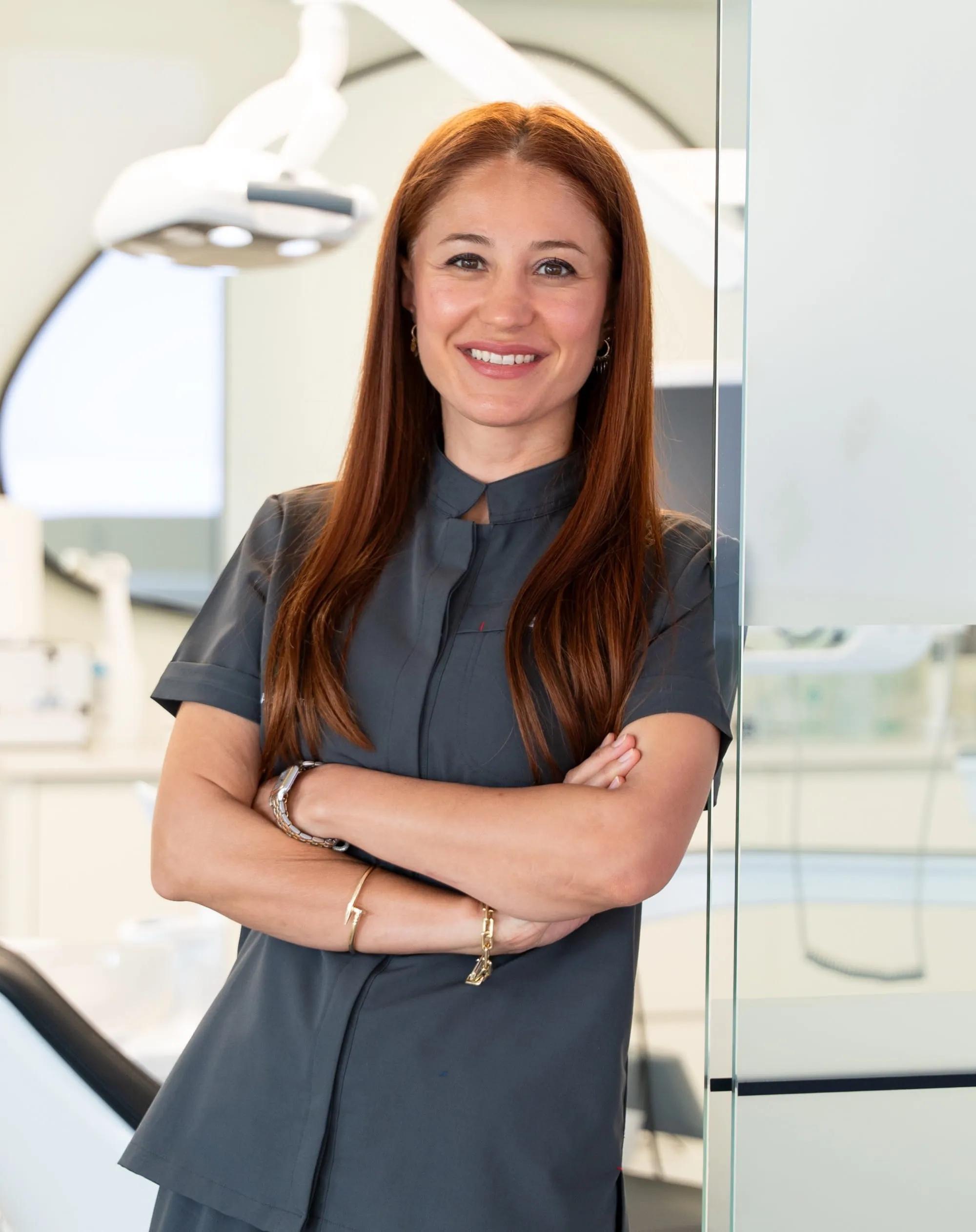
Dt. Dilek AKSU GÜLER
Dentist · Co-founder
Dt. Dilek AKSU GÜLER qualified from the Faculty of Dentistry at Süleyman Demirel University, Turkey, in 2005. She is the founding dentist of our clinic in Lara, Antalya. She works in aesthetic restorations (veneers and crowns), digital smile design and implant-supported prostheses, and speaks Turkish, English and German.
Sources
- NHS: Wisdom tooth removal. NHS (nhs.uk). 2024.↩nhs.uk
- SDCEP Management of Acute Dental Problems (2nd ed.): Acute pericoronitis. Scottish Dental Clinical Effectiveness Programme (SDCEP). 2026.↩acutedentalproblems.sdcep.org.uk
- ICHD-3 11.6: Headache attributed to disorder of the teeth. Headache Classification Committee of the International Headache Society. 2018.↩ichd-3.org
- Are third molars associated with orofacial pain? Findings from the SHIP study (MRI, population cohorts). Community Dentistry and Oral Epidemiology 2020;48(5):364-370. 2020.↩doi.org
- NICE TA1: Guidance on the extraction of wisdom teeth. National Institute for Health and Care Excellence, published 27 March 2000 (last reviewed 31 March 2015; update ID898 in progress). 2000.↩nice.org.uk
- Surgical removal versus retention for the management of asymptomatic disease-free impacted wisdom teeth (Cochrane review). Cochrane Database of Systematic Reviews 2020;5:CD003879. 2020.↩doi.org
- SDCEP: Anticoagulant or antiplatelet medication and your dental treatment (information for patients). Scottish Dental Clinical Effectiveness Programme (SDCEP), March 2022. 2022.↩sdcep.org.uk
- Selection Criteria for Dental Radiography, 3rd edition. Faculty of General Dental Practice (UK), now College of General Dentistry, updated 2018, eds Horner K, Eaton KA. 2018.↩cgdent.uk
- Morphologic and demographic predictors of third molar agenesis: a systematic review and meta-analysis. Journal of Dental Research 2015;94(7):886-94. 2015.↩doi.org
- Ağız ve Diş Sağlığı Hizmeti Sunulan Özel Sağlık Kuruluşları Hakkında Yönetmelik (consolidated text). T.C. Sağlık Bakanlığı; Resmî Gazete 6/10/2022 No 31975, amended RG 5/3/2024-32480 and 15/12/2024-32753. 2022.↩mevzuat.gov.tr
- Standards for the Dental Team, Principle 2: communicate effectively with patients. General Dental Council (UK).↩standards.gdc-uk.org
- Local interventions for the management of alveolar osteitis (dry socket) (Cochrane review, 49 RCTs). Cochrane Database of Systematic Reviews 2022;9:CD006968. 2022.↩doi.org
- Smoking as a risk factor for dry socket: a systematic review (11 observational studies). Dentistry Journal (Basel) 2022;10(7):121. 2022.↩doi.org
- Antibiotics to prevent complications following tooth extractions (Cochrane review, 23 RCTs). Cochrane Database of Systematic Reviews 2021;2:CD003811. 2021.↩doi.org
- Risk relationship associated with inferior alveolar nerve injury following removal of mandibular third molars: a systematic review (23 studies). Journal of Stomatology, Oral and Maxillofacial Surgery 2020;121(1):63-69. 2020.↩doi.org
- Does retaining third molars result in the development of pathology over time? A systematic review (37 studies). Journal of Oral and Maxillofacial Surgery 2020;78(11):1892-1908. 2020.↩doi.org
- SDCEP Management of Acute Dental Problems (2nd ed.): Post-extraction haemorrhage. Scottish Dental Clinical Effectiveness Programme (SDCEP). 2026.↩acutedentalproblems.sdcep.org.uk
- SDCEP: Post-treatment advice for dental patients taking anticoagulant or antiplatelet medication (patient leaflet). Scottish Dental Clinical Effectiveness Programme (SDCEP), March 2022. 2022.↩sdcep.org.uk
- SDCEP Management of Acute Dental Problems (2nd ed.): Alveolar osteitis (dry socket). Scottish Dental Clinical Effectiveness Programme (SDCEP). 2026.↩acutedentalproblems.sdcep.org.uk
- Non-prescription (OTC) oral analgesics for acute pain: an overview of Cochrane reviews. Cochrane Database of Systematic Reviews 2015;(11):CD010794. 2015.↩doi.org
- Ibuprofen for adults: pregnancy, breastfeeding and fertility. NHS (nhs.uk), page last reviewed 27 August 2025. 2025.↩nhs.uk
- Cryotherapy in reducing pain, trismus, and facial swelling after third-molar surgery: systematic review and meta-analysis (6 RCTs). Journal of the American Dental Association 2019;150(4):269-277. 2019.↩doi.org
- Influence of milk and dairy products on wound healing after wisdom teeth removal: a prospective clinical study. BMJ Nutrition, Prevention & Health 2026;9(1):e001432. 2026.↩doi.org
- Impact of postoperative dairy consumption on oral wound healing: critical analysis from a prospective, randomized and controlled trial. Head & Face Medicine 2025;21(1):40. 2025.↩doi.org
- NHS: Dental abscess. NHS (nhs.uk). 2026.↩nhs.uk
- NHS: Toothache. NHS (nhs.uk). 2024.↩nhs.uk
- Dental tourism and the risk of barotrauma and barodontalgia (narrative review with guiding principles). British Dental Journal 2023;234(2):115-117. 2023.↩doi.org
- Going abroad for medical treatment. NHS (England), accessed 21 September 2026.↩nhs.uk
- Dental checks: intervals between oral health reviews (clinical guideline CG19). National Institute for Health and Care Excellence, published 27 October 2004. 2004.↩nice.org.uk
- Dental tourism: Patients need to know the risks. British Dental Association, accessed 21 September 2026.↩bda.org
- What can I provide a patient on the NHS who has just recently returned after having dental treatment abroad? (Knowledge Base article KA-02010). NHS Business Services Authority, accessed 18 September 2026. 2026.↩faq.nhsbsa.nhs.uk
- Going abroad for dental treatment (patient information). General Dental Council, accessed 18 September 2026. 2026.↩gdc-uk.org
- Türk Diş Hekimleri Birliği Kanunu, Law No. 3224 (consolidated text). Resmî Gazete 25/6/1985 No 18792; consolidated PDF, mevzuat.gov.tr. 1985.↩mevzuat.gov.tr
- Türk Dişhekimleri Birliği website: Find a Dentist. Türk Dişhekimleri Birliği (TDB).↩tdb.org.tr
- How to make a complaint or get a refund. General Dental Council, accessed 21 September 2026.↩gdc-uk.org
- Uluslararasi Saglik Turizmi ve Turistin Sagligi Hakkinda Yonetmelik. T.C. Saglik Bakanligi, Resmi Gazete 26/4/2025, No 32882. 2025.↩resmigazete.gov.tr
- Yetkili Saglik Tesisleri ve Araci Kuruluslar. T.C. Saglik Bakanligi, Saglik Turizmi Daire Baskanligi, list updated 20 August 2026. 2026.↩shgmturizmdb.saglik.gov.tr
- Hasta Hakları Yönetmeliği (consolidated text). T.C. Sağlık Bakanlığı; Resmî Gazete 1/8/1998 No 23420, amended RG 8/5/2014-28994, 23/12/2016-29927, 16/1/2019-30657. 1998.↩mevzuat.gov.tr
- Treatment abroad checklist. NHS (England), accessed 21 September 2026.↩nhs.uk