What is a dental crown, and when is one needed?
A crown is a cap that covers the whole visible part of a tooth. It is made in a laboratory or at the clinic. The tooth is prepared by reducing it on every surface, and the crown is then cemented onto it. Its purpose is to protect a weakened tooth from breaking and to restore its shape and function.
A crown is considered for a tooth that has lost much of its structure to a large filling. It is also considered for a cracked or broken tooth, once an examination has shown that it can be repaired. Some deep cracks cannot be, and extraction is then considered. Other reasons are a weakened back tooth after root canal treatment, a tooth that will support a bridge, and a severely worn tooth.
For a healthy tooth whose only problem is its colour or a small flaw in its shape, a crown is not the first choice. Whitening, bonding or veneers can achieve the same aim while removing far less tissue. A crown removes more of the tooth than a veneer, and what is removed does not grow back. In Turkey you may hear the word kaplama for both crowns and veneers, so ask which one is proposed for each tooth. Our dental veneers page explains the difference.
This page is written for readers who live in the UK and are considering treatment at our clinic in Antalya, Turkey. On this page, "we" means that clinic. The section "Crowns on healthy teeth" covers a concern often raised in the UK. The later sections cover who treats you, the trip, and aftercare back in the UK.
- A crown covers the whole tooth; it is made to protect a tooth that is weakened, broken, heavily filled or root-treated.
- The tooth is reduced on every surface, and the tissue removed does not grow back. From then on, the tooth needs a restoration to protect it.
- For a healthy tooth, a crown made only for appearance is not the first choice. Ask why each proposed crown is needed, and have the answer in writing.
- In published studies, most single crowns on natural teeth were still in the mouth after five years. For the four materials in a 2026 review, the differences are small.
- Once you are back in the UK, check-ups are with your own dentist. Agree in writing before treatment who pays if a crown has to be redone.

Who it suits, and who it does not
Where it may be suitable
- A tooth that has lost structure to a large filling, where each new filling leaves less of the tooth
- A cracked or broken tooth, once an examination has shown that it can be repaired. If the crack runs below the gum or towards the root, the tooth may not be repairable (see below)
- Teeth that have had root canal treatment, especially back teeth that carry chewing load
- Teeth that will support a bridge
- Severely worn teeth, once the cause of the wear (for example grinding, or acidic food and drink) has been assessed, or teeth with developmental defects
- Restorations that keep breaking, once the cause of the fracture, the remaining tooth structure and the existing restoration have been assessed. A crown is considered only if the loss of tissue calls for it; clenching is managed as a separate part of the plan
Where an option that removes less may be enough
- If enough sound tissue remains, a filling or an onlay may be enough. An onlay covers one or more of the tooth's cusps (the raised points of the chewing surface). Root canal treatment or a large filling does not on its own mean a crown is needed.
- A complaint about colour only: depending on the cause of the discolouration, whitening first, where suitable.
- A small chip or a flaw in shape: bonding.
- Colour and shape on a front tooth, where the tooth is healthy: a veneer. More detail: our dental veneers page.
- Crowded or crooked teeth: orthodontic treatment moves the teeth instead of reshaping them. "Straightening" teeth with crowns means removing a great deal of tooth, so orthodontic treatment is assessed first.
Where another treatment comes first
- Active decay or gum disease: this is treated first; no crown is made while the disease is active.
- A fracture that reaches the root, or loss of most of the tooth: whether the tooth can be saved is assessed. Some teeth cannot be saved with a crown, and extraction followed by an implant or a bridge then comes into consideration.
- Teeth that are still developing: in young patients, a final crown is usually postponed.
Suitability is decided by an examination, a review of any existing X-rays and, where needed, new imaging.
Crowns on healthy teeth, and the "Turkey teeth" concern
In British media, "Turkey teeth" is a loose label for extensive cosmetic dental work, such as a full row of very white crowns or veneers. One concern raised with it is that healthy front teeth were cut down for full crowns when the patient expected veneers. The criticism is not of ceramics. It is of a plan that gave healthy teeth more treatment than they needed, without the patient understanding which treatment it was.
What a crown takes from the tooth
The difference between a crown and a veneer is how much tooth is removed. For a veneer, usually only a thin layer of enamel is taken from the front. For a crown, the tooth is reduced on every surface, and this often goes through the enamel into the dentine beneath it. A laboratory study measured this on plastic model back teeth. Full crown preparations removed about two thirds to three quarters1 of the visible part of the tooth. That study did not measure front teeth or veneers. On a real tooth, the amount also depends on existing damage and old fillings.
The tissue removed does not grow back. From then on, a crowned tooth needs a restoration to protect it, and the crown may need replacing in the future. The tooth's nerve can also lose its vitality after a crown (see the risks below).
Who a crown is not for
Some crowns are made only to change the colour or a small flaw in the shape of a healthy, straight tooth. Such a crown reduces the tooth for no clinical reason. On a tooth like this, a crown is not the first choice: whitening, bonding or a veneer is considered first. A crown is for a weakened tooth: one that has lost much of its structure, is broken but repairable, or has had root canal treatment.
Before you agree to crowns on healthy teeth
The British Dental Association says patients should be aware of the risks and alternatives to the treatment they want2. It adds that they should get advice on what to do if problems occur when they return. The UK General Dental Council suggests talking to your own dentist3 before you go abroad for treatment; take the written plan with you. Before any tooth is prepared, ask:
- Which teeth will have a crown, which a veneer, and which nothing?
- For each crown, why is a filling, an onlay, bonding, whitening or a veneer not enough for that tooth?
- How much will be removed from each tooth, and can I have that in writing?
- If the plan gives every tooth the same treatment, what is the reason for each one?
The answers should rest on the state of each tooth, not on a package or a material. You can say no, or ask to stop, at any stage. Once a tooth has been prepared for a crown, that step cannot be undone.
Material options, including "porcelain crowns"
The first decision is whether the tooth needs a crown at all; the material comes second. It is chosen for the tooth's position, your bite, the opposing teeth, any clenching habit and what you expect of its appearance.
"Porcelain crown" is an everyday name rather than one material. It can mean an all-ceramic crown, such as lithium disilicate or zirconia, or a metal-ceramic crown, where porcelain is fused to a metal framework. If a plan says "porcelain", ask which of these it means.
- Lithium disilicate (e.max). An all-ceramic crown that lets light through in a way close to a natural tooth; often chosen for front teeth and single crowns.
- Zirconia (often called zirconium). An all-ceramic crown whose strength varies with the type and design. It is strong, and is used most often on back teeth and in bridges. It is made as a single piece (monolithic) or with porcelain layered on top.
- Metal-ceramic (porcelain fused to metal). The type of crown studied over the longest periods; if the gum recedes, metal may show at its edge. People allergic to base metals such as nickel and chromium may react to it; tell your dentist about any metal allergy you know of.
- Full metal (gold alloy). Still an option for back teeth that do not show and for bites with very little space; because of its appearance it is rarely chosen.


| Lithium disilicate (e.max) | Zirconia | Metal-ceramic | |
|---|---|---|---|
| Contains metal? | No | No | Yes |
| Appearance | Options that let light through close to a natural tooth | Single piece: can look opaque; porcelain-layered: more natural | Metal may show at the gum line |
| Strength | Enough for single crowns | Varies with type and design; some types are suitable for bridges | High; metal framework |
| Where it suits | Front teeth, single crowns | Back teeth, bridges | Back teeth, bridges |
| Five-year survival (single crown) | Single piece: about 98 to 99 in every 100 crowns | Single piece and porcelain-layered: about 97 | About 97 |
| Known weak point | Fracture where there is little room for the crown and chewing forces are heavy | If layered, the porcelain can chip | Metal at the edge; the porcelain can chip |
How is a crown made?
The steps depend on how the crown is made. A laboratory-made crown usually takes two or three appointments. A crown designed on a computer and milled at the clinic (CAD/CAM) can, in suitable cases, be done in one. The number of appointments and whether a temporary crown is needed vary accordingly. How the appointments fit a trip is covered in "If you live in the UK: appointments and travel".
Examination and planning
You are asked about your medical history, including medicines and smoking. The remaining tooth structure, the state of the nerve, the gums and the bite are assessed. Existing X-rays are reviewed, and new imaging is taken if needed. Whether a crown is needed, and which material, is decided tooth by tooth.
Treatment first
Decay is removed and, if needed, root canal or gum treatment is completed. If little of the tooth remains, the missing part is built up with a filling, which becomes the core under the crown. In a root-treated tooth with too little tissue left to hold the core, a post may be placed in the root canal. A post is not used to strengthen the tooth; an unnecessary post increases the risk of a root fracture.
Preparation
Under local anaesthetic, the tooth is reduced on every surface, as much as the chosen material requires. The tissue removed does not grow back.
Impression or digital scan
An impression of the tooth and the opposing jaw is taken, or they are scanned with an intraoral scanner, and the shade is chosen. For a laboratory-made crown, a temporary crown made of plastic or composite is fitted; it protects the tooth until the final crown is ready.
Try-in
The fit, the edges, the bite and the colour of the crown are checked in the mouth and adjusted if needed.
Cementing and review
The crown is cemented and the bite is given a final adjustment. At the review appointment, the fit at the gum and any sensitivity are checked.
Risks and benefits
Risks
- Loss of tissue that cannot be undone. The tooth is reduced on every surface; the enamel and dentine removed do not grow back. From then on, the tooth needs a restoration to protect it, and the crown may need replacing in the future.
- The tooth's nerve. The figures here are from published studies, not our own records. The pooled results of 37 studies cover teeth that were alive at the start and were then treated with indirect restorations such as crowns. In about 5 in every 100 of these teeth4, the nerve lost its vitality. In studies with more than ten years of follow-up, the figure was about 7. The certainty of this evidence is low. The rate cannot be put down to the preparation alone: earlier decay and fillings also play a part. If it happens, root canal treatment is needed to keep the tooth; sometimes this shows up years later.
- Sensitivity. Temporary sensitivity to cold and heat after preparation is common; if it lasts or gets worse, it is assessed.
- Decay. A crown does not protect the tooth from decay. New decay can develop at its edge or underneath it, and it is one of the main causes of crowns being lost in the long term.
- Gums. A crown whose edge does not fit the tooth closely at the gum line can cause gum inflammation and recession. Receding gum makes the edge of the crown visible.
- Fracture and chipping. On porcelain-layered crowns, the porcelain on top can chip; this has been reported less often with single-piece crowns5. Clenching increases the risk.
- Wear of the opposing tooth. Ceramic crowns can wear down the natural tooth they bite against. In studies of monolithic zirconia lasting 6 to 24 months, the deepest wear measured on the opposing tooth averaged about 0.1 mm6. The review could not reliably say how this compares with the wear natural teeth cause on each other. Polishing and adjustment of the bite affect this.
- Coming loose. If the cement bond weakens, the crown can come off. The dentist checks why it came off and examines the crown and the tooth. It can be cemented back only if both are sound and the crown still fits.
Benefits
- It protects a weakened tooth from breaking and can delay an extraction.
- It restores chewing and the shape of the tooth.
Aftercare
Until the anaesthetic wears off, take care not to bite your cheek or lip. There may be sensitivity to cold and heat in the first days; avoid hard and sticky foods. If a temporary crown is in place, sticky foods and pulling floss upwards can dislodge it; slide the floss out sideways instead.
Daily care
- Brush twice a day with a fluoride toothpaste; clean carefully along the line where the crown meets the gum.
- Use floss or interdental brushes every day; under a bridge you need special floss.
- Do not bite on hard objects such as ice, pens or your nails.
- If you clench or grind your teeth, a night guard may be advised.
- Keep up regular check-ups with your own dentist in the UK. The edge of the crown, the gums and the bite are checked, with an X-ray of the tooth under the crown when needed.
How long does it last?
The figures below are estimates from published studies, not our own records; they are not a promise of how long your crown will last. What happens in your case depends on how much of the tooth remains, your bite, your habits and your care.
- Single crowns. A 2026 review combined the results of earlier studies of single crowns on natural teeth. It estimated five-year survival in the four material groups below. These figures do not cover other crown materials. For single-piece lithium disilicate, about 98 to 99 in every 1005 were still in the mouth after five years. For porcelain-layered zirconia, metal-ceramic and single-piece zirconia, the figure was about 97. The same review reported fewer fractures and chips on single-piece crowns than on porcelain-layered ones. These estimates cannot be applied directly to bridges or implant crowns.
- Metal-ceramic, over the long term. In a single practice, 2,211 crowns were judged to be in a favourable condition when they were cemented. Of every 100 of them, about 97 were still in the mouth after 10 years and 85 after 25 years7. This series used a high-gold alloy, and the crowns were made by one dentist.
- The studies cited on this page do not show that zirconia lasts longer. We have found no evidence for claims such as "lasts 20 per cent longer".
Staying in the mouth does not mean staying free of complications. Some crowns later need adjusting, polishing, repair or re-cementing. These are signs of a problem, not routine care. The cause (decay, a poorly fitting edge, a fracture) is assessed first, and the crown is replaced if needed.
When to contact a dentist
If you have a crown, contact a dentist if any of these happens:
- Sensitivity that does not settle, or keeps getting worse
- Pain that starts with heat and lingers
- Toothache that lasts more than 2 days8, or that does not go away when you take painkillers
- Pain when you bite, or a feeling that the crown is high
- A crack, a fracture or movement in the crown
- Bleeding, receding gum or a dark line at the edge of the crown
- The crown comes off: keep it, and do not glue it back yourself
- A temporary crown comes off: see a dentist without waiting, to protect the tooth
Throbbing pain, facial swelling or a high temperature are not expected after a crown. See a dentist where you are without waiting for the clinic's reply. If you think you have a dental abscess, do not wait. An abscess does not go away on its own and needs urgent treatment by a dentist9. In England, the NHS advises asking for an urgent dentist appointment or getting help from NHS 1119. If you do not have a dentist or cannot get an emergency appointment, it says to call 111 or use 111 online. Elsewhere in the UK, check the urgent dental care route where you live.
Emergencies. The NHS lists the following as needing urgent medical help9. Do not wait for a dental appointment or for the clinic's reply. In the UK, call 999 or go to A&E. In Turkey, the emergency number is 112.
- Difficulty breathing, speaking or swallowing
- A lot of swelling inside your mouth
- Swelling around your eye or in your neck8
- Pain in the eye, or sudden problems with your sight
- Difficulty opening your mouth
Before you fly home
Make sure your bite has been checked and that you have written care instructions, your treatment record and a way to reach the clinic.
Once you are back in the UK
If a problem comes up that is not urgent, write to the clinic and send photographs. See your own dentist in the UK for problems that need someone to look in your mouth. In the emergencies above, do not wait for a reply.
Who carries out the treatment?
Your treatment is provided by our clinic in Antalya, Turkey, and carried out there by the clinic's dentists.
In Turkey, as in the UK, a dentist does not have to be a specialist to make crowns. Turkish law authorises every dentist10 to diagnose and treat the teeth, the gums and the tissues of the mouth and jaw. It ties the specialist title to a specialist certificate10, issued and registered by the Ministry of Health11. Prosthodontics (in Turkish, protetik diş tedavisi) is one of the nine dental specialties the law sets; its specialist training includes crowns, onlays and veneers12. In the UK, dentists do not have to join a specialist list13 to practise a specialty. They may use the title "specialist" only if they are on the GDC's list.
Ask who will examine you, prepare your teeth and fit the crowns. Ask what their title is, where they qualified, and whether they hold a Ministry-registered specialist certificate in prosthodontics. Ask for the answers in writing.
If you live in the UK: appointments and travel
A laboratory-made crown on a natural tooth usually needs two or three appointments. The crown is made in a laboratory between preparing the tooth and fitting it, and you wear a temporary crown in between. The number of days in Antalya depends on how many teeth are treated and whether a bridge is involved. It also depends on whether decay, root canal or gum problems need treating first, or a tooth needs a post and core. Before you book, you receive a written preliminary plan based on the photographs and any X-rays you send. It sets out the appointments and how many days they need. It is not a diagnosis or a final treatment plan. The General Dental Council says you should always be assessed by a qualified dentist before being given a treatment plan and cost estimate3. For crowns, that assessment is the examination in Antalya. It confirms or changes the preliminary plan, and with it the days and the cost. If it changes, you receive the revised plan in writing before treatment starts. You can say no, or ask to stop, at any stage. Once a tooth has been prepared, that step cannot be undone. Ask before you book what you pay if the examination shows that crowns do not suit you, or if you decide not to go ahead.
A crown is not finished when you fly home. It needs check-ups for as long as it is in the mouth. Some problems, such as a nerve that loses its vitality, show up years later. So before you decide, ask who will look after the crowns once you are back in the UK (see below). Crowns are also made by dentists in the UK, and a UK opinion and written plan give you something to compare.
Flying. A 2023 review of flying after dental treatment suggests waiting at least 24 hours after restorative treatment14, and longer after surgical procedures. The authors note that the research is limited and comes mainly from military aviation. Treat it as a starting point for your dentist's advice, not as a rule.
Back in the UK: your own dentist, the NHS and your records
Your own dentist
The General Dental Council suggests talking to your own dentist3 before you go. They need to know the plan in case problems come up later. Once you are home, a problem with a crown is usually first seen by your own dentist in the UK. If you do not have one, it helps to find one before you travel.
Ask for a written record of the treatment to take back to them. It should show which teeth were crowned, the materials used, and any root canal treatment or post. Ask for copies of your X-rays too. In Turkey, the health tourism regulation entitles international patients to an itemised bill. On request, they also get free copies of the records of the materials used, the tests and the imaging15. The NHS lists exchanging medical records and arranging aftercare back home16 among the things to consider before treatment abroad.
A crown needs regular check-ups for as long as it is in the mouth. National guidance in England (NICE) says the interval between check-ups should be set for each person according to their risk17 and discussed with them.
What the NHS does and does not do
If you later need NHS dental care in England or Wales, having been treated abroad does not by itself shut you out of it. An NHS dental practice that accepts you for a course of treatment, not only an urgent appointment, provides clinically necessary treatment, with your consent. This means the treatment that every NHS dental contract must offer. However, the NHS free-repair and replacement provisions do not apply18 to work done by another provider. These are the free repair or replacement an NHS practice can give for its own work. The NHS also states that it is not liable for negligence or failure of treatment16 when you have treatment abroad. On the NHS England routes that fund planned treatment abroad, you cannot get reimbursement for dental treatment19.
The NHS guidance quoted here is for England, and for England and Wales where stated. Scotland and Northern Ireland have their own NHS rules, which we have not checked. If you live there, ask your dentist how they apply to you.
Travel insurance
The NHS says that most travel insurance policies will not cover you for planned treatment abroad, so you may need specialist cover16. Tell your insurer about your plans. Ask before you book whether anything linked to the treatment is covered, such as a complication or an extra trip.
What the GDC and the NHS tell you to ask
The General Dental Council lists questions to ask before treatment abroad3. Below are its questions, some of them combined, with what this page can answer today and what to ask for in writing. The last question is one of our own.
- Who will carry out my treatment, and what are their qualifications? The treatment is provided by our clinic in Antalya, Turkey. Ask for the name of the dentist who will prepare your teeth and fit the crowns. Ask where they qualified and what their title is (see who carries out the treatment, above).
- Are you regulated by a professional body and registered with it? The GDC notes that it cannot guarantee that other countries have an equivalent regulator3. In Turkey, a health facility needs an authorisation certificate15 from the Ministry of Health to treat international patients. Authorised facilities appear in a register the Ministry publishes20, so you can check it yourself. The authorisation belongs to the facility, not to the dentist, and it says nothing about the result of your treatment. Ask for the treating dentist's own registration details as well. See health tourism authorisation.
- Is the work guaranteed, are the terms in writing, and for how long do they apply? This page makes no guarantee. Ask for the clinic's written terms for remaking a crown or bridge and for handling complications, and read them before you commit. Check how long they apply, what they exclude, and what they say about a crown that fails after you are back in the UK.
- What aftercare do you provide, and who can I contact after the treatment? For a problem that is not urgent, you write to the clinic and send photographs. Check-ups, and problems that need someone to look in your mouth, are with a dentist in the UK, usually your own. Before you commit, check that a UK dentist can see you for check-ups.
- If there are complications, or I am unhappy with the result, what happens and who pays for further treatment, extra flights and the hotel? Is further treatment included in the cost? Ask for the answers in writing before you commit.
- Do you have a complaints system, and can I see a copy? Ask for it before treatment. The GDC says it cannot resolve complaints or help with refunds21; its investigations concern the dentists on its own register. Turkish regulation makes the facility responsible for complications and medical malpractice arising after the health service it provided15.
- Will the dental team speak English, or will you provide a translator? Ask who will explain your plan and your consent form to you, and in which language.
- How many times have you carried out this treatment, what are your rates of success and complications, and can you give references? We publish no figures of our own yet, and this page carries no patient reviews. Ask for the figures in writing, and ask how they were measured.
- Do you have insurance to cover this treatment? In Turkey a facility treating international patients must take out complication insurance for surgical and interventional procedures carried out in an operating theatre15. That does not by itself tell you whether your treatment is covered, so ask which procedures in your plan, if any, fall under it. Ask too, in writing, whether the clinic or the treating dentist holds insurance for complications or errors, what it covers and whom it protects.
- If the examination shows that crowns do not suit me, what happens, and who pays? Ask before you book what you pay for the examination and any X-rays, and what happens to any payment if you do not go ahead.
The NHS names warning signs to think about before booking any treatment abroad. They are a hard sell, a lack of information, pressure to make a quick decision, no discussion of possible complications, and no mention of aftercare19. Apply them to this clinic too. For crowns, add one of our own: a plan that proposes crowns on healthy teeth without a reason for each tooth.
What determines the cost?
This page does not show prices. A treatment plan is prepared for you after an examination. The main factors that shape it are:
- How many teeth need crowns, or how many units a bridge has
- The material and how the crown is made
- Treatment needed first: decay treatment, root canal treatment, a post and core, gum treatment
- The temporary crown and the review appointments
- The number of trips the appointments need
Ask for the plan in writing. It should say why a crown is recommended for each tooth, and why an option that removes less is not enough. Ask too who pays for further treatment and extra travel if there is a complication.
If you are comparing with a quote from a UK practice, compare what each one includes, item by item. Check too whether both propose the same treatment for each tooth.
Does your tooth need a crown?
Send a photograph of your tooth, and an X-ray if you have one. Our dentists will write back with a first view: whether a crown, an onlay or a filling might suit it, which material, and why. This is not a diagnosis; the treatment plan follows an examination.
Frequently Asked Questions
What is a porcelain crown?
"Porcelain crown" is an everyday name, not a single material. It can mean an all-ceramic crown, such as lithium disilicate (e.max) or zirconia, or a metal-ceramic crown, where porcelain is fused to a metal framework. Ask which one is proposed for each tooth, and why.
Is a crown the same as a veneer?
No. A veneer is a thin layer bonded to the front of a tooth, and usually only a thin layer of enamel is removed. For a crown, the tooth is reduced on every surface, so a crown removes more of the tooth. What is removed does not grow back. In Turkey both may be called kaplama, so ask which one is proposed for each tooth.
Should I have crowns on healthy teeth to change how they look?
A crown is not the first choice for a healthy tooth whose only problem is its colour or a small flaw in its shape. On such a tooth it removes tissue for no clinical reason, and this cannot be undone. Whitening, bonding or a veneer is considered first. If a plan proposes crowns on healthy teeth, ask for the reason for each tooth in writing.
Does getting a crown hurt?
The tooth is prepared under local anaesthetic, so pain is not expected during the procedure. Afterwards there may be sensitivity to cold and heat for a few days. If it does not settle or gets worse, or if you have toothache rather than brief sensitivity, see a dentist.
Does a root-treated tooth always need a crown?
No; it depends on how much sound tissue remains. On back teeth that carry chewing load and have lost structure, a crown protects the tooth from breaking. If enough tissue remains, a filling or an onlay may be enough. The decision is made tooth by tooth.
Can the tooth under a crown decay?
Yes. A crown does not protect the tooth from decay. New decay can develop at its edge or underneath it, and it is one of the main causes of crowns being lost in the long term. That is why daily cleaning between the teeth and regular check-ups matter.
Can a crown kill the tooth's nerve?
It can happen. In some teeth that were alive before a crown or a similar restoration, the nerve later lost its vitality. The figures, and their low certainty, are in the risks section above. The rate cannot be put down to the preparation alone. If it happens, root canal treatment is needed. This is one reason a crown is made only when the tooth needs it.
Zirconia, e.max or metal-ceramic: which is better?
There is no single right material for every tooth; the tooth's position, your bite and any clenching decide it. For single crowns on natural teeth, five-year survival is close across the materials compared in the section on how long crowns last. The studies cited on this page do not show that zirconia lasts longer than lithium disilicate.
How many days do I need to be in Antalya?
A laboratory-made crown usually takes two or three appointments, with laboratory time between preparing the tooth and fitting the crown. The number of days depends on how many teeth are treated, whether a bridge is involved and whether other treatment is needed first. Before you book, a written preliminary plan states the appointments and the number of days. It is based on your description, photographs and any X-rays you send, and the examination confirms or changes it.
What should I do if my crown comes off?
Keep the crown, do not glue it back yourself, and see a dentist as soon as possible. Once you are back in the UK, that is usually your own dentist. The exposed tooth may be sensitive. The dentist checks why it came off and examines the crown and the tooth. It can be cemented back if both are sound and the crown still fits; otherwise further treatment or a new crown may be needed.
Will I need follow-up, and will that be in Turkey or in the UK?
Yes. A crown needs regular check-ups for as long as it is in the mouth. These are usually with your own dentist in the UK, at an interval set for your risk. Tell them about the treatment and bring the written record. For a problem with the crown that is not urgent, write to the clinic with photographs; for urgent symptoms, get care where you are first.
Will the NHS fix my crown if something goes wrong later?
In England and Wales, an NHS practice that accepts you for a course of treatment provides clinically necessary treatment, with your consent. The free repair or replacement an NHS practice can give for its own work does not apply to work done elsewhere. The NHS also says it is not liable for negligence or failure of treatment abroad. Scotland and Northern Ireland have their own NHS rules, which we have not checked; if you live there, ask your dentist. Ask before you commit who pays for further treatment, and for any extra trip, if there is a complication.
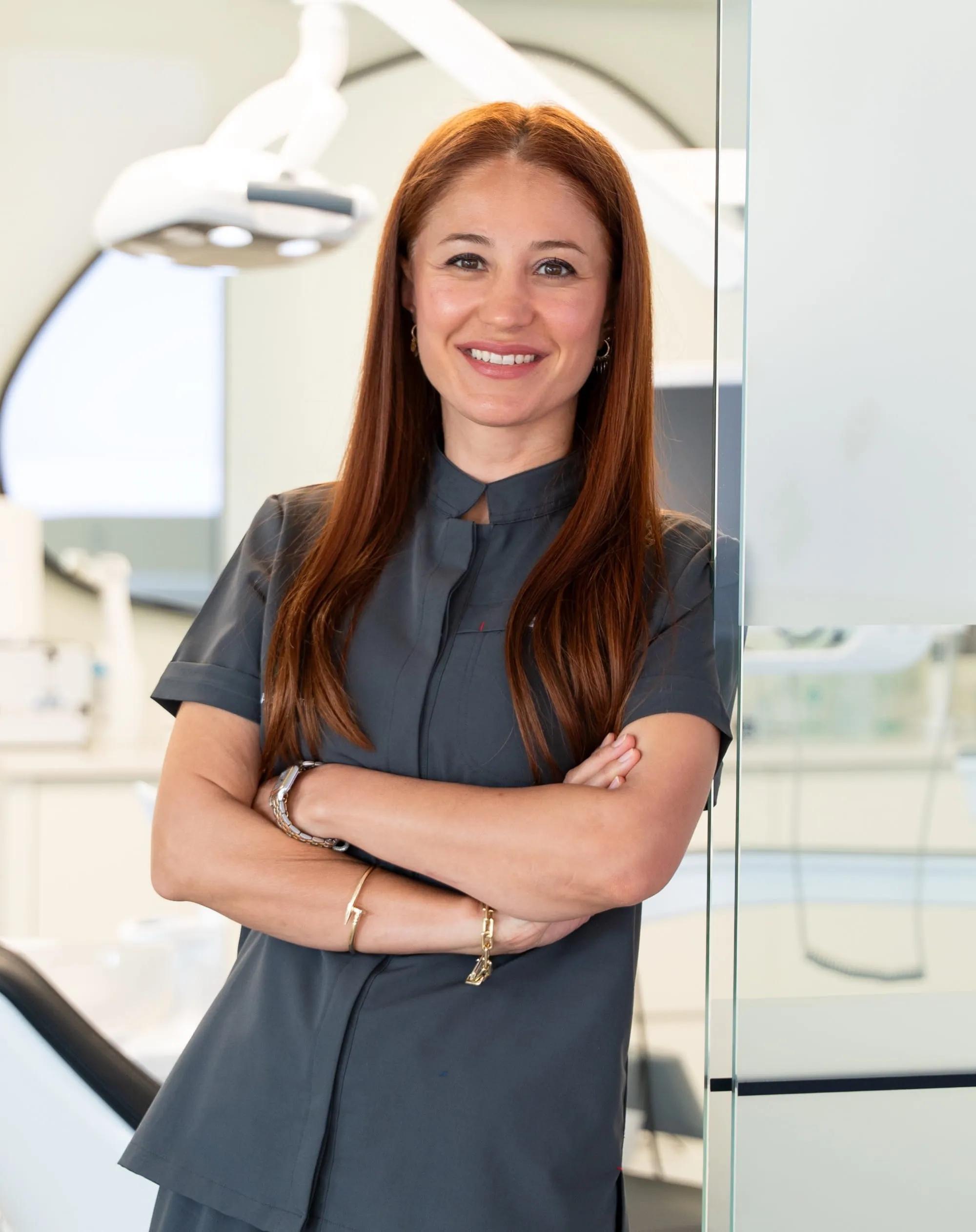
Dt. Dilek AKSU GÜLER
Dentist · Co-founder
Dt. Dilek AKSU GÜLER qualified from the Faculty of Dentistry at Süleyman Demirel University, Turkey, in 2005. She is the founding dentist of our clinic in Lara, Antalya. She works in aesthetic restorations (veneers and crowns), digital smile design and implant-supported prostheses, and speaks Turkish, English and German.
Sources
- Tooth structure removal associated with various preparation designs for posterior teeth. Int J Periodontics Restorative Dent 2002;22(3):241-9. 2002.↩pubmed.ncbi.nlm.nih.gov
- Dental tourism: Patients need to know the risks. British Dental Association, accessed 21 September 2026.↩bda.org
- Going abroad for dental treatment (patient information). General Dental Council, accessed 18 September 2026. 2026.↩gdc-uk.org
- Incidence of pulp necrosis and periapical pathosis after indirect restorations: systematic review and meta-analysis (37 studies, 11,615 teeth). BMC Oral Health 2023. 2023.↩pmc.ncbi.nlm.nih.gov
- Survival of monolithic lithium disilicate, monolithic zirconia and metal-ceramic single crowns: systematic review. International Journal of Prosthodontics 2026;39(3):308-324. 2026.↩doi.org
- Antagonist enamel wear against monolithic zirconia: systematic review and meta-analysis of in-vivo studies. Journal of Clinical Medicine 2020;9(4):997. 2020.↩pmc.ncbi.nlm.nih.gov
- High-gold metal-ceramic single crowns in one practice: up to 25 years (2,340 crowns). International Journal of Prosthodontics 2013;26(2):151-160. 2013.↩pubmed.ncbi.nlm.nih.gov
- NHS: Toothache. NHS (nhs.uk). 2024.↩nhs.uk
- NHS: Dental abscess. NHS (nhs.uk). 2026.↩nhs.uk
- 1219 sayılı Tababet ve Şuabatı San'atlarının Tarzı İcrasına Dair Kanun (consolidated text). T.B.M.M.; RG 14/4/1928 No 863; consolidated on mevzuat.gov.tr. 1928.↩mevzuat.gov.tr
- Tıpta ve Diş Hekimliğinde Uzmanlık Eğitimi Yönetmeliği. T.C. Sağlık Bakanlığı; RG 3/9/2022 No 31942, amended RG 7/10/2023-32332 and 16/5/2024-32548. 2022.↩mevzuat.gov.tr
- Protetik Diş Tedavisi Uzmanlık Eğitimi Çekirdek Müfredatı v2.3. Tıpta Uzmanlık Kurulu, TUKMOS. 2017.↩dosyamerkez.saglik.gov.tr
- Specialist lists. General Dental Council (UK).↩gdc-uk.org
- Dental tourism and the risk of barotrauma and barodontalgia (narrative review with guiding principles). British Dental Journal 2023;234(2):115-117. 2023.↩doi.org
- Uluslararasi Saglik Turizmi ve Turistin Sagligi Hakkinda Yonetmelik. T.C. Saglik Bakanligi, Resmi Gazete 26/4/2025, No 32882. 2025.↩resmigazete.gov.tr
- Going abroad for medical treatment. NHS (England), accessed 21 September 2026.↩nhs.uk
- Dental checks: intervals between oral health reviews (clinical guideline CG19). National Institute for Health and Care Excellence, published 27 October 2004. 2004.↩nice.org.uk
- What can I provide a patient on the NHS who has just recently returned after having dental treatment abroad? (Knowledge Base article KA-02010). NHS Business Services Authority, accessed 18 September 2026. 2026.↩faq.nhsbsa.nhs.uk
- Treatment abroad checklist. NHS (England), accessed 21 September 2026.↩nhs.uk
- Yetkili Saglik Tesisleri ve Araci Kuruluslar. T.C. Saglik Bakanligi, Saglik Turizmi Daire Baskanligi, list updated 20 August 2026. 2026.↩shgmturizmdb.saglik.gov.tr
- How to make a complaint or get a refund. General Dental Council, accessed 21 September 2026.↩gdc-uk.org