
What is conscious sedation, and what is it not?
Conscious sedation is a drug-induced lowering of consciousness used to reduce anxiety. It is not being put to sleep. The UK national standard for conscious sedation in dentistry requires verbal contact with the patient to be kept throughout the procedure. It treats loss of verbal contact as falling outside conscious sedation. Sedation does not remove pain on its own either; a local anaesthetic is still given to numb the area.
The decision rests on two questions. Is this method suitable for you, and do the setting and the team meet the conditions it requires? This page answers both openly, lists who it is not suitable for and explains the escort rule. We have no sourced figure for how often sedation-related adverse events occur, so we do not give a safety percentage.
On this page "we" means our clinic in Antalya, Turkey, where your dental treatment is carried out. If sedation is part of your plan, the written plan names the clinic you contract with and the place where the sedation is given. It also names the dentist who treats you and the person who gives the sedation. The page covers the method and its risks first. It then explains how the escort rule and the day after sedation fit a trip from the UK. It ends with the questions the General Dental Council and the NHS suggest you ask.
- Conscious sedation is not sleep: the UK national standard requires verbal contact to be kept throughout the procedure.
- Sedation is not pain control; a local anaesthetic is still given to numb the area.
- For adults, every technique except inhalation sedation with nitrous oxide needs an escort. Without one, those techniques are not used, so raise it before you book if you travel alone.
- Safety depends on the setting, the team and the monitoring. The guidelines' requirements include consent, fasting instructions, vital signs, pulse oximetry and discharge criteria; monitoring is set by technique.
- There is no sourced figure for how often sedation-related adverse events occur, so we do not give a safety rate.
Who it suits, and who it does not
When it may be considered
- Fear of the dentist strong enough to make you put off treatment
- A gag reflex that makes treatment difficult
- A long surgical procedure is planned (for example full-mouth implant treatment)
- Treatment started under a local anaesthetic could not be completed because of anxiety
Ways it can be given
Conscious sedation is not a single method. A mixture of nitrous oxide and oxygen can be breathed in through the nose (inhalation sedation). A drug can also be given into a vein (intravenous, or IV, sedation) or taken by mouth. The UK standard uses a tablet only when a technique that can be given in small steps is not suitable. The tablet is then taken at the clinic, not at home. It is given only by a practitioner already competent in intravenous sedation. The team that will give the sedation decides which route is used. For adults, inhalation sedation with nitrous oxide is the only method outside the escort rule, and it disrupts your day less. Like every method, it is used only if the assessment shows that it suits you. Every other method requires the team to be competent in placing a cannula in a vein. Ask us which of these methods we offer before you plan around one.
When it is not suitable, or another step comes first
- No escort is available. For adults, an escort is required with every method except inhalation sedation with nitrous oxide; children need an escort with every method. The UK standard says treatment under sedation must not be provided1 if an escort cannot be assured.
- A serious general illness. The American Dental Association guideline asks that, for patients with significant medical problems, the dentist first consults the patient's own doctor2.
- Sleep apnoea or a high body mass index. The same guideline recommends checking body mass index as part of the assessment before sedation. A high index, especially together with sleep apnoea, can make airway problems more likely.
- A risky medication history. If an opioid has been given or taken shortly before, a benzodiazepine can be up to eight times more potent1. Tell us the name and dose of every medicine you take and when you last took it. Tell us too about alcohol and any recreational drugs, and when you last had them.
- Pregnancy or breastfeeding. Tell us before the appointment. The team that will give the sedation decides whether it should wait.
- Children and young people. The UK care pathway refers 12- to 16-year-olds to community dental services or to hospital settings equipped for this work. For younger children the decision is made separately. Ask us whether we treat children under sedation at all.
- Expecting to be fully unconscious. In conscious sedation verbal contact continues. Being unconscious falls under deep sedation or general anaesthesia, which need a separate setting and a separate team. You may not remember part or all of the procedure, but that is a separate matter and no one can promise it.
What to consider instead
- A local anaesthetic, with the treatment split up. Short sessions, an agreed signal for a pause and a step-by-step explanation of the procedure are often enough.
- General anaesthesia. A separate decision that needs a separate team and an approved setting. It is not a stronger form of conscious sedation.
Suitability is decided by an examination, your medical history and a review of the medicines you take. The decision on sedation is made by the team that will give it.
| Local anaesthetic | Conscious sedation | General anaesthesia | |
|---|---|---|---|
| Consciousness | Fully awake | Lowered, but verbal contact continues | Absent |
| Pain control | Provided by the local anaesthetic | Sedation does not replace it; a local anaesthetic is still given | Provided by a combination of drugs |
| Breathing | You breathe for yourself | You breathe for yourself | Managed by the anaesthetic team, with equipment |
| Team and setting | Dentist and dental nurse | Trained team, monitoring equipment, resuscitation competence | Anaesthetic team and an approved setting |
| Escort | Not needed | Needed for adults except with inhalation sedation; for children with every method | Needed |
| Driving afterwards | No restriction | Not for the period the team specifies | Not allowed |
| Remembering the procedure | You remember it | You may not remember part of it; this cannot be promised | You do not remember it |
How a sedation appointment runs
The steps below are the ones two guidelines require, in the order an appointment runs. They are the UK national standard and the guideline of the American Dental Association, in the US. Which drug and which route are chosen depends on the patient; the team that gives the sedation decides. Ask us who will carry out these steps at your own appointment and with what equipment; we give you the answer in writing. This page describes what the guidelines require, not our own team or equipment. The questions to ask before you agree are under "What the GDC and the NHS suggest you ask" below.12
Assessment and consent
Your medical history, the medicines you take and when you last ate and drank are reviewed. Informed consent specific to sedation is taken, and a focused physical examination is made. Baseline vital signs are measured and recorded: blood pressure, pulse, breathing rate, weight, height and oxygen saturation by pulse oximetry, and temperature when clinically indicated. The American guideline makes all of these mandatory. Before the appointment, tell us if you might be pregnant or are breastfeeding. Also tell us about any earlier problem with sedation or anaesthesia, and about a recent chest infection or cold.
Choosing the method
The UK standard asks for the simplest technique that will work. Every technique other than inhalation sedation with nitrous oxide requires competence in placing a cannula in a vein.
Preparation and equipment check
The equipment is checked before every administration. A system for giving oxygen under positive pressure must be immediately available. At least one person trained in basic life support is present with the dentist.
Giving the sedation and monitoring
Where the route allows, the drug is given in small steps while its effect is watched. The next dose is given only after the previous one has taken full effect. The UK standard regards a single drug as safer than giving several different drugs one after another. The American guideline requires continuous pulse oximetry, continual observation of chest movements and assessment of the level of sedation. It also requires equipment that measures exhaled carbon dioxide, and the means to listen to breath sounds, to be immediately available. The UK standard sets monitoring by technique, including pulse oximetry and blood pressure. It does not recommend routine measurement of exhaled carbon dioxide for dental patients who are healthy or whose illness is mild. The treatment is carried out under a local anaesthetic; sedation does not replace numbing.
Recovery and discharge
The dentist does not leave the treatment room until the patient meets the recovery criteria. The patient does not leave the premises until the discharge criteria are met. Post-operative instructions are given to both the patient and the escort, verbally and in writing. You are also told where and how to get advice outside working hours.
Going back to where you are staying
If your method needs an escort, you leave with them, not alone. For the period the team specifies you do not drive or operate machinery, make important decisions or sign documents.
Risks and benefits
Risks and limits
- A deeper effect than expected. The American guideline judges the level of sedation by how you respond, not by how the drug is given. A deeper effect than expected is possible by any route. The same drug can also act more deeply in one patient than in another. As sedation deepens, breathing can slow and the oxygen level in the blood can fall. That is why the guidelines require continuous pulse oximetry2 and, depending on the technique, resuscitation competence1. If this happens, the procedure is stopped, oxygen is given and the airway is supported.
- Drug interactions. If an opioid has been given or taken shortly before, a benzodiazepine can be up to eight times more potent. Tell us about every medicine and herbal product you take, and about alcohol and any recreational drugs.
- Drug allergy and the cannula site. An allergic reaction to the drugs used can occur, though rarely. The place where the cannula went in may bruise, hurt or turn red.
- Airway risk. Sleep apnoea and a high body mass index can make airway problems more likely. In these patients the airway risk is assessed before sedation is decided.
- Sedation does not remove pain. The local anaesthetic does that, and it is still given to numb the area.
- You may still remember the procedure. Some patients do not remember part of the procedure; others do. This varies with the drug and the patient.
- Sedation does not cure dental fear. It reduces anxiety during the treatment. We have found no source that says whether it makes later treatment easier.
- A lost day, and the demands on your escort. For adults an escort is required except with inhalation sedation. For the period the team specifies you do not drive, do not go back to work and are not left alone. This period does not end at midnight; after intravenous sedation it can run into the next day. During the same period, do not take sole charge of a child or of someone who depends on your care. On a trip, that day is not a travel day.
- No safety rate can be given. Both guidelines cited on this page are standards documents. Neither contains a figure for how often sedation-related adverse events occur1.
Benefits
- It can make it possible to carry out treatment that has been put off for years because of anxiety.
- It can help a long procedure feel less demanding.
- It can make treatment easier for patients with a strong gag reflex.
- Because verbal contact continues throughout, you can say "stop"; under general anaesthesia you cannot.
None of these benefits is the same for everyone. The same drug at the same dose does not give two patients the same experience.
After the procedure
Discharge
You are discharged when the criteria are met. Under the UK standard, instructions given verbally and in writing to both the patient and the escort are a condition of discharge1. So is an explanation of where to get advice outside working hours.
The same day
- Go back to where you are staying with a responsible adult, and do not stay alone that day. This does not apply to adults after inhalation sedation with nitrous oxide alone.
- Do not drive or operate machinery for the period the team specifies. That includes a hire car.
- Do not make important decisions or sign contracts or consent forms.
- Do not drink alcohol. Ask the team how to take your regular medicines that day.
- In the first hours, choose light, lukewarm food.
- Do not plan a flight for the day of a sedation appointment, or before the period the team specifies has passed. The dental treatment itself also has a wait before flying; see below.
Flying
Two waits apply, and whichever ends later sets your flight date. One is the period the sedation team gives you; after intravenous sedation it can run into the next day. The other is the wait after the dental treatment itself, which still applies once the sedation has worn off. A 2023 review in the British Dental Journal suggests waiting about a week3 before flying after most dental procedures. After an implant is placed it suggests at least 72 hours. After a sinus lift it suggests at least two, and ideally six, weeks. Its shortest suggested wait, after restorative treatment such as a filling, is 24 hours. These times assume there is no pain, swelling or bleeding where you were treated. The authors say the research is limited and comes mostly from military aviation. Treat these intervals as a starting point for a conversation with the dentist who treated you, not as clearance. Your written plan gives your flight date, set with that dentist.
The next day and after
The dental treatment itself comes with its own care instructions, given separately; sedation does not replace them. After implant surgery or a bone graft, the rules for that surgery apply; they are explained on the dental implants and bone grafting pages.
When to get help
Contact the clinic if any of the following happens after sedation.
- Excessive sleepiness that continues into the next day
- Dizziness, unsteadiness or nausea that does not pass
- Vomiting that continues, and fluids cannot be kept down
- Unusual restlessness or agitation
- Pain, swelling or redness where the cannula went in
Before you fly home. If any of these signs starts while you are still in Turkey, tell us before you travel.
Once you are home. Contact us through the route written in your plan. If a sign above does not settle, also see your GP or a dentist near you without waiting for our reply. For an urgent problem with your teeth or mouth, call your dentist. In England, if you have no dentist or cannot get an emergency appointment, the NHS says to call 111 or get help from 111 online4. They can tell you where to get help, and you may have to pay for the appointment. Elsewhere in the UK, check the local arrangements.
Emergencies. If your escort cannot wake you easily, that is an emergency. So are difficulty breathing, blue lips or skin, a seizure or chest pain. Do not wait for the clinic's reply. Sudden confusion, slurred speech, a drooping face or weakness in an arm are also emergencies. Do not put these down to sedation and wait, even if the symptoms pass. In Turkey call 112. In the UK call 999. The NHS lists severe difficulty breathing, blue or grey lips or skin, tight chest pain and passing out5 among its reasons to call 999. Show these lines to your escort beforehand.
Travelling from the UK for treatment under sedation
The escort rule changes your travel plan. For adults it applies to every method except inhalation sedation with nitrous oxide. After such an appointment, going back to a hotel on your own is not appropriate; a responsible adult must be with you. If you are travelling alone, raise this before you book. Sedation that needs an escort is not given without one1. We will then discuss the options that do not need one, such as a local anaesthetic alone.
The day of sedation is not a travel day, and the rest of that day is not for sightseeing or other appointments. Your written plan states on which day of your stay sedation is planned, and when you can fly. Ask for it before you book travel.
Before you go
The NHS website for England advises you to discuss your plans with a GP6 before making any final decisions about travel or medical arrangements. For sedation this matters: the medicines you take and any long-term condition are part of the decision. Take an up-to-date list of your medicines, with doses, to the assessment. The GDC says it is always a good idea to speak to your own dentist7 before treatment abroad. If you do not have a regular dentist, find one, NHS or private, before you travel. You can also ask a dentist in the UK for an independent opinion, including whether the treatment could be done in the UK instead. Until the sedation is given, you can still decide against it.
Back in the UK
The effects of the sedation should have passed before you fly; you do not fly before the period the sedation team gives you. Once you are home, the aftercare you follow is mostly for the dental treatment itself. Soreness or bruising where the cannula went in can also take time to settle. A problem after you return is usually seen first by your GP or a dentist near you, so take your records with you. The NHS states that it is not liable for negligence or failure of treatment6 you receive abroad. It also warns that most travel insurance policies will not cover you for planned treatment abroad6, so you may need specialist cover. Ask your insurer, in writing, before you book. The NHS guidance quoted on this page is from the NHS website for England. Scotland, Wales and Northern Ireland have their own NHS services, which this page does not cover.
What the GDC and the NHS suggest you ask
The UK General Dental Council lists thirteen questions7 to ask before dental treatment abroad, and the NHS has its own checklist. Below are the ones that matter most for sedation, each with our answer. Where our answer is a commitment rather than something you can check today, it says so. Ask us the full list, and ask for the answers in writing.
Who will give the sedation, and what are their qualifications?
The GDC's first question is who will treat you and what qualifications they have. For sedation, ask it about the person who gives the sedation as well as the dentist who treats you. Before you commit, we name both in writing, with their titles as registered in Turkey and where they qualified. A dentist in private practice in Turkey must register with the provincial or regional dental chamber8 within a month of starting. Without it, they cannot practise privately. The Turkish Dental Association's website offers a search of registered dentists by name and province9. Registration in Turkey is separate from the UK register: the GDC states that only people registered with it can legally practise dentistry in the UK10. This page does not set out the Turkish rules on who may give sedation in a dental clinic. Ask us which rules apply and how the sedation team meets them.
How often do you do this, and what are your complication rates?
The GDC suggests asking how many times the procedure has been carried out, and the success, complication and infection rates7. For sedation this page has no figure to offer, because the two standards it cites contain no adverse-event rates. We publish no sedation figures of our own yet. Ask us how many patients we treat under sedation, how adverse events are recorded and over what period.
Is the clinic licensed and regulated?
In Turkey a dental clinic cannot open without a licence or treat patients without an operating permit. It is inspected at least once a year11. To treat international patients, a facility also needs an authorisation certificate from the Ministry of Health12. The Ministry publishes a register of authorised facilities13 that you can check yourself. We give you our authorisation details before you commit. A licence or authorisation is a legal minimum, not a statement about the result of your treatment. The GDC itself cannot guarantee that a regulator like it exists in another country7.
Will I get the plan in writing?
Yes. The GDC says you should be assessed by a qualified dentist before being given a treatment plan and cost estimate7. For sedation, your written plan states the method proposed and why, who gives it, and on which day of your stay it is planned. It also states whether you need to fast and the earliest day you can fly. A plan made from photographs, X-rays or a medical history you send is preliminary. The decision on sedation is made after the assessment in Antalya.
What if sedation proves unsuitable once you are assessed?
The assessment in Antalya may show that sedation does not suit you, or your escort may not be able to come. Ask before you book what happens then: whether the treatment goes ahead under a local anaesthetic alone, is postponed or is not done. Ask, too, what you pay in each case.
Will the team speak English during the procedure?
The GDC suggests asking whether the team speaks your language and, if not, whether a translator is provided7. Under sedation this is a safety question, not a courtesy: conscious sedation relies on the team being able to talk with you throughout. Before you commit, we confirm in writing which language the sedation team will use with you. We also confirm who will explain the consent form and the aftercare instructions to you in English.
Who do I contact after the appointment?
The UK standard makes written and verbal instructions, and an explanation of where to get advice outside working hours, a condition of discharge1. Ask us for both in English. Your written plan also names the contact route once you are home. For urgent symptoms, get emergency care where you are first (see "When to get help" above).
If there are complications, who pays?
The GDC suggests asking whether further treatment is included if there are complications, and who pays for extra flights, hotel and remedial work7. For sedation, ask too where you would be taken if you needed hospital care, and who pays for extra nights or a changed flight. Ask for the answers in writing before you commit.
Is there insurance if something goes wrong?
The GDC list also asks about insurance7. In Turkey a facility treating international patients must take out complication insurance for surgical and interventional procedures carried out in an operating theatre12. That does not by itself tell you whether your treatment, or the sedation given with it, is covered. Ask which procedures in your plan fall under it. Ask us too, in writing, whether the clinic, the treating dentist or the person giving the sedation is insured for complications or errors. Ask what that cover includes. Travel insurance is covered under "Back in the UK" above.
What records will I take home?
The NHS lists exchanging medical records and arranging aftercare back home6 among the things to consider. In Turkey you are entitled to an itemised bill, and on request to free copies of the records of materials, tests and imaging12. You may also examine your file and take a copy14. Ask that your record states the sedation method, the drugs and doses given and how you responded, as well as the dental treatment. If you have sedation again, in the UK or elsewhere, the next team will want to know.
What if I am unhappy, and where can I complain?
We give you our written complaints procedure before treatment. A complaint goes to the clinic first; private dental polyclinics, centres and hospitals in Turkey must have a patient rights unit11. If the clinic does not resolve it, you can apply in writing to the provincial health directorate's Patient Rights Board14. The Board decides within thirty days, but it does not assess allegations of medical error. The dental chamber can also open disciplinary proceedings8 against a dentist. Do not expect the UK regulator to settle it. The GDC states that it cannot resolve complaints or help with refunds10; its investigations are about whether dental professionals are fit to practise.
Questions from the sedation standards
The next three are not on the regulator's list. We have drawn them from the sedation standards, and we suggest you ask them too:
- What monitoring will be used during the procedure?
- If a problem arises, which team and which equipment will be ready?
- What are the discharge criteria, and will the instructions be given in writing?
Warning signs, including for us
The NHS checklist names five signs to think twice about before booking. They are a hard sell, a lack of information, pressure to make a quick decision, no discussion of possible complications, and no mention of aftercare15. Apply them to us too. If you feel pushed to decide quickly, wait.
What determines the cost?
This page does not quote fees. The aspects of sedation that affect a plan are the method, the length of the procedure, and the monitoring and team it needs. An additional assessment, if one is needed, and the length of the appointment also count. Ask in writing whether sedation is included in the treatment fee and, if it is charged separately, what it covers. What you pay if sedation proves unsuitable is covered under "What the GDC and the NHS suggest you ask" above.
If your sedation needs an escort, their travel and stay are part of the cost of your trip. The Dutch dental association advises counting all the costs, travel and accommodation included16.
Talk to us about your fear before you book
Write to us about what you are afraid of and what you have been through before. Together we will work out whether sedation is needed, which method could be considered and how the escort arrangement will fit your trip. The decision is made after an examination and a review of your medical history.
Frequently Asked Questions
Will it hurt?
Sedation does not remove pain on its own; it reduces anxiety. A local anaesthetic is still given to numb the area. If you feel pain during the procedure you can say so, because verbal contact continues. Afterwards some pain can be expected, depending on the procedure, and it is managed with medicines. We do not tell you that you will feel nothing at all.
Is sedation a general anaesthetic? Will I be asleep?
No. Conscious sedation is not being put to sleep. The UK national standard requires verbal contact with the patient to be kept throughout the procedure. It treats loss of verbal contact as falling outside conscious sedation. If you cannot speak even when fully awake, the standard asks the team to keep your usual way of communicating. The American Dental Association's definition of moderate sedation also requires the patient to respond purposefully to spoken instructions.
Will I remember the procedure?
It varies. Some patients do not remember part of the procedure; others do. It depends on the drug, the dose and the person. No one can promise that you will remember nothing; if that is what you expect, let us talk about it before the appointment.
I am travelling alone. Can I still have sedation?
Not for adults with any technique other than inhalation sedation with nitrous oxide; children need an escort with every method. The UK standard makes an escort mandatory for those methods. It says treatment under sedation must not be provided if an escort cannot be assured. If you have no one to travel with you, tell us before you book. Sedation that needs an escort is not given without one. We will discuss the options that do not need an escort, such as a local anaesthetic alone.
When can I fly home after treatment under sedation?
Not before the period the sedation team gives you has passed; that period does not end at midnight. The wait after the dental treatment also applies, and whichever ends later sets your flight date. The waits a published review suggests after different dental procedures are under "Flying" above. Its authors call them a starting point, not clearance. We set your flight date with you when we make your plan.
How many hours do I need to fast?
The team that will give the sedation tells you whether you need to fast and, if so, for how long. The guidelines ask for this to be given verbally and in writing, and recorded. We do not give a number of hours on this page, because the time depends on the method and the patient. A figure remembered wrongly could lead to your appointment being cancelled.
Is sedation safe?
We do not answer this with a percentage. The two guidelines cited on this page are standards, not studies of how often things happen. Neither contains a figure for how often adverse events occur. What determines safety is the setting, the team, the monitoring and the discharge rules. Ask how these are met at your own appointment.
I have heart disease or high blood pressure. Can I have sedation?
It needs an assessment. The American Dental Association guideline asks the dentist to consult the patient's own doctor or the relevant medical specialist first. This applies to patients with significant medical problems. Talk to your GP before you decide, and send us a list of the medicines you take and any recent reports before you travel. The decision is made once this information has been seen.
Can my child be treated under sedation?
For children the decision is made separately. The UK care pathway refers older children and young people to community dental services or to hospital settings equipped for this work. The ages it uses are under "Who it suits, and who it does not" above. For younger children the method and setting are also assessed separately. Write to us beforehand with your child's age, health and previous experience.
When can I drive after sedation?
Do not drive or operate machinery until the period given by the team that sedated you has passed. That includes a hire car. If your method needs an escort, you go back with them on the same day and are not left alone. The period depends on the method and on you; it is given in writing at discharge.

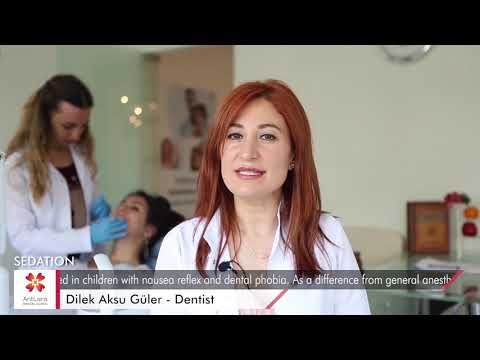
Dt. Dilek AKSU GÜLER
Dentist · Co-founder
Dt. Dilek AKSU GÜLER qualified from the Faculty of Dentistry at Süleyman Demirel University, Turkey, in 2005. She is the founding dentist of our clinic in Lara, Antalya. She works in aesthetic restorations (veneers and crowns), digital smile design and implant-supported prostheses, and speaks Turkish, English and German.
Sources
- Standards for Conscious Sedation in the Provision of Dental Care (V1.1). Intercollegiate Advisory Committee for Sedation in Dentistry, Dental Faculties of the Royal Colleges of Surgeons and the Royal College of Anaesthetists, 2020. 2020.↩saad.org.uk
- Guidelines for the Use of Sedation and General Anesthesia by Dentists (moderate sedation section). American Dental Association, adopted by the House of Delegates, October 2016. 2016.↩ada.org
- Dental tourism and the risk of barotrauma and barodontalgia (narrative review with guiding principles). British Dental Journal 2023;234(2):115-117. 2023.↩doi.org
- NHS: Dental abscess. NHS (nhs.uk). 2026.↩nhs.uk
- NHS: Heart attack symptoms. NHS (nhs.uk).↩nhs.uk
- Going abroad for medical treatment. NHS (England), accessed 21 September 2026.↩nhs.uk
- Going abroad for dental treatment (patient information). General Dental Council, accessed 18 September 2026. 2026.↩gdc-uk.org
- Türk Diş Hekimleri Birliği Kanunu, Law No. 3224 (consolidated text). Resmî Gazete 25/6/1985 No 18792; consolidated PDF, mevzuat.gov.tr. 1985.↩mevzuat.gov.tr
- Türk Dişhekimleri Birliği website: Find a Dentist. Türk Dişhekimleri Birliği (TDB).↩tdb.org.tr
- How to make a complaint or get a refund. General Dental Council, accessed 21 September 2026.↩gdc-uk.org
- Ağız ve Diş Sağlığı Hizmeti Sunulan Özel Sağlık Kuruluşları Hakkında Yönetmelik (consolidated text). T.C. Sağlık Bakanlığı; Resmî Gazete 6/10/2022 No 31975, amended RG 5/3/2024-32480 and 15/12/2024-32753. 2022.↩mevzuat.gov.tr
- Uluslararasi Saglik Turizmi ve Turistin Sagligi Hakkinda Yonetmelik. T.C. Saglik Bakanligi, Resmi Gazete 26/4/2025, No 32882. 2025.↩resmigazete.gov.tr
- Yetkili Saglik Tesisleri ve Araci Kuruluslar. T.C. Saglik Bakanligi, Saglik Turizmi Daire Baskanligi, list updated 20 August 2026. 2026.↩shgmturizmdb.saglik.gov.tr
- Hasta Hakları Yönetmeliği (consolidated text). T.C. Sağlık Bakanlığı; Resmî Gazete 1/8/1998 No 23420, amended RG 8/5/2014-28994, 23/12/2016-29927, 16/1/2019-30657. 1998.↩mevzuat.gov.tr
- Treatment abroad checklist. NHS (England), accessed 21 September 2026.↩nhs.uk
- Naar de tandarts in het buitenland? Wees op je hoede!. KNMT / Allesoverhetgebit.nl, 13 April 2026. 2026.↩allesoverhetgebit.nl