What are porcelain veneers?
A porcelain veneer, also called a laminate or ceramic veneer, is a thin layer of ceramic bonded to the tooth. It mainly covers the front of the tooth and, where needed, also extends over the biting edge and onto the sides. Veneers are used on front teeth to correct colour, shape or small gaps. Unlike a crown, which covers the whole tooth, a veneer needs much less tooth tissue removed.
In most cases a thin layer of enamel is removed from the front of the tooth, and the treatment cannot be reversed1. One of the factors that most affects the result is keeping the preparation within the enamel. That is why veneers suit teeth that have enough enamel and are largely well aligned; they are not for every tooth. For colour alone, whitening should be considered first; for crooked teeth, orthodontic treatment.
Treatment is provided by our clinic in Antalya, Turkey; when this page says "we", it means that clinic. This page covers the treatment, who it suits and its risks first. Later sections cover the "Turkey teeth" concern and treatment in Antalya when you live in the UK. The page ends with the questions the GDC and the NHS tell you to ask.
- A thin ceramic layer that mainly covers the front of the tooth. Much less tissue is removed than for a crown, but the treatment cannot be undone.
- Keeping the preparation within the enamel is one of the main factors in how well a veneer does.
- For colour, whitening should be considered first; for crowding, orthodontic treatment. On a healthy front tooth a crown removes far more tissue than a veneer, so ask which is planned for each tooth.
- Back in the UK, a chipped or loose veneer is usually seen first by a UK dentist. In England and Wales, the NHS free-repair provisions do not apply to work done by another provider.

Who porcelain veneers suit, and who they do not
Where they may be suitable
- Discolouration that whitening does not improve
- Small chips, wear and irregular shapes on front teeth
- Small gaps between teeth
- Teeth that have enough enamel and are largely well aligned
Where they are not suitable, or another treatment should come first
- Healthy, well-aligned teeth whose only problem is colour. Teeth whitening should be considered first; it removes no tooth tissue, although it can cause temporary sensitivity.
- Marked crowding or a bite problem. Cutting teeth back to line them up exposes the tissue beneath the enamel (dentine). Orthodontic treatment should be considered first.
- Too little enamel. On worn teeth, heavily restored teeth or teeth with thin enamel, the veneer is bonded to dentine and survival is lower2.
- Teeth that have lost much of their structure. There is not enough tooth left to support a veneer; a partial restoration or a crown may be needed.
- Untreated decay or gum disease. These are treated first. Australian government health information (healthdirect) notes that veneers may not be suitable if you grind or clench your teeth or have gum disease3.
- Young people who are still growing. The gum level can change over time and the nerve chamber of the tooth is large, so veneers are not recommended at this stage.
Where extra care is needed
- Clenching and grinding. How severe it is will be assessed; for some people veneers may not be suitable. A night guard may reduce the risk4, but it does not fully prevent a veneer from fracturing or coming off.
- Habits such as biting nails or pens. These can chip the edge of a veneer.
- Very dark teeth. Thin, translucent veneers may not mask the colour well enough; a more opaque, thicker veneer needs more tissue removed.
The right option is decided at an examination, with X-rays assessed where needed.
What could be done instead of veneers?
Veneers are not the only option, and often they should not be the first.
- Doing nothing. If your teeth are healthy and your concern is only how they look, leaving them alone is a valid choice.
- Teeth whitening. For colour, it can work without removing any tooth tissue. It acts on natural teeth only: whitening does not lighten crowns or veneers5, so natural teeth whitened later may no longer match them. Discuss whitening before the colour of the veneers is chosen.
- Shaping with composite (bonding). Tooth-coloured filling material is built up directly on the tooth; often little or no tooth tissue is removed. Composite is easier to fix if damaged, but not as stain- or wear-resistant1 as ceramic. In one long-term study, composite veneers needed repair or replacement more often than ceramic ones (see the studies below). Removing the composite later can still affect the enamel. More on our composite bonding page.
- Orthodontic treatment. It corrects alignment and gaps by moving the teeth rather than covering them. It takes longer, and the result then has to be held in place (retention).
- A crown. For teeth that have lost much of their structure. On a sound tooth it removes much more tissue than a veneer (see "Veneer or crown" below).
The table below sets veneers, bonding, crowns and whitening side by side; the dental veneers page compares them too. All of these options are also available from dentists in the UK, and a UK dentist can give you an independent opinion before you decide.
| Porcelain veneer | Composite bonding | Crown | Whitening | |
|---|---|---|---|---|
| Is tooth tissue removed? | Usually a thin layer of enamel | Usually not, or very little | Yes, from all surfaces of the tooth | No |
| Can it be reversed? | No | Not always fully; removing the composite can affect the enamel | No | No tissue is removed; the colour can darken again over time |
| What it corrects | Colour, shape, small gaps | Small chips, shape, small gaps | Extensive loss of tooth structure | Colour only |
| Number of appointments | Usually more than one | Often one | Usually more than one | Depends on the method |
| Colour change over time | The surface stains little; the edge can discolour | The surface stains more than ceramic | The surface stains little; the edge can discolour | The colour partly returns over time |
Which ceramic, and how does composite compare?
Veneers are made of feldspathic porcelain, built up by hand, or of reinforced glass ceramics such as lithium disilicate (often called e.max). A 2025 review that pooled 29 studies found no significant difference between these materials6 in how many veneers stayed in place at about ten years. For zirconia veneers, the same review found no long-term data.
A two-year trial in selected patients with gaps between several teeth compared composite veneers with pressed lithium disilicate veneers. It found no significant difference in survival7, and fractures were included in that comparison. The edges of composite veneers discoloured more often. In a ten-year study at one practice, composite veneers needed repair or replacement more often than ceramic ones8. That study was not randomised, so the difference cannot be put down to the material alone.

How porcelain veneers are made and fitted
Treatment is usually completed in two or three appointments. How much tissue is removed depends on the colour and position of the tooth and on the change you want. In some selected cases a veneer can be made without removing any tooth tissue. This does not suit everyone, and it does not mean the treatment can be reversed. You can say no, or ask to stop, at any stage. Once a tooth has been prepared, that step cannot be undone. How the appointments fit a stay in Antalya is covered in "Treatment in Antalya when you live in the UK".
Examination and planning
An examination, with X-rays where needed, assesses decay, the gums, how much enamel there is and your bite. Your medical history and medicines are reviewed too. Your expectations are discussed, and less invasive options are reviewed.
Trial (mock-up)
The planned shape can be tried on your teeth in a temporary material. You see the result before any tooth tissue is removed and can ask for changes.
Preparing the teeth
Under local anaesthetic, a thin layer is removed from the front of the tooth. The aim is to keep the preparation within the enamel. An impression or a digital scan is taken, and temporary veneers are fitted if needed.
Laboratory
The ceramic is built up in layers by hand, pressed, or shaped from a ceramic block by a computer-controlled machine. Its colour is matched to the neighbouring teeth.
Try-in and bonding
Shape, colour and bite are checked in the mouth. Once you agree, the veneer is bonded to the tooth with a special adhesive. Its colour cannot be changed after bonding. If you need a night guard, the impression for it is taken at this appointment.
Review
Your bite and the fit at the gum are checked again. You receive written care instructions. If you need a night guard, it is handed over.
Risks and benefits
Risks and disadvantages
- It cannot be undone. Enamel that has been removed does not grow back1; from then on, the tooth needs a veneer or another restoration.
- Fracture and coming off. In a review of 25 studies, these were the main reasons veneers failed9, mostly in the early years. Not every crack or small chip means the veneer has to be replaced.
- Effect on the tooth's nerve. The living tissue inside the tooth can be affected, and some teeth need root canal treatment later. The deeper the preparation, the higher this risk.
- Sensitivity. Teeth can become more sensitive because some enamel is removed3. Tell a dentist if it does not settle or keeps getting worse.
- New decay. A veneer does not protect the tooth from decay. New decay can start at its edges.
- Stained edges and receding gums. Over the years, the edge of the veneer can become visible.
- Colour match. The colour of a veneer cannot be changed3 after bonding. If the neighbouring natural teeth change colour over time, a difference can appear.
- Need for replacement. No veneer stays in place for ever; each replacement can take a little more tissue from the tooth.
Benefits
- Much less tooth tissue is removed than for a crown.
- Ceramic resists staining better than composite, which is not as stain- or wear-resistant1.
- When bonded to enamel, veneers do well in long-term studies (see "How long do porcelain veneers last?").
Veneer or crown: what "Turkey teeth" is about
In British media, "Turkey teeth" is a loose label for extensive cosmetic dental work, such as a full row of very white crowns or veneers. One concern raised with it is that healthy front teeth were cut down for full crowns when the patient expected veneers. The criticism is not of the ceramic. It is of a plan that gave healthy teeth more treatment than they needed, without the patient understanding which treatment it was.
What each one removes. A veneer differs from a crown because it covers the front surface of the tooth rather than the whole tooth1. For a porcelain veneer, usually only a thin layer of enamel is taken from the front. For a crown, the tooth is reduced on every surface, and this often goes through the enamel into the dentine beneath it. Neither can be undone: enamel that is removed does not grow back.
The nerve of the tooth. A review pooled 37 studies of teeth that were alive before they received crowns or other indirect restorations. In about 5 in every 100 of these teeth, the nerve lost its vitality10. In studies with more than ten years of follow-up, the figure was about 7 in 100. The review gives no separate figure for veneers, and the certainty of this evidence is low. If it happens, root canal treatment is needed to keep the tooth.
The enamel. In a study of 580 veneers followed for up to 12 years, 99 in 100 survived where the preparation stayed in enamel11. Veneers bonded to dentine were about 10 times as likely to fail11. The more a tooth is cut, the less enamel is left. The figures in this section come from published studies, not from the clinic's own results.
When a crown is the right choice. A crown protects a tooth that has lost much of its structure; a veneer is not enough there. On a healthy, straight front tooth, a crown for colour or a small fault in shape removes tissue for no clinical reason.
Who veneers are not for. Teeth with too little enamel, marked crowding, untreated decay or gum disease, or severe grinding may need another treatment first, or none. See "Who porcelain veneers suit".
The British Dental Association advises that patients should be aware of the risks and alternatives to the treatment they want12. Before any tooth is prepared, ask:
- Which teeth will have a veneer, which a crown, and which nothing?
- For each crown, why is a veneer, bonding or whitening not enough for that tooth?
- How much will be removed from each tooth, and can I have that in writing?
- Can I see the X-rays and photographs the decision is based on?
The answers should rest on the state of each tooth, not on a package or a material. A plan that gives every tooth the same treatment needs a reason, tooth by tooth. If you are unsure, show the written plan to your own dentist in the UK before you agree to it. If earlier work has already failed, see our page on replacing previous dental work.
Recovery and daily care
After the procedure, wait until the anaesthetic has worn off before eating or drinking. Mild sensitivity and tender gums are common in the first days.
Daily care
- Brush twice a day with a fluoride toothpaste, and clean between your teeth every day.
- Do not bite hard objects with your front teeth; avoid biting nails, pens and ice.
- If you clench or grind your teeth, wear your night guard every night.
- Keep up regular check-ups; small chips at the edge can be put right if they are found early. The Oral Health Foundation, a UK charity, notes that good daily cleaning and regular check-ups help veneers last longer13.
How long do porcelain veneers last?
Studies do not give a lifespan in years. They report how many veneers are still in place after a period of time. That does not mean that no problem or repair was needed during that time. The figures below come from published studies, not from the clinic's own results.
According to a review of 25 studies and 6,500 veneers, about 95 in every 100 are still in place after ten years9. A separate 2025 review that pooled 29 studies reported a similar result: about 94 to 97 in every 1006, depending on the material.
What affects the result?
Keeping the enamel. A retrospective study followed 672 veneers for up to 15 years, 6 years on average. Estimated survival was about 97 in 1002 where the preparation stayed in enamel only. Where a large area of the tissue beneath the enamel was exposed, it was about 94 in 100. Failures were more common where dentine was exposed.
Clenching and night guards. A retrospective study covered 70 patients. In the subgroup of 30 who clenched or ground their teeth, those who wore a night guard had fewer fractures4. The study was small and not randomised: a night guard may reduce the risk, but it does not remove it.
When to contact a dentist
Contact a dentist if any of the following happens:
- A veneer cracks, chips or feels rough at the edge
- A veneer comes off (keep it in a clean container, and do not glue it back yourself)
- Sensitivity that does not settle, or keeps getting worse
- Pain that starts on its own or wakes you at night
- Swelling, bleeding or discharge from the gum around a veneer
- Your bite feels high
Small chips may be repaired, but sometimes a new veneer is needed13. Avoid biting on the tooth until a dentist has seen it.
If you think you have a dental abscess, do not wait. An abscess does not go away on its own and needs urgent treatment by a dentist14. If pain is increasing, or you have facial swelling or a fever, see a dentist where you are the same day. Do not wait for the clinic's reply. In England, the NHS advises asking for an urgent dentist appointment or getting help from NHS 11114 if you think you have a dental abscess. If you do not have a dentist or cannot get an emergency appointment, it says to call 111 or use 111 online. Elsewhere in the UK, check the urgent dental care route where you live.
Emergencies. The NHS lists the following as needing urgent medical help14. Do not wait for a dental appointment or for the clinic's reply. In the UK, call 999 or go to A&E. In Turkey, the emergency number is 112.
- Difficulty breathing, speaking or swallowing
- A lot of swelling inside your mouth
- Swelling around your eye or in your neck15
- A swollen or painful eye, or sudden problems with your sight
- Difficulty opening your mouth
Before you fly home
Make sure your bite has been checked, and that you have written care instructions and a written record of your treatment. If you need a night guard, make sure it has been handed over.
Once you are back in the UK
If a problem comes up that is not urgent, write to the clinic and send photographs. For anything that needs someone to look in your mouth, a dentist in the UK, usually your own, is the first to see it. If you do not have a dentist, use NHS 111 as described above. In the emergencies above, do not wait for a reply.
Treatment in Antalya when you live in the UK
Appointments and days
Veneers usually need two or three appointments. The ceramic is usually made in a laboratory between preparing the teeth and bonding the veneers, and you may wear temporary veneers in between. The number of days in Antalya depends on how many teeth are treated. It also depends on whether other treatment is planned, such as whitening or treatment for decay or gum disease. If whitening is part of the plan, ask how it fits into the schedule.
Before you book, ask for a written preliminary plan based on the photographs and any X-rays you send. It should set out the appointments and how many days the treatment will take. It is not a diagnosis: the examination confirms or changes it, and with it the days and the cost. If it changes, ask for the revised plan in writing before any tooth is prepared.
Flying home
A 2023 review of flying after dental treatment suggests waiting at least 24 hours after restorative treatment16, and longer after surgical procedures. The authors note that the research is limited and comes mainly from military aviation. This assumes there is no pain, swelling or bleeding where you were treated. Treat it as a starting point for your dentist's advice, not as a rule.
Your own dentist and your records
The UK General Dental Council suggests talking to your own dentist17 before you go. They need to know the plan in case problems come up later. If you do not have a dentist in the UK, it helps to find one before you travel. The NHS lists exchanging medical records and arranging aftercare back home18 among the things to consider before treatment abroad.
Ask for a written record of the treatment to take back to your dentist. It should show which teeth have veneers, which have crowns, and the ceramic and shade used. In Turkey, the health tourism regulation entitles international patients to an itemised bill. On request, they also get free copies of the records of the materials used, the tests and the imaging19. Ask for these copies before you fly home.
Veneers need regular check-ups for as long as they are in the mouth. National guidance in England (NICE) says the interval between check-ups should be set for each person according to their risk20 and discussed with them.
What the NHS does and does not do
If you later need NHS dental care in England or Wales, having been treated abroad does not by itself shut you out of it. An NHS dental practice that accepts you for a course of treatment, not only an urgent appointment, provides clinically necessary treatment, with your consent21. That may not be a new porcelain veneer. The free repair or replacement21 an NHS practice can give for its own work does not apply to work done by another provider. It does not cover a veneer made abroad. The NHS also states that it is not liable for negligence or failure of treatment18 when you have treatment abroad.
The NHS guidance quoted here is for England, and for England and Wales where stated. Scotland and Northern Ireland have their own NHS rules, which this page does not cover. If you live there, ask your dentist how they apply to you.
If a veneer fails after you are home
A dentist in the UK, usually your own, is the first to see the problem. A new porcelain veneer usually needs a laboratory and more than one appointment, wherever it is made. Its colour also has to match the teeth beside it. Ask any dentist about the cost before they repair or replace a veneer. Ask before treatment whether the clinic's written terms cover a veneer that fails after you are back in the UK (see the questions below).
Travel insurance
The NHS says that most travel insurance policies will not cover you for planned treatment abroad, so you may need specialist cover18. Tell your insurer about your plans before you book.
What the GDC and the NHS tell you to ask
The General Dental Council lists questions to ask before treatment abroad17. Below are its questions, some of them combined, with what this page can answer today and what to ask for in writing.
- Who will carry out my treatment, and what are their qualifications? The treatment is provided by our clinic in Antalya, Turkey, and carried out there by the clinic's dentists. Ask for the name of the dentist who will prepare your teeth and fit the veneers. Ask where they qualified and what their title is.
- Are you regulated by a professional body and registered with it? The GDC notes that it cannot guarantee that other countries have an equivalent regulator17. In Turkey, a health facility needs an authorisation certificate19 from the Ministry of Health to treat international patients. Authorised facilities appear in a register the Ministry publishes22, so you can check it yourself. The authorisation belongs to the facility, not to the dentist, and it says nothing about the result of your treatment. Ask for the treating dentist's own registration details as well. See health tourism authorisation.
- Will a dentist assess me before I get a plan and a cost estimate? The GDC says you should always be assessed by a qualified dentist before a treatment plan and cost estimate17. A plan made from photographs is preliminary. The examination decides, tooth by tooth, between a veneer, a crown and no treatment. Ask for the final plan in writing before any tooth is prepared, with the reason for each crown. Ask too what you pay, and what is refunded, if veneers turn out not to suit you or you decide not to go ahead.
- Is the work guaranteed, are the terms in writing, and for how long do they apply? This page makes no guarantee. Ask for the clinic's written terms for remaking a veneer and for handling complications, and read them before you commit. Check what they say about a veneer that fails after you are back in the UK.
- If there are complications, or I am unhappy with the result, what happens and who pays for further treatment, extra flights and the hotel? Is further treatment included in the cost? Ask for the answers in writing before you commit. A remade veneer usually needs laboratory time, so it can mean another trip.
- What aftercare do you provide, and who can I contact after the treatment? Your written plan should name who to contact, how, and in which language. For a problem that is not urgent, you write to the clinic and send photographs.
- Will the dental team speak English, or will you provide a translator? Ask who will explain your plan and your consent form to you, and in which language.
- How many times have you done this, what are your success and complication rates, and can you give references? We publish no figures of our own yet, and this page carries no patient reviews. The figures on this page come from published studies, not from the clinic's own results. Ask for the clinic's figures in writing, and how they were collected.
- Do you have insurance to cover this treatment? In Turkey a facility treating international patients must take out complication insurance for surgical and interventional procedures carried out in an operating theatre19. That does not by itself tell you whether your treatment is covered, so ask which procedures in your plan, if any, fall under it. Ask too, in writing, whether the clinic or the treating dentist holds insurance for complications or errors, what it covers and whom it protects.
- Do you have a complaints system, and can I see a copy? Ask for it before treatment. The GDC says it cannot resolve complaints or help with refunds23; its investigations concern the dentists on its own register. Turkey's health tourism regulation makes the facility responsible for complications and medical malpractice arising after the health service it provided19.
The NHS names warning signs to think about before booking any treatment abroad. They are a hard sell, a lack of information, pressure to make a quick decision, no discussion of possible complications, and no mention of aftercare24. Apply them to this clinic too.
What determines the cost?
This page does not show prices. A treatment plan is prepared for you after an examination. The main factors that shape it are:
- How many teeth will have veneers, and whether any need a crown or nothing at all
- The ceramic chosen and the laboratory work
- Other treatment: whitening, treatment for decay or gum disease, and orthodontic treatment if needed
- The trial (mock-up), temporary veneers and a night guard, if needed
- The number of trips the appointments need
Ask for the plan in writing, including what it covers and which items would be charged separately. Ask whether the examination and any X-rays are included. Ask too who pays for further treatment and extra travel if there is a complication.
If you are comparing with a quote from a UK practice, compare what each one includes, tooth by tooth: veneer or crown, and which material.
Are porcelain veneers the right option for you?
Send photographs of your teeth. One of our dentists will reply with a preliminary view on whether veneers, a less invasive option such as whitening or bonding, or no treatment may suit you. It is not a diagnosis: the plan is confirmed or changed at an examination in person.
Frequently Asked Questions
Are my teeth filed down for veneers?
In most cases a thin layer of enamel is removed from the front of the tooth. The tooth is not reduced on every side as it is for a crown. In some selected cases veneers can be made without removing tooth tissue, but this does not suit everyone. Enamel that is removed does not grow back, so the treatment cannot be undone.
Can veneers be removed later?
Not in the sense of going back to your natural teeth. A veneer is bonded to the tooth and is not designed to be taken off. The enamel prepared beneath it does not grow back, so the tooth needs a covering from then on.
I asked for veneers. Why was I offered crowns?
A veneer needs a tooth with enough sound structure and enamel. If a tooth has lost much of its structure, a crown may be proposed. On a healthy front tooth a crown removes far more tissue than a veneer. Ask for the reason for each tooth, in writing, before any tooth is prepared.
Porcelain veneers or zirconia?
"Veneer" and "crown" describe how much of the tooth is covered; porcelain and zirconia are materials. When patients say "zirconia", they usually mean zirconia crowns, which cover the whole tooth and are for teeth that have lost much of their structure. Crowning a sound front tooth means removing much more tissue than for a veneer. Zirconia veneers also exist, but their long-term clinical data are limited.
What is the difference between composite bonding and veneers?
With bonding, tooth-coloured filling material is built up directly on the tooth. It is often finished in one appointment, and little or no tooth tissue is removed. A porcelain veneer is usually made in a laboratory and bonded to the tooth. A clinical trial in selected patients with several gaps compared composite and ceramic veneers. It found no significant difference in survival, and fractures were included in that comparison. Composite edges discoloured more often. The trial was short, so it does not show that composite lasts as long as ceramic.
My teeth are crooked. Can I have veneers?
With slight irregularities it may be possible. With marked crowding, more tissue has to be removed to line the teeth up, and that affects the result; orthodontic treatment should be considered first.
Can veneers close the gaps between my teeth?
Small gaps can be closed with veneers or bonding. With wide gaps the teeth would become disproportionately wide, so orthodontic treatment or a combined plan is more suitable.
Do veneers cause bad breath?
The ceramic itself does not cause an odour. An odour usually comes from plaque building up at the edge of the veneer, gum inflammation or a poorly fitting edge. If you notice one, see your dentist.
How many days do I need to be in Antalya?
Veneers usually take two or three appointments, with laboratory time between preparing the teeth and bonding the veneers. The number of days depends on how many teeth are treated and whether other treatment, such as whitening, is planned. Ask for a written preliminary plan with the appointments and the number of days before you book. It is based on your description, photographs and any X-rays you send, and the examination confirms or changes it.
Will I need check-ups, and will they be in Turkey or in the UK?
Yes. Veneers need regular check-ups for as long as they are in the mouth. These are usually with a dentist where you live, at an interval set for your risk. Tell them about the treatment and bring the written record. For a problem with a veneer that is not urgent, write to the clinic with photographs; for urgent symptoms, get local care first.
What if a veneer comes off after I am back in the UK?
Keep it, do not glue it back yourself, and see a dentist; in the UK that is usually your own dentist. Write to the clinic and send photographs. Ask before treatment what the clinic's written terms say about this. In England and Wales, the NHS free-repair provisions do not apply to work done by another provider.
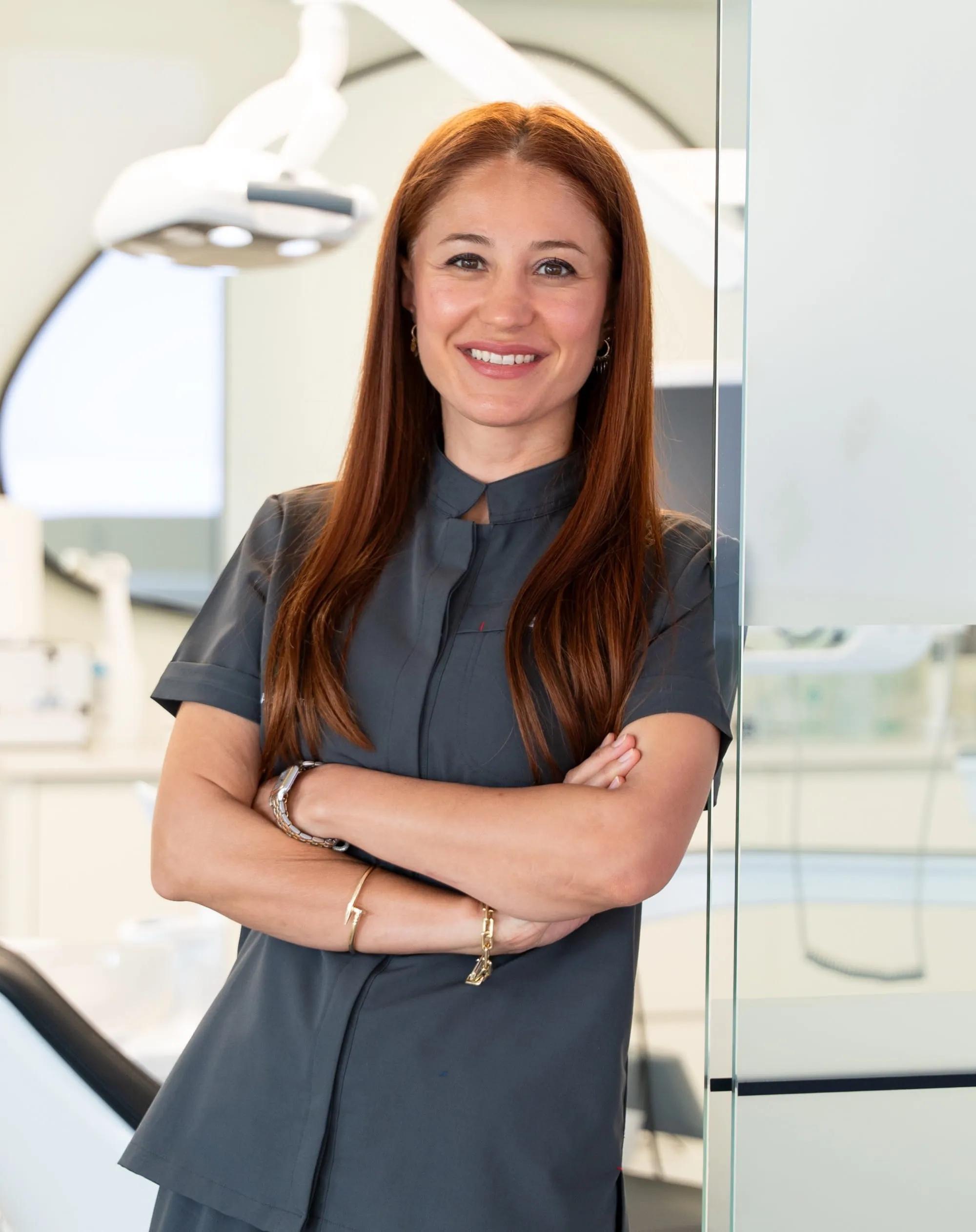
Dt. Dilek AKSU GÜLER
Dentist · Co-founder
Dt. Dilek AKSU GÜLER qualified from the Faculty of Dentistry at Süleyman Demirel University, Turkey, in 2005. She is the founding dentist of our clinic in Lara, Antalya. She works in aesthetic restorations (veneers and crowns), digital smile design and implant-supported prostheses, and speaks Turkish, English and German.
Sources
- Veneers. American Dental Association, MouthHealthy.↩mouthhealthy.org
- Ceramic veneers and dentin exposure: 672 veneers in 189 patients, 1-15 years (mean 6 years). Journal of Esthetic and Restorative Dentistry 2025. 2025.↩pmc.ncbi.nlm.nih.gov
- Veneers. healthdirect Australia (government-funded health information), last reviewed February 2025. 2025.↩healthdirect.gov.au
- Porcelain veneers in patients with bruxism: 323 veneers in 70 patients, 3-11 years. Medicina Oral Patologia Oral y Cirugia Bucal 2014. 2014.↩pmc.ncbi.nlm.nih.gov
- Teeth Whitening (patient information). American Dental Association, MouthHealthy.↩mouthhealthy.org
- Survival and complication rates of ceramic laminate veneers by material: systematic review and meta-analysis (29 studies). Journal of Esthetic and Restorative Dentistry 2025;37(3):601-619. 2025.↩doi.org
- Direct composite versus pressed lithium disilicate veneers for multiple diastema closure: double-blind randomised controlled trial, 2 years. Materials 2024;17(14):3514. 2024.↩pmc.ncbi.nlm.nih.gov
- 10-year practice-based evaluation of ceramic and direct composite veneers. Dent Mater 2022;38(5):898-906. 2022.↩doi.org
- Survival and failure causes of ceramic laminate veneers: systematic review (25 studies, 6,500 veneers, 3-21 years). Journal of Clinical Medicine 2021;10(5):1074. 2021.↩pmc.ncbi.nlm.nih.gov
- Incidence of pulp necrosis and periapical pathosis after indirect restorations: systematic review and meta-analysis (37 studies, 11,615 teeth). BMC Oral Health 2023. 2023.↩pmc.ncbi.nlm.nih.gov
- Porcelain laminate veneers, 580 veneers up to 12 years: effect of preparation in enamel versus dentin. International Journal of Periodontics & Restorative Dentistry 2013;33(1):31-39. 2013.↩doi.org
- Dental tourism: Patients need to know the risks. British Dental Association, accessed 21 September 2026.↩bda.org
- Veneers (patient information). Oral Health Foundation (UK charity); published January 2017, updated April 2026. 2026.↩dentalhealth.org
- NHS: Dental abscess. NHS (nhs.uk). 2026.↩nhs.uk
- NHS: Toothache. NHS (nhs.uk). 2024.↩nhs.uk
- Dental tourism and the risk of barotrauma and barodontalgia (narrative review with guiding principles). British Dental Journal 2023;234(2):115-117. 2023.↩doi.org
- Going abroad for dental treatment (patient information). General Dental Council, accessed 18 September 2026. 2026.↩gdc-uk.org
- Going abroad for medical treatment. NHS (England), accessed 21 September 2026.↩nhs.uk
- Uluslararasi Saglik Turizmi ve Turistin Sagligi Hakkinda Yonetmelik. T.C. Saglik Bakanligi, Resmi Gazete 26/4/2025, No 32882. 2025.↩resmigazete.gov.tr
- Dental checks: intervals between oral health reviews (clinical guideline CG19). National Institute for Health and Care Excellence, published 27 October 2004. 2004.↩nice.org.uk
- What can I provide a patient on the NHS who has just recently returned after having dental treatment abroad? (Knowledge Base article KA-02010). NHS Business Services Authority, accessed 18 September 2026. 2026.↩faq.nhsbsa.nhs.uk
- Yetkili Saglik Tesisleri ve Araci Kuruluslar. T.C. Saglik Bakanligi, Saglik Turizmi Daire Baskanligi, list updated 20 August 2026. 2026.↩shgmturizmdb.saglik.gov.tr
- How to make a complaint or get a refund. General Dental Council, accessed 21 September 2026.↩gdc-uk.org
- Treatment abroad checklist. NHS (England), accessed 21 September 2026.↩nhs.uk