
Replacing crowns, veneers or implants: where to start
Crowns, veneers, bridges and implant crowns do not last for ever, and some cause problems early. When one hurts, comes loose, breaks or looks wrong, the first step is not a new one. It is finding out why. The cause may lie in the work itself, in the tooth or gum underneath, in the root canal or in the bite.
Once the cause is known, there are several routes. Sometimes the work can be left as it is and checked again later. It can sometimes be adjusted or repaired, or it can be replaced. The problem underneath may need treating first. Where a tooth cannot be kept, it may be replaced with an implant, a bridge or a denture. Replacing work usually removes more tooth each time, and every route has drawbacks as well as benefits.
On this page, "we" means our clinic in Antalya. The page applies wherever your earlier treatment was done. It does not judge the dentist or clinic that did that work. Dental work wears, gums change and decay can start at an edge, even when the work was done well.
- Find the cause before choosing the fix. Pain, looseness or a poor look can come from decay, the gum, the nerve or the bite.
- Adjusting, repairing, replacing, treating the problem underneath and replacing the tooth are all possible routes. Sometimes no treatment is needed.
- Replacing a crown or veneer usually removes more tooth, and tooth that has been removed does not grow back.
- Ask for a written plan, tooth by tooth. It should say what may change once the old work is off, and who pays if something goes wrong.
- Start with the dentist or clinic that did the work, and ask for copies of your records and X-rays. You can also ask another dentist for an opinion.
Why existing dental work may need assessment
Most crowns and veneers work well for years, but none lasts for ever without problems. A 2026 review looked at single crowns on natural teeth made of one-piece lithium disilicate, zirconia (one-piece or layered with porcelain) or metal-ceramic. After five years, about 97 to 99 in every 100 were still in place1. Staying in place is not the same as having no problems.
Common reasons for a fresh look:
- New decay at the edge. A crown or veneer does not protect the tooth from decay, which can start at or under the edge. In a review of bridges on natural teeth, decay and the death of the nerve in the supporting teeth were the main problems2.
- The nerve of the tooth. This is the pulp, the soft tissue inside the tooth. In some teeth that were alive before a crown, a partial crown or a bridge was fitted, the nerve dies later. A review of 37 studies of these restorations put this at about 5 in every 100 teeth3. In studies with more than ten years of follow-up, it was about 7 in 100. The certainty of this evidence is low: better studies could change these figures. If the nerve dies, the tooth may need root canal treatment, sometimes years after the crown.
- The gums. Gum disease or receding gum can expose the edge of a crown, or leave a gap where food collects.
- Breaking and coming loose. For ceramic veneers, breaking and coming loose were the main reasons for failure in a review of 25 studies. They happened mostly in the early years4.
- Around implants. A review of 57 studies looked at inflammation with bone loss around an implant (peri-implantitis). It found this in about 20 of every 100 patients and 12 of every 100 implants5. The rates vary widely with how each study defined the disease.
- Appearance and comfort. A colour, shape or size you are unhappy with, a bite that feels wrong, or teeth that were reduced more than you expected.
None of these reasons on its own says who is at fault. A new plan starts from what is in your mouth now.
The figures on this page come from published studies, not from our own records. They are averages for groups of people, not a forecast for one tooth.
Symptoms and findings that need investigating
See a dentist if you notice any of the signs below. They apply to crowns, veneers, bridges and implants.
- Pain when you bite, or a feeling that the crown or veneer is too high
- Pain with hot food or drink that lasts after the heat has gone, or sensitivity that keeps getting worse
- A crack, a chip or movement in a crown, veneer or bridge
- A crown or veneer that has come off: keep it, and do not glue it back yourself
- Bleeding, swelling, a dark line or receding gum at the edge
- Food trapping, a bad taste or bad breath from one area
- Around an implant: bleeding or pus when you brush, a crown that moves or clicks, or gum that has shrunk back
Some problems cause no symptoms and are found at a check-up or on an X-ray. Examples are decay under the edge of a crown, bone loss around an implant or an infection at the tip of a root. A finding on an X-ray is a reason to investigate. It is not always a reason to replace the work.
Urgent: a dental abscess. An abscess needs urgent treatment by a dentist and will not go away on its own6. Antibiotics do not replace this treatment. If you think you have one, see a dentist without delay.
Emergencies. The signs below need urgent medical help6. Do not wait for a dental appointment; go to a hospital emergency department or call 112.
- It is hard to breathe, speak or swallow
- Your eye is swollen or painful, or you have sudden problems with your sight
- There is a lot of swelling in your mouth
- It is hard to open your mouth
Records and imaging
Before anything is removed, the dentist needs to know what is there and how it was done. Bring what you have:
- Earlier X-rays and 3D scans, with their dates
- The treatment notes or plan from the clinic that did the work
- Which teeth have crowns, veneers, posts or root canal fillings, and the materials used
- For implants: the system, the size and the parts used, and any implant card or record you were given
- The X-ray taken when an implant crown was fitted, if you have it
Start with the dentist who did the work
It is worth going back first to the dentist or clinic that did the work, especially if it is recent. Describe the problem to them in writing. They know what was done and they hold your records. They may also have their own terms for redoing work, such as what is covered and for how long. Whatever you decide, ask for copies of your X-rays and treatment notes. Turkey's patient rights regulation lets you examine your file and get a copy of it7.
If you want to complain about the work, the complaint goes first to the clinic that did it. If it is not resolved there, you can apply to the provincial health directorate's Patient Rights Board7, which does not assess allegations of medical error. The dental chamber can also open disciplinary proceedings8 against a dentist.
Which X-rays, and why
A UK guideline on dental X-rays says they should be chosen for each person after a history and a clinical examination9. They should not be taken routinely for everyone. Small X-rays of single teeth can show the root canal, the bone level and decay at some crown edges. They do not show everything under a crown (see "What can only be seen later" below). The same guideline shows that a 3D scan (cone beam CT) usually gives a higher radiation dose than small X-rays9. European guidelines say a 3D scan should be used only when lower-dose X-rays cannot answer the question10. Planning an implant is one use where it can be justified11.
Why implant records matter
There are many implant systems, and the parts made for one do not necessarily fit another. A 2017 international consensus report on diseases around implants recommends recording an X-ray and gum measurements once the implant crown is completed12. Without that starting point, bone change around an implant is harder to judge.
What can only be seen later
Some things cannot be judged until the old crown or veneer is off: decay underneath, a crack, or how much sound tooth remains. A good plan says so in advance and explains what would change.
Repair or replace?
Replacing work is not automatically better than repairing it. The decision depends on the cause of the problem and how much sound tooth remains. The gums, the bite and what you want from the result matter too.
- Leave it and monitor. A small stain at an edge, a minor chip with no sharp edge or a slight colour difference may not need treatment. It is checked again at the next visit.
- Adjust or repair. A high spot can be adjusted. A small chip can sometimes be polished or repaired with composite (tooth-coloured filling material). A crown that has come off can be cemented back if the crown and the tooth are both sound and it still fits. A loose implant screw can often be tightened or replaced.
- Treat the problem underneath first. Decay, gum disease or an infected root canal is treated before any new crown or veneer is made. A new crown or veneer does not treat the disease beneath it.
- Replace the crown, veneer or bridge. This is considered for decay under the edge, an edge that does not fit, a fracture, or an appearance that cannot be corrected another way.
- Replace the tooth. A crack that runs down the root, or too little tooth left, can mean that a tooth cannot be kept; the examination decides. A tooth that cannot be kept may be removed, and an implant, a bridge or a denture can then replace it.
How strong is the evidence for repairing rather than replacing? A review of studies comparing the repair of defective fillings with their replacement found no clear difference in failure13. It rested on three studies, and the certainty of the evidence was very low. We have found no comparable evidence for crowns or veneers. Whether an old filling should be repaired or replaced is covered on our dental fillings page.
Keeping your own tooth is worth weighing seriously. A review of 143 studies looked at teeth that had root canal treatment and at single crowns on implants. Their long-term survival rates were similar14. Direct comparisons between the two were very rare.
| What is checked first | Options that may follow | |
|---|---|---|
| Crown or veneer has come off | Why it came off; whether the tooth and the crown or veneer are sound and still fit | Cementing it back; a new crown or veneer; treating decay first |
| Chipped porcelain | The size and position of the chip; the bite; grinding | Polishing or a composite repair; a new crown or veneer if the chip is large |
| Pain or sensitivity under a crown | The nerve of the tooth, decay at the edge, a high bite, a crack | Adjusting the bite; root canal treatment, sometimes through the existing crown; a new crown after treatment |
| Dark line or bleeding at the edge | Gum health, decay, the fit of the edge | Gum treatment first; a new crown or veneer if the edge is open or decayed |
| Teeth look too large, white or uneven | The gum line, the bite, how much tooth remains under the work | Reshaping, for size or shape; new crowns or veneers after a trial of the new shape; sometimes no change |
| Implant crown loose or moving | The screw, the connecting part and the crown; the bone and gum around the implant | Tightening or replacing the screw; a new crown; treating inflammation |
| Bleeding or pus around an implant | Gum measurements and an X-ray, compared with earlier records | Cleaning and treating the inflammation; surgery in some cases; removing the implant if it cannot be kept |
Crowns, bridges and veneers
Crowns
A crown covers the whole visible part of the tooth, so the tooth under it has already been reduced on every surface. Shaping a tooth in this way is called preparing it. In a study on plastic model back teeth, a full crown preparation removed about two-thirds to three-quarters of the tooth above the gum, by weight15. These are laboratory values and give only a sense of scale. An old crown often has to be cut off, and it cannot then be reused. The tooth is cleaned and shaped again, which usually removes more tooth. How much depends on any decay or damage found. Each replacement leaves less tooth to hold the next one. If the nerve has died, the tooth may need root canal treatment first. If little tooth is left, the missing part may be built up with filling material; under a crown, this build-up is called a core. In a root-treated tooth with too little tissue left to hold the core, a post may be placed in the root canal. More on our dental crowns page.
Bridges
A bridge is one piece that fills a gap and is fixed to one or more teeth or implants beside it. If one supporting tooth develops decay or a fracture, the bridge often has to come off to treat it. The plan then covers that tooth, any other support and the gap together. The answer may be a new bridge, or an implant or another way of filling the gap. The types of bridge are explained on our dental bridges page.
Veneers
Veneers are bonded to the front of the tooth, usually after a thin layer of enamel is removed. That enamel does not grow back16; from then on, the tooth needs a veneer or another restoration. Old veneers are usually removed by grinding them away, and some enamel may go with them. How much enamel remains matters for a new veneer. Under the enamel is a softer layer, the dentine. In a study of 580 veneers followed for up to 12 years, 99 in every 100 survived where the preparation stayed in enamel17. In the same study, veneers bonded to dentine were about 10 times as likely to fail17. Where little enamel is left, other options such as composite or crowns are discussed, each with its own trade-offs. The difference between veneers and crowns is explained on our veneers and crowns page.
Teeth that were reduced more than you expected
If your teeth were cut down further than you expected, the tissue that was removed cannot be replaced. A new plan cannot return the teeth to how they were. It aims to protect what remains and to keep the nerves healthy where possible. Within what the remaining teeth allow, it also aims for crowns or veneers that fit well and come close to the look you want. Ask for the state of each tooth in writing before anything more is removed.
Implant restorations
An implant restoration has several parts: the implant in the bone, a connecting part (the abutment), a screw, and the crown or bridge on top. A problem in one part does not always mean replacing the others.
- A loose or moving crown. Screw loosening is a common technical problem. A review of 46 studies of single implant crowns estimated screw loosening in 8.8 per cent over five years18. Its published summary does not say whether this is counted per implant or per crown. A loose screw can often be tightened or replaced. Have any movement checked soon: the dentist checks whether the crown, its screw or the implant itself is loose.
- Screw-retained or cemented. A crown held by a screw can be taken off through a small access hole. A cemented crown may have to be cut off. A review of 59 studies found that screw-retained restorations are easier to take off, so complications can be treated more easily19. Screw-retained restorations had more technical problems, and cemented ones more serious biological complications, such as implant loss or bone loss of more than 2 mm19. Neither method was clearly better overall, although the authors judged screw-retained restorations to seem preferable, partly because they are easier to take off.
- Inflammation around the implant. Bleeding or pus around an implant is treated before a new crown is made. Sometimes the crown has to come off first so that the area can be reached. If bone loss has got worse since earlier X-rays, its cause is treated first too. Treatment may need surgery. If the inflammation cannot be controlled, the implant may be lost, and a new implant cannot always be placed in the same spot.
- Parts and records. Ask which implant system is in your mouth, and whether original parts from that system can still be obtained. If the system is unknown, finding matching parts may be difficult.
Implants need regular care for as long as they are in place. A European clinical guideline calls for a supportive care programme, with periodic checks of the tissue around the implants20, once they are in use. A history of periodontitis, the advanced form of gum disease, matters too. In a review of 14 studies, people treated for it lost implants at about 1.75 times the rate of those without that history21. More on our dental implant treatment page.
Material and appearance
The material for a new crown or veneer is chosen tooth by tooth. It depends on the tooth's position, your bite, the opposing teeth, any grinding habit and how you want it to look. For single crowns on natural teeth, the differences in five-year survival between one-piece lithium disilicate, zirconia and metal-ceramic crowns are small1. A different material is therefore not, on its own, a reason to replace work that is sound.
Points to settle before anything is removed:
- Colour. Whitening does not work on crowns or veneers22, so the colour of new ceramic cannot be lightened later. If your other teeth are to be whitened, that is done first.
- Shape and size. Very white, large or uniform teeth are a choice, not a standard. Ask whether a trial of the new shape (a mock-up) can be shown in your mouth before any tooth is prepared.
- The gum line. Healthy, stable gums come first. Inflamed or receding gum changes how the edges look and fit. If your gums bleed, have them checked by a dentist before any new work. More on our gum disease page.
- Grinding. Veneers may not be suitable if you grind or clench your teeth23, so this is checked before new veneers are chosen. A night guard may be advised to protect new work.
- What cannot change. A replacement cannot add back tooth that has been removed. A single new front crown cannot always match its neighbours exactly.
The order of treatment: what comes first
Replacing earlier work follows an order. Each step can change the next. A plan that goes straight to new crowns or veneers should explain why the earlier steps are not needed. Gum disease is treated before new work, in steps. A European guideline on treating periodontitis describes cleaning above and then below the gum line, then surgery where needed for areas that do not respond24. It sets supportive care afterwards at intervals of 3 to 12 months according to each person's risk24. If the plan changes along the way, ask to be told straight away and to get the updated plan in writing.
Records and examination
Your medical history, medicines, earlier records and X-rays are reviewed. The teeth, gums, bite and any implants are examined, and X-rays are taken where they are justified.
A decision for each tooth
For each tooth or implant, the dentist explains what was found, what is proposed and why. The options are to leave it and monitor it, repair it, replace it, treat the problem underneath first, or remove the tooth or the implant.
A written plan
The plan is given in writing before treatment starts. It sets out the options, what each involves, what could change once old work is removed, and the cost.
Disease first
Decay is removed, gum disease is treated and root canal problems are dealt with. Sometimes old work has to come off first to reach the problem. The gums are re-assessed before new crowns or veneers are made.
Removal and temporaries
Old crowns, veneers or bridges are removed. Temporary crowns or veneers protect the teeth and let you try the shape and the bite. If removal reveals something new, the plan is updated in writing before treatment continues.
New crowns or veneers
The new work is made and fitted, the bite is adjusted, and the fit at the gum is checked.
Review and maintenance
Regular check-ups follow, at an interval your dentist sets for your risk.
Risks of removal and retreatment
Risks
- More tooth is lost. Removing an old crown or veneer and preparing the tooth again takes away more tissue, and it does not grow back.
- The nerve. Preparing a tooth can affect its nerve. The figure of about 5 in every 100 teeth whose nerve died3 comes from teeth that were alive at the start. The review gives no separate figure for teeth prepared a second time, so it cannot say whether the risk is higher. If the nerve dies, the tooth may need root canal treatment.
- Root canal retreatment. A tooth with root canal treatment under a crown can become infected again. The crown, and sometimes a post, may then have to come out to reach the canal. Removing a post carries a risk of damaging the root.
- Damage during removal. Cutting off a crown or grinding away a veneer can chip the tooth or the core beneath. A tooth may turn out to be beyond repair once the old work is off.
- The gums. New edges, temporary crowns and repeated treatment can irritate the gum. Damage from periodontitis cannot be reversed, but the disease can be stabilised25. It is treated before new work.
- Implants. Removing an implant crown, treating inflammation and removing an implant are separate procedures, each with its own risks.
- Time and visits. Replacing work can take several appointments, with temporary crowns or veneers in between.
- The result. New work can solve the problem it is aimed at. It cannot be promised to meet every expectation. It needs ongoing care, and it may in time need repair or replacement.
Benefits
- Treating the cause, such as decay under an edge or inflammation around an implant, can protect the tooth or the implant.
- Crowns and veneers that fit well are easier to keep clean.
- New work can correct a colour, shape or bite you are unhappy with, within what the remaining teeth allow.
After the new work is fitted
If you had a local anaesthetic, take care not to bite your cheek or lip until the numbness wears off. In the first days, the tooth may be sensitive to hot and cold. Tell your dentist if this lasts or gets worse, or if your bite feels high; the bite can be adjusted.
Temporary crowns or veneers
Temporaries protect the teeth between appointments. Avoid biting hard or sticky food with them. Slide dental floss out sideways rather than pulling it back through the gap between the teeth. Ask how long your temporaries are meant to last. If one comes off, contact your dentist without delay.
Daily care
- Brush twice a day with a fluoride toothpaste. Take care along the line where a crown, veneer or implant meets the gum.
- Clean between the teeth every day. Under a bridge, use bridge floss or an interdental brush; around implants, clean as your dentist shows you.
- If you clench or grind and a night guard was made for you, wear it.
- Do not bite hard objects such as ice, pens or your nails.
Check-ups, and if a problem appears later
Keep to the check-up interval your dentist sets for your risk; implants need their own supportive care (see "Implant restorations" above). If a crown, veneer or bridge comes off, keep it and do not glue it back yourself. Contact the dentist who did the work. If you cannot reach them quickly, see another dentist rather than wait. The signs that need emergency help are listed under "Symptoms and findings that need investigating" above.
Second opinions and informed consent
A plan to replace several crowns or veneers is a big decision, and it is reasonable to have it checked. You can take a written plan, with your X-rays, to another dentist and ask whether they agree, tooth by tooth. Turkey's patient rights regulation gives you the right to ask for another doctor's opinion7.
Informed consent means that, before you agree, you know:
- What is wrong, and what is proposed for each tooth
- The other options, including doing nothing, with their benefits and risks
- What could go wrong, and what happens if it does
- Who will carry out the treatment, where, and over how long
- The cost, and what is and is not included
Apart from the cost, these points match what the regulation says you must be told before treatment. That includes who will carry it out, where and how, its estimated duration, the other options with their benefits and risks, and the possible complications7. Private dental clinics must obtain a consent form for every intervention26. The form is signed in two copies, and one copy is for you7; ask for yours.
You can take time to decide. You can say no, or ask to stop, at any stage. The regulation gives you the right to refuse treatment or ask for it to be stopped7; the possible consequences are explained to you. Once a tooth has been prepared, that step cannot be undone.
Who carries out the treatment?
In Turkey, a dentist does not have to be a specialist to replace crowns, bridges or veneers. Turkish law authorises every dentist27 to diagnose and treat the teeth, the gums and the tissues of the mouth and jaw. It ties the specialist title to a specialist certificate27, issued and registered by the Ministry of Health28. Prosthetic dentistry (prosthodontics) is one of the nine dental specialties set by law27.
At our clinic, our dentists assess earlier work and, where needed, remove and replace it. You have the right to be told, on request, who is treating you, and their role and title7. Ask who will examine you, who will remove the old work and who will fit the new work.
Your plan and records in writing
Ask for your plan in writing before treatment starts. It should answer these questions:
- For each tooth or implant, what was found, and what is proposed: keep, repair, replace, treat first or remove?
- What could change once the old work is off, and what would happen then?
- Which materials are planned, and why?
- How many appointments are needed, and will you have temporary crowns or veneers in between?
- What does the plan include, and what does it leave out?
- If new work fails or has to be redone, which terms apply: what is included, for how long, and what is not?
A view based on photographs or X-rays you send is preliminary, not a treatment plan. The plan is made after the examination. If it changes before or during treatment, ask for the new plan in writing before treatment continues.
Private dental clinics record the diagnosis, the treatment and any X-rays in detail, with tooth numbers26. At the end of treatment, ask for a record that shows:
- which teeth or implants were treated, and what was done to each
- the materials and, for crowns and veneers, the shade
- any root canal treatment, posts or cores
- for implants: the system, the size and the parts used
- anything that still needs to be done, and by when
Ask for copies of the X-rays as well. A dentist who treats you later can then see what was done.
Ask too for your aftercare instructions in writing. They should say how to care for the new work and any temporaries, which problems to report, and when your check-ups are.
What determines the cost?
This page carries no prices. A treatment plan is prepared for you after an examination. The main factors that shape it are:
- How many teeth or implants are involved, and what each one needs
- Whether old work can be adjusted or repaired, or has to be removed and replaced
- Treatment needed first: decay, gum disease, root canal treatment, a post or a core
- The materials chosen, and the laboratory work
- Temporary crowns or veneers, a trial of the new shape and a night guard
- For implants: the implant system and the parts needed
Some findings appear only once the old work is off, so ask how the plan and the cost would change if that happens. Ask for your plan in writing, including what it covers and how redoing work would be handled.
Frequently Asked Questions
I am unhappy with my crowns or veneers. Can they be redone?
Often, yes, but the first step is an assessment, not a new set. Replacing veneers or crowns usually removes more tooth, so the plan should explain why each tooth needs what is proposed. The dentist needs to find out what is wrong, what is under the old work and how much sound tooth remains. Sometimes an adjustment or a repair is enough. Sometimes the gum or a root canal needs treating first.
Can teeth reduced more than I expected go back to how they were?
Tooth that has been removed does not grow back, so the teeth cannot return to how they were. A new plan aims to protect what remains and to keep the nerves healthy where possible. Within what the teeth allow, it also aims for crowns or veneers that fit well and come close to the look you want. Ask for the state of each tooth in writing before anything more is removed.
Will I need root canal treatment if my crowns are replaced?
Not necessarily, but it can happen. Preparing a tooth can affect its nerve, and sometimes decay or infection is found once the old crown is off. If the nerve dies or is inflamed beyond recovery, the tooth may need root canal treatment to keep it. Ask before treatment which teeth are at higher risk and what the plan would be if it happens.
How do I know whether I need a repair or a new crown?
It depends on the cause. A small chip or a high spot can often be polished, repaired or adjusted. Decay under the edge or an edge that does not fit is a reason to consider a new crown, once the problem underneath is treated. A crack needs examining: one that runs down the root can mean the tooth cannot be kept. An examination, and X-rays where they are justified, decide it.
Can a loose implant crown be fixed without removing the implant?
Often, yes. Have it checked soon: the dentist checks whether the crown, the screw or the implant itself is loose. A loose crown is commonly a loose screw, which can be tightened or replaced. A cemented crown may have to be cut off and remade. If there is inflammation or bone loss around the implant, that is treated first. Knowing the implant system helps the dentist find matching parts.
Should I go back to the dentist who did the original work?
It is worth asking them first, in writing, especially if the work is recent. They may have terms for redoing it, and they hold your records. You can also ask another dentist for an independent opinion. Whatever you decide, ask for copies of your X-rays and treatment notes.
Can I ask another dentist for a second opinion?
Yes. A plan to replace several crowns or veneers is a big decision, and it is reasonable to have it checked. Take the written plan and your X-rays to another dentist and ask whether they agree, tooth by tooth. Turkey's patient rights regulation gives you the right to ask for another doctor's opinion.
Can anyone tell you in advance how long new work will last?
Not for certain. Studies give figures for groups of people, not a forecast for your tooth, and no dentist can promise a result. New work needs ongoing care, and it may in time need repair or replacement. Ask any clinic for its terms in writing for complications and for redoing work. Check what is included, for how long, what is not, and what you need to do for the terms to apply.
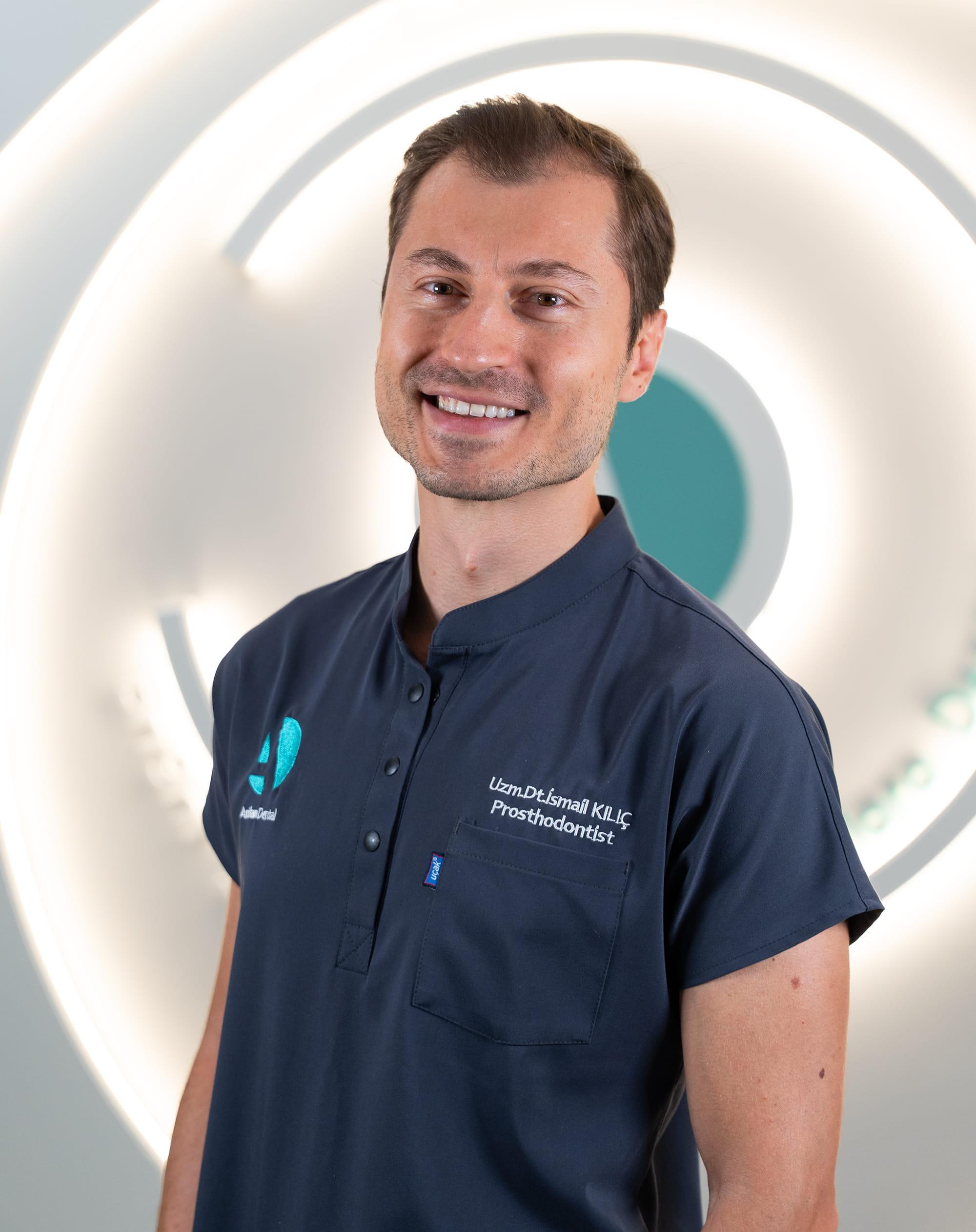
Uzm. Dt. İsmail KILIÇ
Prosthodontics Specialist
Uzm. Dt. İsmail KILIÇ is a prosthodontics specialist who graduated from Hacettepe University in 2014. Since 2024 he has worked at Antlara Dental in aesthetic dentistry, digital smile design and dental implantology.
Sources
- Survival of monolithic lithium disilicate, monolithic zirconia and metal-ceramic single crowns: systematic review. International Journal of Prosthodontics 2026;39(3):308-324. 2026.↩doi.org
- Comparison of survival and complication rates of tooth-supported FDPs and implant-supported FDPs and single crowns. Clin Oral Implants Res 2007;18 Suppl 3:97-113. 2007.↩doi.org
- Incidence of pulp necrosis and periapical pathosis after indirect restorations: systematic review and meta-analysis (37 studies, 11,615 teeth). BMC Oral Health 2023. 2023.↩pmc.ncbi.nlm.nih.gov
- Survival and failure causes of ceramic laminate veneers: systematic review (25 studies, 6,500 veneers, 3-21 years). Journal of Clinical Medicine 2021;10(5):1074. 2021.↩pmc.ncbi.nlm.nih.gov
- What is the prevalence of peri-implantitis? A systematic review and meta-analysis (57 articles, 2005-2021). BMC Oral Health 2022;22(1):449. 2022.↩doi.org
- NHS: Dental abscess. NHS (nhs.uk). 2026.↩nhs.uk
- Hasta Hakları Yönetmeliği (consolidated text). T.C. Sağlık Bakanlığı; Resmî Gazete 1/8/1998 No 23420, amended RG 8/5/2014-28994, 23/12/2016-29927, 16/1/2019-30657. 1998.↩mevzuat.gov.tr
- Türk Diş Hekimleri Birliği Kanunu, Law No. 3224 (consolidated text). Resmî Gazete 25/6/1985 No 18792; consolidated PDF, mevzuat.gov.tr. 1985.↩mevzuat.gov.tr
- Selection Criteria for Dental Radiography, 3rd edition. Faculty of General Dental Practice (UK), now College of General Dentistry, updated 2018, eds Horner K, Eaton KA. 2018.↩cgdent.uk
- Radiation Protection No 172. Cone beam CT for dental and maxillofacial radiology: evidence-based guidelines. European Commission, Directorate-General for Energy (SEDENTEXCT project, Euratom FP7), Luxembourg 2012. 2012.↩op.europa.eu
- Cone beam computed tomography in implant dentistry: recommendations for clinical use. BMC Oral Health 2018;18(1):88 (Jacobs R, Salmon B, Codari M, Hassan B, Bornstein MM). 2018.↩doi.org
- Peri-implant diseases and conditions: consensus report of workgroup 4 of the 2017 World Workshop on the Classification of Periodontal and Peri-Implant Diseases and Conditions. Journal of Clinical Periodontology 2018;45 Suppl 20:S286-S291. 2018.↩doi.org
- Risk of failure of repaired versus replaced defective direct restorations in permanent teeth: a systematic review and meta-analysis. Clin Oral Investig 2022;26(7):4917-4927. 2022.↩doi.org
- Outcomes of root canal treatment and restoration, implant-supported single crowns, fixed partial dentures, and extraction without replacement: a systematic review. Journal of Prosthetic Dentistry 2007;98(4):285-311 (Torabinejad M et al.). 2007.↩doi.org
- Tooth structure removal associated with various preparation designs for posterior teeth. Int J Periodontics Restorative Dent 2002;22(3):241-9. 2002.↩pubmed.ncbi.nlm.nih.gov
- Veneers. American Dental Association, MouthHealthy.↩mouthhealthy.org
- Porcelain laminate veneers, 580 veneers up to 12 years: effect of preparation in enamel versus dentin. International Journal of Periodontics & Restorative Dentistry 2013;33(1):31-39. 2013.↩doi.org
- Systematic review of the survival rate and the incidence of biological, technical and aesthetic complications of single crowns on implants (46 studies, mean follow-up 5 years). Clinical Oral Implants Research 2012;23 Suppl 6:2-21. 2012.↩doi.org
- Cemented and screw-retained implant reconstructions: a systematic review of the survival and complication rates (59 studies). Clinical Oral Implants Research 2012;23 Suppl 6:163-201. 2012.↩doi.org
- Prevention and treatment of peri-implant diseases: the EFP S3 level clinical practice guideline. Journal of Clinical Periodontology 2023;50 Suppl 26:4-76. 2023.↩doi.org
- Effectiveness of implant therapy in patients with and without a history of periodontitis: systematic review with meta-analysis of prospective cohort studies (14 studies, >=36 months). Journal of Periodontal Research 2025;60(6):524-543. 2025.↩doi.org
- Teeth Whitening (patient information). American Dental Association, MouthHealthy.↩mouthhealthy.org
- Veneers. healthdirect Australia (government-funded health information), last reviewed February 2025. 2025.↩healthdirect.gov.au
- Treatment of stage I-III periodontitis - the EFP S3 level clinical practice guideline. Journal of Clinical Periodontology 2020;47 Suppl 22:4-60 (erratum 2021;48:163). 2020.↩doi.org
- Prevention and Treatment of Periodontal Diseases in Primary Care, 2nd edition. Scottish Dental Clinical Effectiveness Programme (SDCEP), February 2024. 2024.↩periodontalcare.sdcep.org.uk
- Ağız ve Diş Sağlığı Hizmeti Sunulan Özel Sağlık Kuruluşları Hakkında Yönetmelik (consolidated text). T.C. Sağlık Bakanlığı; Resmî Gazete 6/10/2022 No 31975, amended RG 5/3/2024-32480 and 15/12/2024-32753. 2022.↩mevzuat.gov.tr
- 1219 sayılı Tababet ve Şuabatı San'atlarının Tarzı İcrasına Dair Kanun (consolidated text). T.B.M.M.; RG 14/4/1928 No 863; consolidated on mevzuat.gov.tr. 1928.↩mevzuat.gov.tr
- Tıpta ve Diş Hekimliğinde Uzmanlık Eğitimi Yönetmeliği. T.C. Sağlık Bakanlığı; RG 3/9/2022 No 31942, amended RG 7/10/2023-32332 and 16/5/2024-32548. 2022.↩mevzuat.gov.tr