
What are bone grafting and a sinus lift, and why are they proposed?
A bone graft builds up jaw bone where there is too little to hold an implant. A sinus lift raises the sinus floor in the back of the upper jaw to gain bone beneath it. Neither replaces a missing tooth; both are extra surgical steps that make an implant possible. Your dentist decides, after an examination and a 3D scan, whether you need a graft or a sinus lift.
The aim is to make an implant possible, or to place it in the planned position. Not every patient needs a graft. If there is enough bone, the implant is placed directly. If there is too little, the options are a graft, a sinus lift, a short implant or a different implant design. This page covers why a graft is proposed, what studies report, how much longer treatment takes, and the options without a graft.
- A graft or a sinus lift is an extra surgical step that makes an implant possible. Not every patient needs one.
- Implant loss after a sinus floor augmentation has been reported as low in studies: 0.43 per cent per implant per year.
- A tear in the sinus membrane during surgery is common; when it was repaired, implant survival was similar.
- Complications are common with vertical bone augmentation; in a resorbed lower jaw, short implants have been reported as a better option.
- No single grafting technique or material has been shown to be superior for every patient and every outcome.
Who it suits, and who it does not
When a graft comes into consideration
- The height or width of bone where the implant is planned is not enough
- In the back of the upper jaw the sinus sits low and there is no bone left for the length of the implant
- The socket is to be preserved in the same session as an extraction
- The ridge of the jaw has thinned where a tooth has been missing for a long time
- Gum disease has left a limited defect in the bone; not every defect can be grafted
When another step comes first
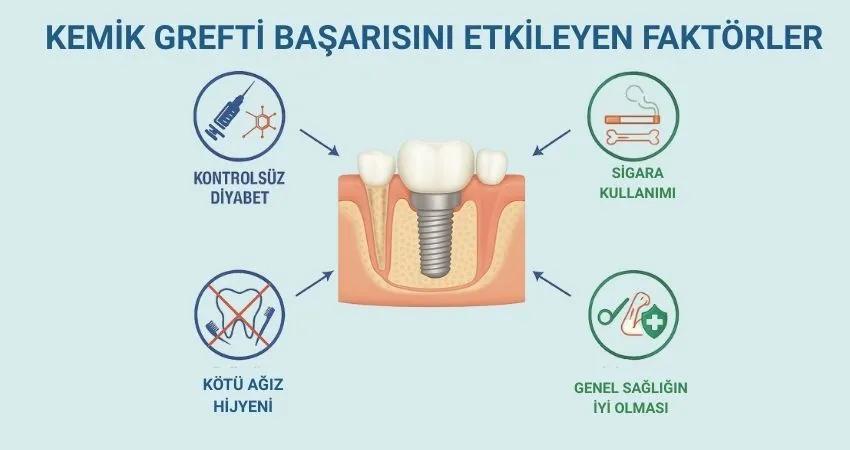
- Active infection and untreated gum disease. These are treated first.
- Uncontrolled medical conditions. If blood sugar is unstable or there is an undiagnosed problem, surgery is postponed.
- A jaw that is still growing. In young patients, implants and any graft for them are postponed until growth is complete.
What is associated with higher risk
The figures below come from studies of implant loss. We have no figure that measures graft success directly, and we say so plainly.
- Smoking. In people smoking more than 20 cigarettes a day, implant loss was about 2.5 times as likely per implant1 as in non-smokers. Per patient it was about 4 times as likely. Smoking also impairs wound healing. No safe number of cigarettes has been shown.
- Bone-strengthening medicines. In a 21-study review, implant loss in people taking bisphosphonates was about 1.7 times more likely per implant2. Jaw osteonecrosis was about 3.5 times more likely per patient. The per-patient analysis of implant loss found no significant difference. The same review could not make a reliable risk estimate for denosumab, so we give no figure for it. The certainty of the evidence is very low. For people taking high-dose bisphosphonates or denosumab as part of cancer treatment, surgery is usually not appropriate. Whether the medicine is given by drip, by injection or by mouth does not on its own decide the risk. The decision is made with your oncology team.
- Diabetes. The findings are mixed. Two of three reviews found no significant difference in implant loss (2021 review3; 2016 review4), and one found a higher rate5. The 2021 review, in type 2 diabetes, ties its result to strictly maintained oral hygiene. All three found more bone loss around implants in people with diabetes.
- A history of gum disease. Across 14 prospective studies the rate of implant loss was about 1.75 times higher6 (a hazard ratio). Surgery is not done while the disease is active.
- Radiotherapy to the head and neck. Wound healing is impaired in irradiated bone, and there is a risk of bone death. The area and dose of the radiotherapy are established, and planning is done with your oncology team.
What can be considered instead
- Short implants. A Cochrane review found that in a resorbed lower jaw, short implants appear to be a better option7 than a vertical bone graft. Case selection, bone quality and chewing forces are assessed.
- Tilted implants. In a jaw with no teeth, placing the back implants at an angle may reduce the need for a graft in some patients. The details are on the All-on-6 page.
- Zygomatic implants. When very little bone is left in the upper jaw, implants anchored in the cheekbone come into consideration. This is larger surgery with its own risks; it is explained at the consultation.
- A removable denture. If surgery is not wanted or not suitable, a denture is an option.
Suitability is decided by an examination, a 3D scan and your medical history. A plan given from photographs is not final; it is a preliminary assessment.
Can it be done without a graft?
Sometimes. If there is enough bone, no graft is needed; and if there is not, a graft is not the only route. The options are considered in order: doing nothing extra, a design that needs less surgery, then a graft.
A sinus lift without graft material has also been reported. A review of 16 articles looked at implant survival over 48 to 60 months of follow-up. It was 96 per cent without graft material8 and 99.6 per cent with a biomaterial. The summary we could access reports no direct statistical comparison of these two rates. So the difference cannot be counted as a proven advantage, and nor can the opposite.
No single technique or material has been shown to be superior for every patient and every outcome. A Cochrane review states that the most effective technique remains unclear7. The same review reports differences in single comparisons, such as bone gain and patient preference. A review of sinus floor augmentation found no significant difference9 in implant loss between your own bone and bone substitutes. Finding no difference in implant loss does not mean the materials are equivalent in every respect. If a material is presented to you as "the best", ask for the reasoning on your own scan.
Where the graft material comes from is also part of your decision. It can be taken from your own bone or prepared from a human donor or an animal source (bovine or porcine). It can also be fully synthetic. Covering membranes can also be of animal origin. For some patients this is decisive, for religious or personal reasons. Before you consent, you are told which graft and which membrane will be used and where they come from. You are also told the alternatives, and whether they need to be removed later.
| Bone graft / sinus lift | Short implant | Zygomatic implant | Removable denture | |
|---|---|---|---|---|
| Extra surgical stage | Yes; often a separate operation | Can remove the need for a vertical graft; if the bone is too narrow, an extra procedure may be needed | Yes; larger surgery | No |
| Waiting | Time for new bone to form in the grafted area | No graft waiting if no extra graft is needed | Temporary teeth may be fitted soon after surgery if the implants are stable enough; otherwise later | None |
| When it is considered | Bone height or width is not enough | In the back of a resorbed lower jaw | Very little bone left in the upper jaw | Surgery is not wanted or not suitable |
| Evidence | Reviews with long follow-up | Randomised trials comparing it with vertical grafting | Few randomised trials; low certainty | Long history of use |
| Known problems | Sinus membrane tear, sinusitis, infection, graft not taking | Case selection and chewing forces are decisive | Sinusitis and technical difficulty | Bone loss continues; grip is limited |
How the treatment runs
This is the usual sequence. Which method is chosen depends on the scan and the shape of the defect. The number of visits, the gaps between them and the waiting periods are given in your written plan; they vary from patient to patient.9
Examination, 3D scan and medical history
A 3D scan measures the height and width of the remaining bone and the position of the sinus. In the lower jaw it also shows the nerve canal. We ask about smoking, diabetes, gum-disease history, medicines and radiotherapy. If a sinus lift is being considered, we also ask about sinusitis, a blocked nose, previous sinus surgery and conditions that stop the sinus draining. If symptoms or the scan call for it, an ear, nose and throat assessment is requested. An active sinus infection is treated before the procedure. The plan is given in writing, with the reasoning and the alternatives.
Preparation
Active infection and gum disease are treated first. Blood sugar control and your medicines are reviewed. If you want sedation, whether it suits you is assessed first from your medical history and medicines. With a serious general illness your own doctor is consulted; with sleep apnoea or a high body weight the breathing risk is assessed separately. The escort and fasting rules are explained in advance.
Surgery
It is done under local anaesthetic, with conscious sedation if you want it and it suits you. The suitable method is chosen from socket preservation, widening the ridge, vertical augmentation or raising the sinus floor. The sinus floor can be raised through a window opened at the side or through the implant site. The graft material is placed and, if needed, covered with a membrane.
Healing and bone formation
Stitches are removed in the first weeks. Bone formation takes months; the time depends on the size of the defect, the method chosen and how you heal. During this period you avoid chewing on the area, and a check X-ray is taken.
Placing the implant
In some cases the implant is placed in the same session as the graft, in others after the bone has formed. A review of sinus floor augmentation found no statistically significant difference in implant loss between same-session and later placement. That does not show the two routes are equivalent for every patient. The plan is made before surgery. It is confirmed during surgery, from how firmly the implant holds in the remaining bone at placement and from the shape of the bone defect.
Crown or bridge stage
Once the implant is confirmed to have fused with the bone, impressions are taken and the crown or bridge is made. The bite is adjusted, and the cleaning method is taught hands-on.
Review programme
When the crown or bridge is completed, probing measurements around the implant and an X-ray are recorded as a baseline. Your review interval is set by your risk and given in writing.
Risks and benefits
Risks
- A tear in the sinus membrane. The membrane often tears during a sinus lift. A review of 10 studies looked at sinus lifts through a side window with graft material. The average tear rate was 29.42 per cent10. The earlier studies it cites report 16 to 56 per cent. A tear is usually repaired in the same session. Depending on its size and how reliable the repair is, the procedure may be stopped and planned again once the membrane has healed. Implant survival was 97.1 per cent after a repaired tear and 97.7 per cent with no tear. The difference was not significant. Some of its studies describe problems after surgery, such as sinusitis. The review does not compare them between torn and intact membranes. So it does not show that a tear has no drawbacks.
- Complications with vertical augmentation. A Cochrane review of 13 randomised trials states that complications are common, especially with vertical augmentation. Compared with short implants, the odds ratio for complications was 4.977. In the same review the difference in implant loss was not significant.
- Infection and the graft not taking. Infection can develop at the graft site, stitches can open and a membrane can become exposed. If that happens, part or all of the graft may be lost and the procedure may need to be repeated.
- Graft particles coming out. In the first weeks, small hard particles may come out through the gum. A bad smell, discharge or increasing pain may be a sign of infection.
- The donor site. If a block of your own bone is taken, a second surgical site is opened. It too brings pain, swelling and a scar.
- The sinus area in the upper jaw. Sinusitis, a nosebleed or an opening between the mouth and the sinus can develop. We have no sourced figure for how often these happen, and we say so plainly.
- The nerve in the lower jaw. Because the nerve canal is close in the back of the jaw, the lip and chin may feel numb for a while and, rarely, permanently.
- Medication-related death of jaw bone (osteonecrosis). In patients taking bisphosphonates, the risk of jaw osteonecrosis after surgery was found to be higher. The review cited on this page gives no reliable estimate for denosumab. If you take either medicine, always tell us your full medication history.
Benefits
- The aim is to increase bone volume so an implant may be placed in the planned position and at the planned length.
- Implant loss after sinus floor augmentation has been reported as low. In 11 prospective studies with at least five years of follow-up, annual loss was 0.43 per cent per implant9. In these studies the remaining bone height was 6 millimetres or less, and the side-window technique was used.
- The same review found no significant difference between your own bone and bone substitutes. Nor did it find a difference between placing the implant in the same session or later. Finding no difference does not show that the methods are equivalent for every patient; the findings are limited to the group of patients described above.
- Preserving the socket at the time of an extraction can help keep the later surgery smaller.
These rates are outcomes observed in studies, not promises. They are averages of studies from different countries and different groups of patients. What happens in your case depends on your bone, your habits and your care.
After surgery and daily care
The first days
- Swelling and bruising increase over the first two to three days, then settle. Use cold packs and the medicines prescribed.
- Choose soft, lukewarm food, and avoid chewing on the graft site.
- If the sinus area was treated, do not blow your nose or drink through a straw, and if you sneeze, keep your mouth open. These rules reduce pressure changes on the sinus membrane.
- Keep brushing; clean the graft site gently, the way your dentist shows you.
- Smoking impairs healing. At the least, do not smoke during the healing period.
- If you had sedation, do not drive or operate machinery for as long as the sedation team tells you. For adults, every form of sedation other than inhaled sedation requires a responsible adult to take you home11. If an escort cannot be arranged, treatment under sedation is not carried out. The discharge rules for your method are explained in advance. The details are on the conscious sedation page.
Later reviews
Follow-up after an implant is different from a general dental check-up. The 2017 consensus report recommends that an X-ray and probing measurements be taken as a baseline12 when the crown or bridge is completed. Later changes are judged more reliably against that record. The NICE guideline on dental recall recommends that the review interval be set for each patient13, with three months as the shortest interval. That guideline is not specific to implants; a ready-made interval is not enough for a patient with implants.
How much longer does it make treatment?
A graft does not lengthen treatment by the same amount for every patient. There are two main routes. Small grafts done in the same session as the implant often add no separate waiting period; treatment moves on with the implant's own healing time. In a staged graft, the graft comes first and the bone is left to form; the implant is placed later. This route adds a separate waiting period. For sinus floor augmentation, no significant difference9 in implant loss was found between these two routes. That does not show the two routes are equivalent for every patient. How much longer it takes depends on the size of the defect, the method chosen and how you heal. The time expected for you is given in your written plan.
There are studies comparing early and later fitting of the teeth on implants. A Cochrane review of 26 randomised trials found no evidence of a difference14 in implant loss between immediate and conventional loading. Follow-up ranged from 4 months to 1 year, and most of the trials were at high or unclear risk of bias. This finding does not show that a whole treatment with a graft can be fitted into a few days. We have found no study comparing the whole grafting process compressed into a short period with treatment spread over months. The difference is judged by practical questions. How is healing checked? Who do you contact if there is a problem? Which aftercare is included in the plan?
Before treatment we give you, in writing, the route to follow if there is a complication and our remake terms. You can ask us for that document before you decide.
When to contact a dentist
After surgery, contact your dentist if any of the following happens.
- Pain or swelling that increases after the third day, or bleeding that does not stop
- A high temperature, feeling unwell, or a bad smell and pus from the area
- Stitches opening, or the graft or membrane becoming visible through the gum
- Hard particles coming out continuously and in large amounts
- Discharge from the nose, a blocked nose or sinus pain on the treated side
- Liquid coming out of your nose when you drink, or air passing between your mouth and nose
- Numbness of the lip or chin that lasts beyond the expected duration of the anaesthetic
Emergencies. Difficulty breathing or swallowing, rapidly spreading swelling of the face or neck, or swelling around the eye with a high fever are serious signs. If you have any of them, do not wait for the clinic's reply. Go to the nearest emergency department or call 112.
What determines the cost?
This page does not quote fees. The main factors in a plan are these:
- The size and position of the defect
- The method chosen
- The type and amount of graft material
- Whether a membrane is used
- Whether a block of your own bone is taken
- Sedation
- The number of visits and the review programme
The plan also states what will be done if the graft does not take. Ask in writing what your plan includes, and who pays for further treatment if there is a complication.
Is your bone enough for an implant?
Send a panoramic X-ray or scan if you have one. Our dentists will write back on whether a graft is needed, which method is likely and how many visits are needed. The final plan is confirmed by an examination and a 3D scan.
Frequently Asked Questions
Why do I need a sinus lift or a bone graft?
Because the bone the implant would hold on to has been found to be insufficient. The sinus may sit low in the back of the upper jaw, or the ridge may have thinned where a tooth has long been missing. The implant then cannot be placed at the planned length and in the planned position. Your dentist decides, after an examination and a 3D scan, whether you need a graft. If there is enough bone, no graft is done.
Is a bone graft always needed for an implant?
No. If there is enough bone, the implant is placed directly. If there is too little, a graft is still not the only route. Options include short implants in a resorbed lower jaw and a fixed bridge on tilted implants in a jaw with no teeth. For advanced bone loss in the upper jaw, zygomatic implants are an option. A Cochrane review reports short implants as a better option than a vertical bone graft in a resorbed lower jaw.7
Can the graft and the implant be done in the same session?
In some cases, yes. A review of sinus floor augmentation found no significant difference in implant loss between placing the implant in the same session and placing it later. That does not mean the two routes are equivalent for every patient. The plan is made before surgery. It is confirmed during surgery, from how firmly the implant holds in the remaining bone and from the shape of the defect. Nobody is promised a single session.9
What happens if the sinus membrane tears?
A tear is common during surgery and is usually repaired in the same session. Depending on its size, the procedure may be stopped and planned again once the membrane has healed. In a 10-study review of sinus lifts through a side window with graft material, the average tear rate was 29.42 per cent. Implant survival was 97.1 per cent after a repaired tear and 97.7 per cent with no tear. The difference was not significant. Some of its studies describe problems after surgery, such as sinusitis. The review does not compare them between torn and intact membranes. So it does not show that a tear has no drawbacks.10
Which graft material is best?
No single material has been shown to be superior in every situation. A Cochrane review states that the most effective technique remains unclear. A review of sinus floor augmentation found no significant difference in implant loss between your own bone and bone substitutes. The material can come from your own bone, a human donor or an animal source (bovine or porcine), or be synthetic. Membranes can also be of animal origin. The choice depends on the shape of the defect, the volume needed and your preference. The origin of the material and the reasoning are explained to you before you consent.79
Can a sinus lift be done without graft material?
It can. A review of 16 articles looked at implant survival over 48 to 60 months of follow-up. It was 96 per cent without graft material and 99.6 per cent with a biomaterial. The summary we could access reports no direct statistical comparison of these two rates. So we do not present the difference as a proven advantage.8
What if the graft does not take?
Part or all of the graft may be lost. The cause is then investigated. Once the area has healed, the procedure can be repeated, or the plan changed to an option that needs less bone. Ask in writing, before treatment, which steps would be taken in that case and how the cost would be covered.
Is a bone graft painful?
The procedure is done under local anaesthetic, with conscious sedation added if you want it and it suits you. Afterwards, pain, swelling and tightness are expected in the first days and are managed with medicines. Pain that increases after the third day is not the expected course; if that happens, contact your dentist.
Dt. Dilek AKSU GÜLER
Dentist · Founder
She has completed advanced training in implantology and works in aesthetic restorations and smile design.
Sources
- Levels of smoking and dental implants failure: systematic review and meta-analysis (23 articles). Journal of Clinical Periodontology 2020;47(4):518-528. 2020.↩doi.org
- Effects of bisphosphonates and denosumab on dental implants: systematic review with meta-analysis (21 studies, ROBINS-I, GRADE). Oral Diseases 2025;31(10):2835-2847. 2025.↩doi.org
- Impact of hyperglycemia on the rate of implant failure and peri-implant parameters in patients with type 2 diabetes mellitus: systematic review and meta-analysis (9 studies). Journal of the American Dental Association 2021;152(3):189-201. 2021.↩doi.org
- The impact of diabetes on dental implant failure: a systematic review and meta-analysis. International Journal of Oral and Maxillofacial Surgery 2016;45(10):1237-1245. 2016.↩doi.org
- Diabetes mellitus and dental implants: systematic review and meta-analysis (89 publications; 5,510 implants in diabetic and 62,780 in non-diabetic patients). Materials 2022;15(9):3227. 2022.↩doi.org
- Effectiveness of implant therapy in patients with and without a history of periodontitis: systematic review with meta-analysis of prospective cohort studies (14 studies, >=36 months). Journal of Periodontal Research 2025;60(6):524-543. 2025.↩doi.org
- Interventions for replacing missing teeth: horizontal and vertical bone augmentation techniques for dental implant treatment (Cochrane review, 13 RCTs). Cochrane Database of Systematic Reviews 2009;(4):CD003607. 2009.↩doi.org
- Maxillary sinus lift surgery - with or without graft material? A systematic review (16 articles). International Journal of Oral and Maxillofacial Surgery 2016;45(12):1570-1576. 2016.↩doi.org
- Long-term effectiveness of maxillary sinus floor augmentation: systematic review and meta-analysis (11 prospective studies, follow-up at least 5 years). Journal of Clinical Periodontology 2019;46 Suppl 21:307-318. 2019.↩doi.org
- Influence of Schneiderian membrane perforation on implant survival rate: systematic review and meta-analysis (10 studies, 7 in the meta-analysis). Journal of Clinical Medicine 2024;13(13):3751. 2024.↩doi.org
- Standards for Conscious Sedation in the Provision of Dental Care (V1.1). Intercollegiate Advisory Committee for Sedation in Dentistry, Dental Faculties of the Royal Colleges of Surgeons and the Royal College of Anaesthetists, 2020. 2020.↩saad.org.uk
- Peri-implant diseases and conditions: consensus report of workgroup 4 of the 2017 World Workshop on the Classification of Periodontal and Peri-Implant Diseases and Conditions. Journal of Clinical Periodontology 2018;45 Suppl 20:S286-S291. 2018.↩doi.org
- Dental checks: intervals between oral health reviews (clinical guideline CG19). National Institute for Health and Care Excellence, published 27 October 2004. 2004.↩nice.org.uk
- Interventions for replacing missing teeth: different times for loading dental implants (Cochrane review, 26 RCTs, 1,217 participants, 2,120 implants). Cochrane Database of Systematic Reviews 2013;(3):CD003878. 2013.↩doi.org