
How is the shade of a crown or veneer chosen?
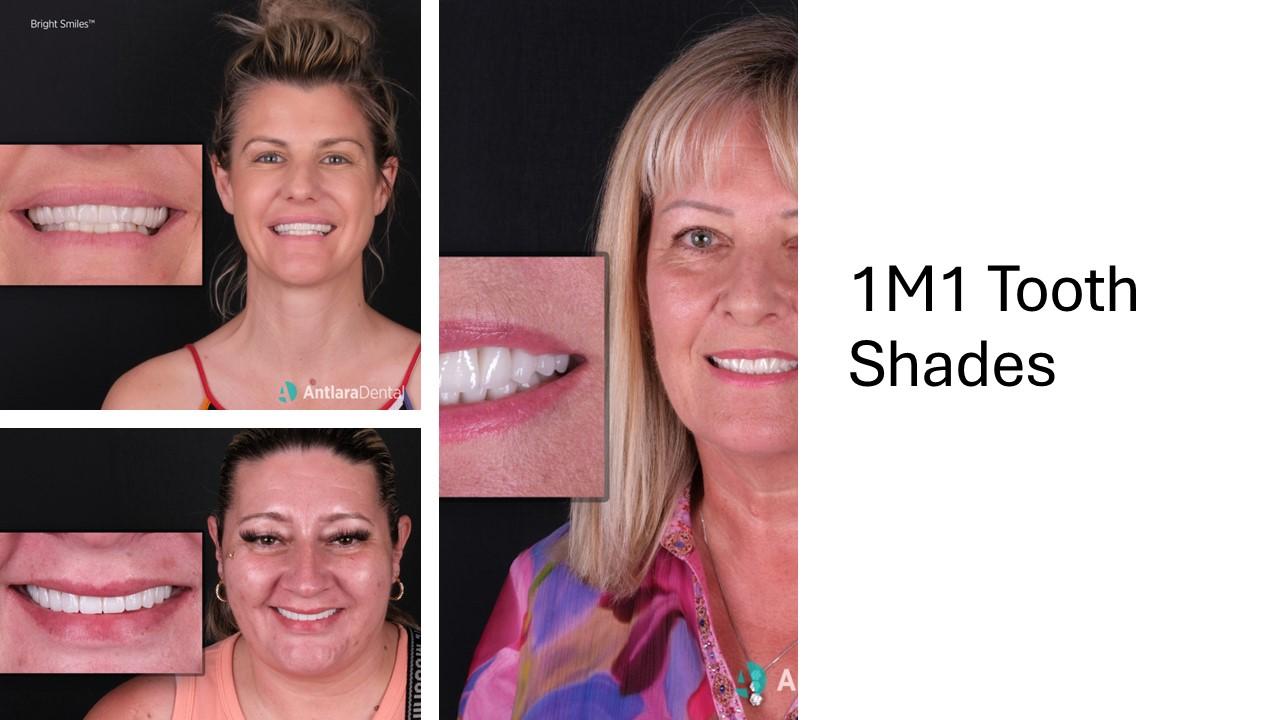
Most often the dentist holds tabs from a shade guide next to your teeth and picks the closest one. The tab's code, such as A1, B1 or 1M1, is recorded and sent to the laboratory with photos and notes. Photos and measuring devices can make the match more objective; intraoral scanners are not recommended for choosing shade. The light in the room and the person matching also affect the result.
Whitening does not lighten crowns, veneers or fillings the way it lightens natural teeth. If you are thinking about whitening, say so before the shade is chosen: a restoration made to match your teeth today will not lighten with them later.
- A shade code is the name of a tab in a particular shade guide; no code is right for everyone.
- Photos and measuring devices usually bring the match closer than the eye alone; intraoral scanners are not recommended for choosing shade.
- Whitening does not lighten crowns, veneers or fillings, so mention any plan to whiten before the shade is chosen.
What shade guides and codes are
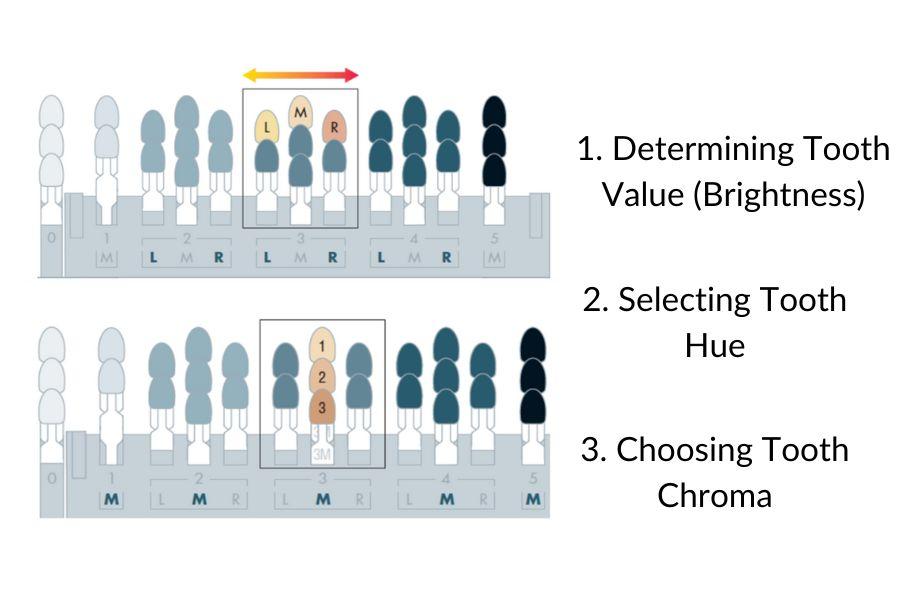
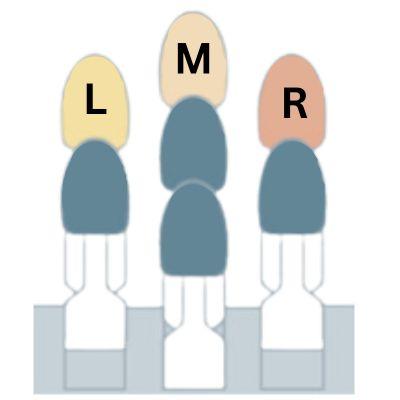
A shade guide is a set of tooth-coloured tabs. Two widely used systems come from the same maker: the classical guide has 16 tabs, and the 3D-Master guide has 26 tabs and chooses the shade in three steps1 instead of one. A code such as A1 or 1M1 only means something together with the guide it comes from.
In a laboratory study, 60 dentists, technicians and students matched 40 ceramic samples. Shades chosen with the 3D-Master guide were on average slightly closer to the target than those chosen with the classical guide2, a statistically significant difference. It was a laboratory study, and it does not show that one guide gives better results in patients.
No guide covers every natural tooth colour: a review of shade-matching studies notes that the available shade guides do not represent the true colours of teeth3. So a code is a starting point for the laboratory, not a promise of an exact colour.
Is a light shade "too white"?
There is no shade that suits everyone. Whether a light tab looks natural depends on the teeth that will sit next to the restoration, on whether all the visible teeth are being changed, and on the light you are seen in. Ask to see the tab held next to your own teeth before you agree. On a dark tooth, a thin veneer may not hide the colour underneath, even in a light shade.
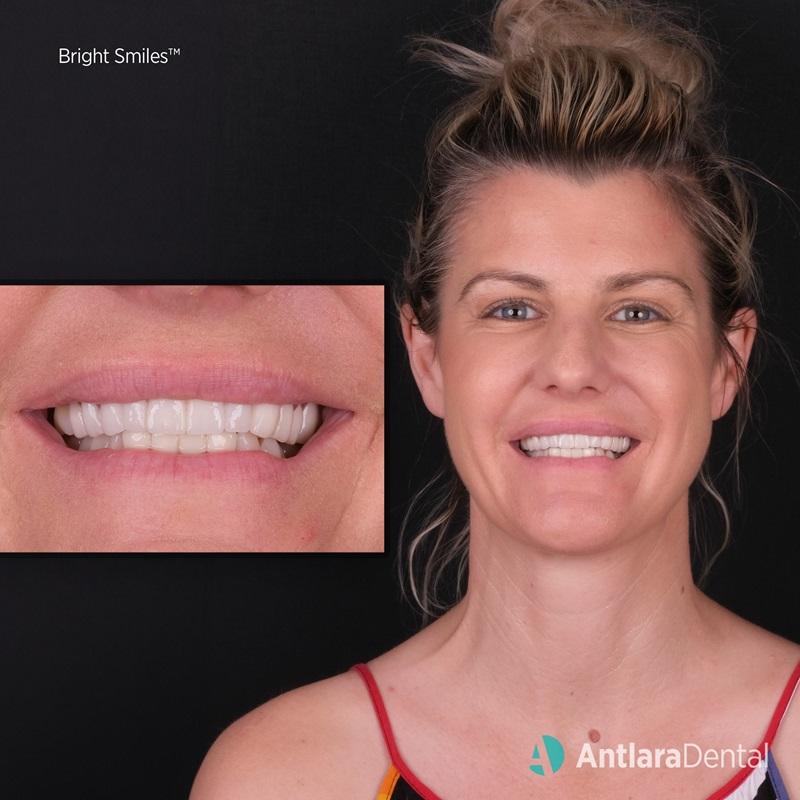
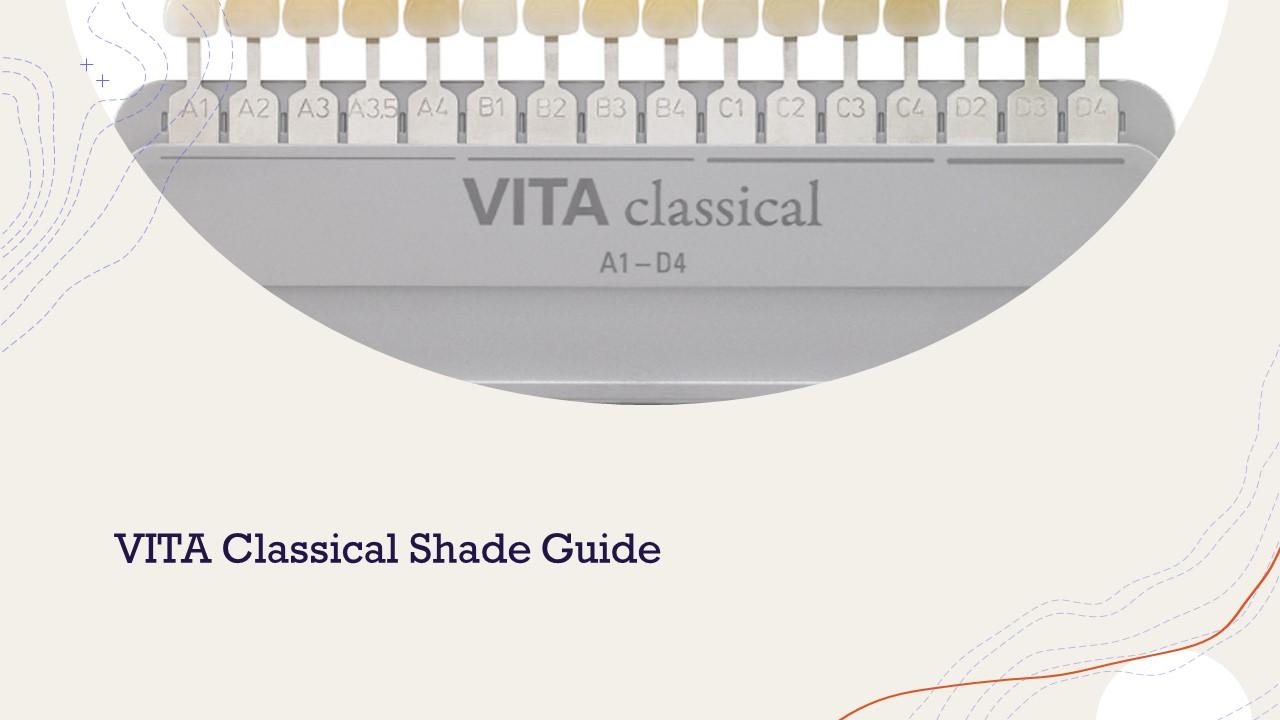
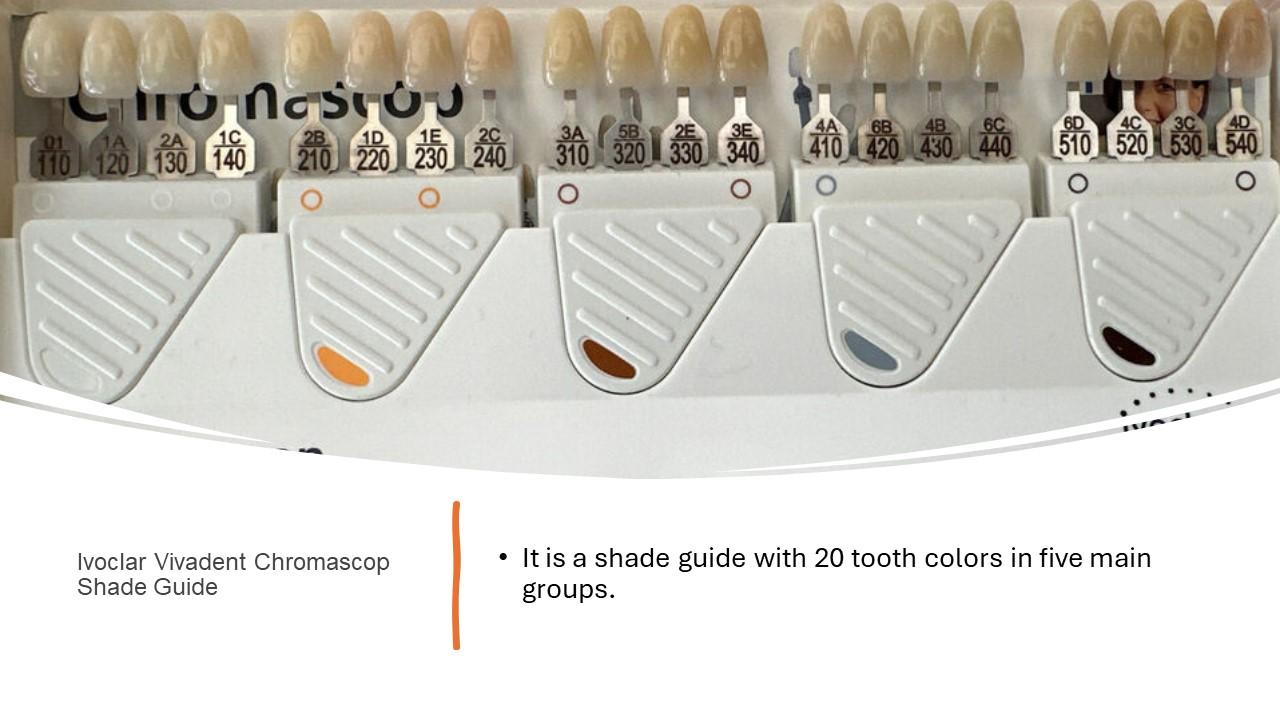
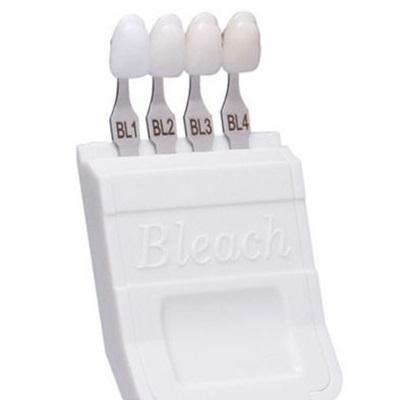
| Shade guide by eye | Photos and measuring devices | Intraoral scanner | |
|---|---|---|---|
| How it works | Tabs held next to the tooth | A calibrated photo, or a device that measures colour | The 3D scanner used for impressions also suggests a shade |
| What studies found | Subjective; accuracy and repeatability lower | Usually closer to the target than the eye; reviews disagree on spectrophotometers | Not better than the eye; not recommended for shade (very low certainty) |
| Best use | Always part of the process | Checking and recording the choice for the laboratory | Impressions, not shade |
Eye, camera or device: how reliable is each?
Choosing a shade by eye is subjective. A systematic review found that the visual method has lower accuracy and repeatability1 and advises clinicians not to rely on their senses alone.
Two meta-analyses compared methods. One found that shades taken with instruments, such as spectrophotometers and cameras, were on average closer to the target than shades chosen by eye3. The other found that digital photographs reduced the colour difference, but that a spectrophotometer had no advantage over shade guide tabs4. Both were based on few, mostly small studies.
Intraoral scanners are a different case. In a meta-analysis, scanners picked the same tab as a spectrophotometer in about 38 in 100 readings with the 3D-Master guide and about 28 in 100 with the classical guide5, and the authors do not recommend using them to determine shade, although the certainty of this evidence was very low. A scanner is still useful for the impression itself.
In practice, a careful visual match combined with photos of the chosen tab next to your teeth can help document the shade choice for the laboratory.
Why the light and the person matter
The same tooth looks different under different light, which is also why teeth can look a different shade in photographs. In a laboratory study, dentists with normal colour vision matched shades significantly better under a standard daylight lamp than under a tungsten bulb6, while those with red-green colour deficiency did better under the tungsten light. In a randomised laboratory study with dental students, handheld shade-matching lights gave better scores than a viewing booth, and training also improved the scores7.
The matcher's sex does not appear to be critical. Of 37 studies on whether men or women match colours better, 25 found no significant difference8, and the authors concluded that sex is unlikely to be a critical factor.
Small differences can show. In a study of 175 observers looking at ceramic samples in a viewing booth, half noticed a difference of 0.8 units on the CIEDE2000 colour-difference scale, and half found a difference of 1.8 units unacceptable9. These are laboratory thresholds; they varied between groups of observers and between centres, and they cannot be compared directly with figures measured on other scales or under other conditions.
What whitening does not change
Whitening works on natural teeth. According to the American Dental Association, whitening will not work on caps, veneers, crowns or fillings10. After whitening, an existing restoration can therefore look darker than the teeth next to it.
That does not mean restorations are untouched. Laboratory studies show that bleaching may affect the surface, the edges and the colour of some restorative materials11; the same 2004 review found no clinical reports of restorations needing to be replaced because of bleaching. A later review advises dentists to tell patients that restorations may need polishing or replacing at the end of whitening12, and to avoid bleaching ceramic restorations, especially on front teeth, because their surface may become rougher.
If you are planning new crowns or veneers and also want lighter teeth, discuss both together before the shade is chosen. For whitening itself, see yellow stains on teeth and hydrogen peroxide for whitening.
At your shade appointment
- Ask to see the chosen tab held next to your own teeth, and say whether it looks right to you.
- Ask whether the shade will be recorded with photos of the tab beside your teeth for the laboratory.
- For front teeth, ask to see the crown or veneer tried in your mouth, and discuss how it looks, before it is permanently bonded or cemented.
- If only one or two teeth are being restored, the aim is usually to match the teeth next to them, not a code from a chart.
When to see a dentist
Colour is usually a question for a routine appointment, but see a dentist if:
- A single tooth darkens, especially after a knock
- A crown or veneer has a dark line or a chip at its edge, or the gum around it bleeds or recedes
- Teeth are very sensitive or painful during or after whitening
Emergencies. Facial swelling, a fever or throbbing pain needs a dentist without waiting. Difficulty breathing or swallowing: go to an emergency department or call 112.
Frequently asked questions
Is B1 too white?
It depends on what it sits next to. A light tab can look natural beside light teeth and stand out beside darker ones. There is no shade that suits everyone; ask to see the tab held next to your own teeth before you agree.
Can I change the shade of a crown or veneer later?
Not by whitening. Changing the colour of a finished crown or veneer usually means replacing it, so take time over the choice.
Why do my teeth look a different shade in photos?
Teeth look different under different light, and cameras and screens handle colour in their own way. That is also why dentists check a shade under suitable light and record it with photos of the tab beside the teeth.
Which shade should I choose for an implant crown?
Usually the one that matches the teeth next to it, since a single crown should blend in. If you want your own teeth lighter too, discuss that before the crown's shade is chosen.

Dt. Dilek AKSU GÜLER
Dentist · Founder
She has completed advanced training in implantology and works in aesthetic restorations and smile design.
Sources
- A clinician's perspective on the accuracy of the shade determination of dental ceramics: a systematic review. J Pers Med 2024;14(3):252. 2024.↩doi.org
- Selecting VITA classical shades with the VITA 3D-master shade guide. Int J Prosthodont 2014;27(4):376-82. 2014.↩doi.org
- Color difference for shade determination with visual and instrumental methods: a systematic review and meta-analysis. Syst Rev 2023;12(1):95. 2023.↩doi.org
- Novel trends in dental color match using different shade selection methods: a systematic review and meta-analysis. Materials (Basel) 2022;15(2):468. 2022.↩doi.org
- Color comparison between intraoral scanner and spectrophotometer shade matching: a systematic review and meta-analysis. J Esthet Restor Dent 2025;37(2):361-377. 2024.↩doi.org
- Shade matching performance of normal and color vision-deficient dental professionals with standard daylight and tungsten illuminants. J Prosthet Dent 2010;103(3):139-47. 2010.↩doi.org
- Influence of light source, polarization, education, and training on shade matching quality. J Prosthet Dent 2016;116(1):91-7. 2016.↩doi.org
- Effect of assessor's sex on visual color matching in dentistry: a systematic review of the literature. J Esthet Restor Dent 2022;34(2):383-396. 2021.↩doi.org
- Color difference thresholds in dentistry. J Esthet Restor Dent 2015;27 Suppl 1:S1-9. 2015.↩doi.org
- Teeth Whitening (patient information). American Dental Association, MouthHealthy.↩mouthhealthy.org
- Effect of bleaching on restorative materials and restorations: a systematic review. Dent Mater 2004;20(9):852-61. 2004.↩doi.org
- Effects of external bleaching on restorative materials: a review. J Can Dent Assoc 2011;77:b59. 2011.↩jcda.ca