
What should you know before getting veneers?
A veneer is a thin shell, usually ceramic, bonded to the front of a tooth. Fitting one usually removes a thin layer of enamel, so the treatment is not reversible1: the tooth will need a restoration from then on.
Ceramic veneers do well in studies. A review of 25 studies estimated that about 95 in 100 were still in place after ten years2, and fracture and coming off were the main reasons they failed. They are not maintenance-free and not for everyone. Their colour is fixed once bonded, clenching and grinding raise the risk of fracture, and crowded teeth are often better straightened first. The answers below take the common questions one by one.
- Fitting a veneer usually removes enamel, which does not grow back, so the tooth will always need a restoration.
- A large review estimated that about 95 in 100 ceramic veneers were still in place at ten years; fracture and coming off were the main failures.
- A failed veneer does not mean replacing them all; the difficulty is matching the colour of the others.
- The shade cannot be changed after bonding, and crowded teeth are often better straightened first.

Do veneers harm your teeth in the long run?
They change the tooth for good, and they carry some risks.
- Enamel. Usually a thin layer is removed from the front, and this cannot be undone1. How much depends on the tooth and the change planned; a crown removes far more.
- Sensitivity. Teeth can become more sensitive because some enamel is removed3. Sensitivity that lasts or gets worse should be checked.
- Decay. A veneer does not protect the tooth. New decay can start at its edge, so brushing, cleaning between the teeth and check-ups still matter.
- The nerve. The nerve of the tooth can be affected, and some teeth need root canal treatment later. The deeper the preparation, the higher this risk.
- Bonding to enamel. Veneers bond best to enamel. In a study of 580 veneers, those bonded to dentine were about 10 times as likely to fail4.
Keeping the preparation in enamel supports reliable bonding; deeper preparation exposes dentine. Decay also depends on cleaning, diet and how well the edge fits. How much tooth is removed is the main difference between a veneer and a crown, explained in our article crowns or veneers.
Ceramic or composite?
The figures on this page are for ceramic veneers. Composite veneers, made of tooth-coloured resin, are the other option: they may need less enamel removed and are easier to repair, but are less resistant to stains and wear1. The materials are compared in types of veneers, and composite in composite veneers.
Do veneers fall off easily?
Not often, but it happens. In a 2025 review of 29 studies of ceramic veneers, about 2 in 100 came off over an average of about ten years5; the studies varied widely. In the larger 2021 review, fracture and coming off were the main reasons veneers failed, mostly in the early years2.
If a veneer comes off, keep it and do not glue it back yourself. Whether it can be bonded again depends on whether it is intact and on the tooth underneath. Biting hard objects with the front teeth, and clenching or grinding, make it more likely.
If one veneer fails, do they all have to be replaced?
No, not as a rule. A failed veneer can be repaired, replaced or, if it came off intact, bonded again on its own1, and small chips may be repaired6.
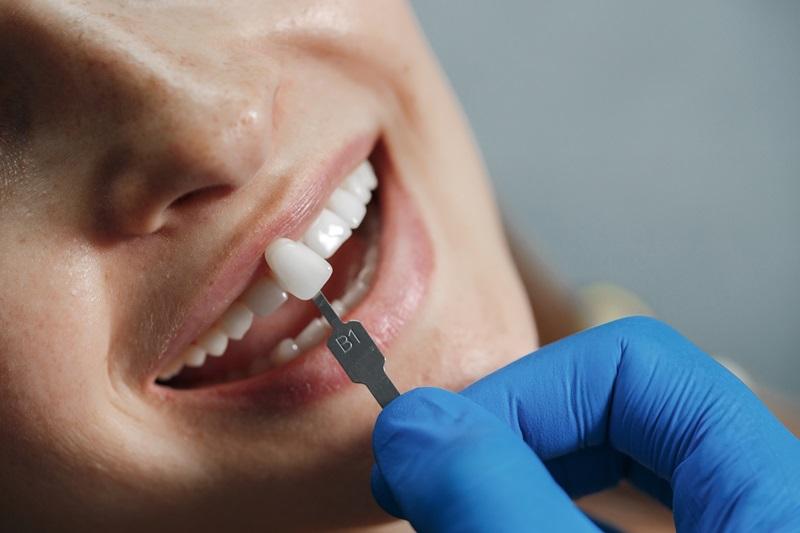
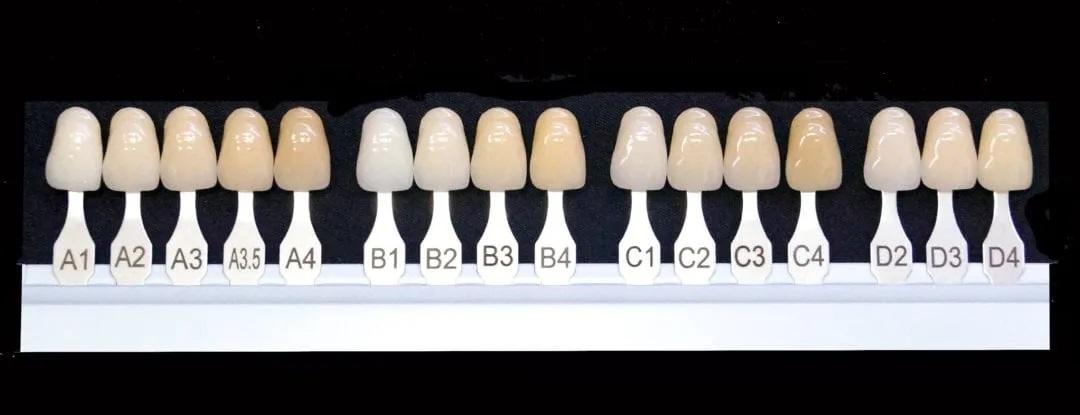
The difficulty is colour. The colour of a veneer cannot be changed after it is bonded, and natural teeth may change colour over time3, so a new veneer has to match both the older veneers and your own teeth. Choosing a shade by eye alone is subjective, and a review advises dentists not to rely on their senses alone7. Photographs or measuring instruments can help.
If you are told that several sound veneers should be replaced because one failed, ask why each one is included. Replacing a veneer can take a little more tissue from the tooth each time.
Which shade should I choose? Is the whitest one wise?
We know of no good evidence on which shade is "most popular", and popularity is not a reason to choose one. What matters is this:
- The shade cannot be changed. It cannot be altered after bonding3, and whitening does not work on veneers8. The edges can still stain over the years. If you are thinking of whitening your natural teeth, discuss it before the shade is chosen.
- Veneers sit next to your own teeth. If only some teeth get veneers, a very white shade may stand out beside the others, and more so as your natural teeth change colour over the years.
- Light changes how teeth look. In a laboratory study, dentists with normal colour vision matched shades more accurately under standard artificial daylight than under a tungsten lamp9. Ask to see the shade in more than one light.
Very dark staining, such as from the antibiotic tetracycline taken in childhood, is harder. Whitening can reduce these stains to some degree, but it can take three to four months of nightly treatment10, and a thin veneer may not hide a very dark tooth completely.
Why straighten teeth first if veneers are quicker?
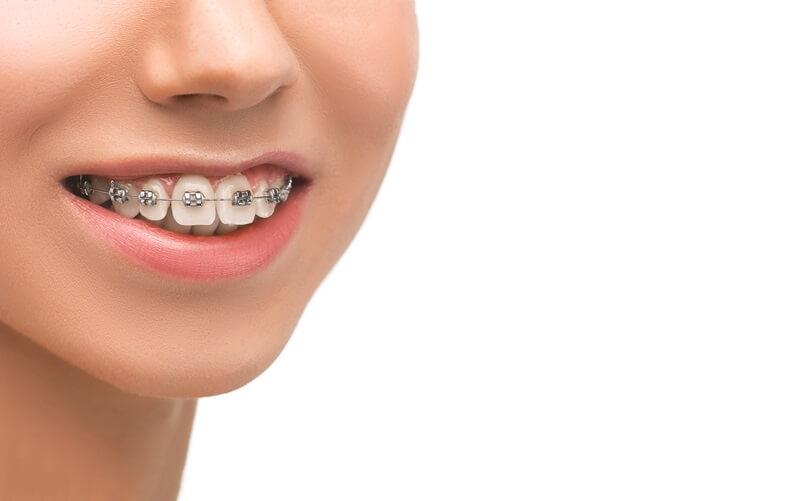
Making crooked teeth look straight with veneers takes more tooth. A tooth that stands forward has to be reduced further to bring its veneer into line, and that can take the preparation through the enamel into the dentine. Veneers bonded there fail more often: in a retrospective study of 672 veneers followed for about 6 years on average (up to 15), estimated survival was about 97 in 100 where the trimming stayed within the enamel and about 94 in 100 where a large area of dentine was exposed11. That shows an association, not proof of cause.
Straightening first can mean less tooth removed, or no veneers at all. It takes longer, but it keeps more of your own tooth. For a gap between the front teeth, bonding or orthodontic treatment may be enough.
Can I have veneers if I clench or grind my teeth?
Sometimes, but it raises the risk. Clenching and grinding increase the risk of fracture, and for some people veneers are not suitable12. In a retrospective study of 70 patients with veneers, 30 had bruxism; among them, those who wore a night guard had fewer fractures. That was not a randomised comparison: a night guard may lower the risk, not remove it.
Your dentist also checks how your teeth meet: a deep bite can make veneers unsuitable1. Gum disease and decay are treated before any veneer. How long veneers last, and what shortens their life, is covered in how long do veneers last.
When to see a dentist
Contact your dentist if any of these happens.
- A veneer chips, cracks or feels rough at the edge
- A veneer comes off: keep it, and do not glue it back yourself
- Sensitivity that lasts more than a few weeks or keeps getting worse
- Pain that starts on its own or wakes you at night
- Bleeding, swelling or a dark line at the gum edge
Emergencies. Throbbing pain, facial swelling or a fever: see a dentist without waiting. Difficulty breathing or swallowing, or swelling in the mouth or neck that spreads quickly: go to an emergency department or call 112.
A question we have not answered?
Send us your question, with a photo of your teeth if it helps. Our dentists will write back.
Frequently asked questions
Can veneers be whitened?
No. Whitening lightens natural teeth only, and the colour of a veneer cannot be changed after it is bonded. If you whiten your natural teeth later, the veneers may look darker next to them.
Can I have a veneer on just one tooth?
Yes, for example after a chip. Matching one veneer to the natural teeth beside it can be harder than matching a row, and those teeth may change colour over the years while the veneer does not.
Can I eat normally with veneers?
Mostly, yes. Avoid biting nails, pens, ice or other very hard things with your front teeth, as that raises the risk of chipping. Coffee, tea and smoking can stain the edges over time.
Can veneers be removed later?
Not in the sense of going back. The enamel removed for a veneer does not grow back, so if a veneer is taken off or fails, the tooth needs a new veneer or another restoration.
Sources
- Veneers. American Dental Association, MouthHealthy.↩mouthhealthy.org
- Survival and failure causes of ceramic laminate veneers: systematic review (25 studies, 6,500 veneers, 3-21 years). Journal of Clinical Medicine 2021;10(5):1074. 2021.↩pmc.ncbi.nlm.nih.gov
- Veneers. healthdirect Australia (government-funded health information), last reviewed February 2025. 2025.↩healthdirect.gov.au
- Porcelain laminate veneers, 580 veneers up to 12 years: effect of preparation in enamel versus dentin. International Journal of Periodontics & Restorative Dentistry 2013;33(1):31-39. 2013.↩doi.org
- Survival and complication rates of ceramic laminate veneers by material: systematic review and meta-analysis (29 studies). Journal of Esthetic and Restorative Dentistry 2025;37(3):601-619. 2025.↩doi.org
- Veneers (patient information). Oral Health Foundation (UK charity); published January 2017, updated April 2026. 2026.↩dentalhealth.org
- A clinician's perspective on the accuracy of the shade determination of dental ceramics: a systematic review. J Pers Med 2024;14(3):252. 2024.↩doi.org
- Teeth Whitening (patient information). American Dental Association, MouthHealthy.↩mouthhealthy.org
- Shade matching performance of normal and color vision-deficient dental professionals with standard daylight and tungsten illuminants. J Prosthet Dent 2010;103(3):139-47. 2010.↩doi.org
- Oral Health Topics: Whitening. American Dental Association (ADA Library & Archives), last updated 16 August 2022. 2022.↩ada.org
- Ceramic veneers and dentin exposure: 672 veneers in 189 patients, 1-15 years (mean 6 years). Journal of Esthetic and Restorative Dentistry 2025. 2025.↩pmc.ncbi.nlm.nih.gov
- Porcelain veneers in patients with bruxism: 323 veneers in 70 patients, 3-11 years. Medicina Oral Patologia Oral y Cirugia Bucal 2014. 2014.↩pmc.ncbi.nlm.nih.gov

Dt. Dilek AKSU GÜLER
Dentist · Founder
She has completed advanced training in implantology and works in aesthetic restorations and smile design.