
Four or six: the short answer
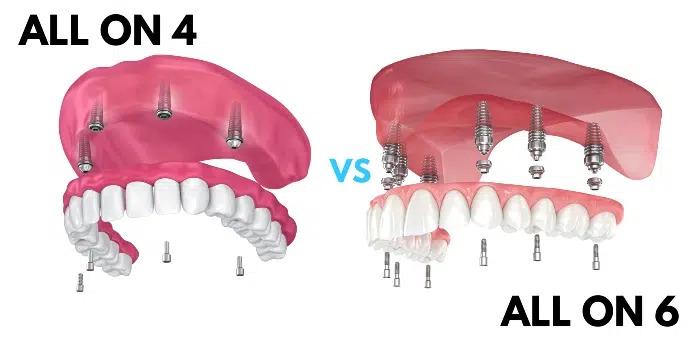
Neither design has been shown to be better overall. All-on-4 and All-on-6 both replace every tooth in one jaw with a fixed bridge screwed onto implants. Reviews have found no significant difference in implant or bridge survival1 between four and six. The number of implants, their positions and their angles are planned for your jaw, not by a rule.
This article sets out what the studies found and what they could not measure. It also covers what decides the number, and what to ask if two dentists have proposed different plans.
- Reviews found no significant difference in implant or bridge survival between four and six implants; the numbers do not all point one way.
- At five years and beyond, about 98 in 100 All-on-4 implants and 97 to 98 in 100 All-on-6 implants were still in place.
- We found no measurement in these reviews of what happens to the bridge when one of four or six implants is lost.
- Bone, jaw shape, the opposing jaw, clenching and the length of the bridge decide the number; ask for the reasoning on your own scan.

What the studies found
A 2026 review pooled 55 studies of All-on-4 and All-on-6. At five years and beyond, about 98 in 100 All-on-4 implants and about 97 to 98 in 100 All-on-6 implants2 were still in place. These rates are per implant, not per patient. The studies differed a great deal, and the authors ask for the results to be read with caution.
The numbers do not all point one way. All-on-6 had higher survival in the first year and less bone loss at five years (0.94 mm versus 1.28 mm)2. All-on-4 had slightly higher pooled survival in the medium and long term. An umbrella review of seven systematic reviews found that the number of implants did not significantly affect implant or bridge survival1. The consensus of the International Team for Implantology (ITI) states that the literature supports different implant numbers3 for full-arch fixed bridges.
The bridge matters as much as the implants. In the umbrella review, about 90 to 97 in 100 bridges1 were still in use over 5 to 15 years. These ranges are as stated in the review abstracts. A 2012 review looked at full-arch fixed bridges on four to six implants. In the upper jaw, about 97 in 100 bridges were in use at five years and 95 at ten4. In the lower jaw the figures were 98 and 96. Being in use does not mean trouble-free: screws may need tightening and porcelain repairing. Some bridges have to be remade, which counts as losing the original bridge.
What the studies could not show
The comparisons in these reviews rest mostly on pooled results from different groups of patients. They do not prove that one design is better than the other, or that the two are equivalent.
In the reviews cited here we found no measurement of what happens to the bridge when one of four or six implants is lost. That is the practical argument for six: if an implant is lost, the bridge may be easier to rescue. The practical argument for four is of the same kind. There are fewer surgical sites. Where the back implants can be tilted to keep clear of the sinus and the nerve canal, some patients need no bone graft. Both are clinical reasoning, not measured advantages.
The same gap applies to the part of the bridge that extends behind the last implant. Its length depends on where the rearmost implants sit and how far back the teeth reach, not only on the number of implants. We found no comparison in these reviews of how its length affects the outcome.
| All-on-4 | All-on-6 | |
|---|---|---|
| Implants under the bridge | Four; the two back implants are usually tilted | Six; the back implants are tilted where the anatomy allows |
| Bone needed | Enough bone at the front of the jaw for four implants | Enough bone for implants in the extra positions too |
| Survival in reviews | No significant difference found between the two designs | No significant difference found between the two designs |
| If one implant is lost | No data found; the plan is reassessed | No data found; the plan is reassessed |
| Daily care | Cleaning under the bridge every day; regular reviews | Cleaning under the bridge every day; regular reviews |
What decides the number in your jaw
The number of implants is a design decision made on your own 3D scan. These are the questions behind it:
- The amount and position of bone. Four implants need enough bone at the front of the jaw; six need enough in the extra positions too.
- Upper or lower jaw, and its shape. The sinus in the upper jaw and the nerve canal in the lower jaw limit where implants can go.
- The opposing jaw. Natural teeth, a denture or another implant bridge bite against the new bridge with different forces.
- Clenching or grinding. A night guard may be advised to protect the bridge; it has not been shown to prevent implant loss.
- The length of the bridge. The further back it reaches, the longer the part behind the last implant.
Smoking5, a history of gum disease6 and clenching7 are associated with implant loss whichever design is used. They belong in the same conversation. Active gum disease is treated first; implants are not placed while it is active.
Some problems are not solved by adding implants. There may be too little vertical space for the bridge, or your lip may need the support of the gum-coloured part of a denture. You may not be able to clean under a fixed bridge every day. In these cases a removable implant-retained denture may suit you better.
Suitability is decided by an examination, a 3D scan and your medical history. Photographs cannot show the bone, so a plan made from them is only a preliminary assessment. Each design is explained in full on the All-on-4 and All-on-6 pages.
What both designs have in common
- Steps that cannot be undone. Extracting the remaining teeth, and removing part of the jaw bone where that is planned, cannot be reversed. Before surgery, ask which teeth could be kept, the reason for each extraction and the alternatives.
- Inflammation around implants. Peri-implantitis is inflammation around an implant with loss of the supporting bone. Reviews of full-arch bridges report it at 4 to 18 per cent1 (as stated in the review abstracts). The rate depends on the definition used and the time in function.
- Technical problems with the bridge. Reviews report screw loosening at 5 to 15 per cent and fracture of the bridge's framework under 5 per cent1. Chipping of the porcelain layer on zirconia bridges (veneered zirconia) is reported at 15 to 35 per cent. Bridges of solid zirconia (monolithic) and screw-retained designs have fewer technical problems. The follow-up period and the denominators could not be verified in the full text.
- Surgical risks. Bleeding, swelling, bruising and infection. In the lower jaw, the nerve canal is close: the lip and chin may feel numb for a while and, rarely, permanently. In the upper jaw, the sinus is close: its membrane may tear, and sinusitis or an opening between the mouth and the sinus may follow. The 3D scan and careful planning reduce these risks; they do not remove them.
- Maintenance. Both need cleaning under the bridge every day and regular reviews. When the bridge is completed, an X-ray and pocket measurements are taken as a baseline8 so that later changes can be compared.
When to see a dentist
If you are weighing the two designs, have an examination and a 3D scan before you decide. Ask for the plan and its reasoning in writing. If you already have a full-arch bridge, contact your dentist if you notice any of these:
- The bridge moves, a screw feels loose, or a piece cracks or breaks
- Bleeding, a bad smell, discharge or receding gum around the bridge
- Pain on biting, or a bite that feels high
- After surgery, pain or swelling that increases after the third day, or bleeding that does not stop
- Numbness of the lip or chin that lasts beyond the expected duration of the anaesthetic
- Nasal discharge, blockage or sinus pain (upper jaw)
Emergencies. Difficulty breathing or swallowing, rapidly spreading swelling of the face or neck, high fever or swelling around the eye are serious signs. Do not wait for the clinic's reply: go to the nearest emergency department or call 112.
Frequently asked questions
Is All-on-6 safer than All-on-4?
Not as a rule. Reviews found no significant difference in implant or bridge survival between four and six, and the numbers do not all point one way. The comparisons pool different groups of patients, so neither "six is safer" nor "four is enough" is proven.
Why would a dentist suggest four implants rather than six?
Usually because of the bone. Tilted back implants can keep clear of the sinus and the nerve canal, which avoids a graft in some patients. There are also fewer surgical sites. These are clinical reasons, not a measured advantage; ask to see them on your scan.
If one implant fails, do I lose the whole bridge?
Not necessarily, but we found no measurement of this for either design in the reviews. Replacing a lost implant and keeping the bridge is not always possible; further surgery, a new bridge or a removable denture may be needed. Ask how your plan would handle it.
Does All-on-6 last longer?
The studies do not show that. In a 55-study review, about 98 in 100 All-on-4 implants were in place at five years and beyond. For All-on-6 it was 97 to 98 in 100. Staying in place is not trouble-free with either design.
Two dentists gave me different plans. Which one is right?
Ask each dentist to explain the plan on your own 3D scan. Why this number? Are implants tilted, and is a graft needed? How far does the bridge extend behind the last implant, and what if one implant is lost? Is a temporary bridge fitted straight away? Written answers make plans comparable.
Sources
- Prosthetic complications of implant-supported complete arch prostheses: an umbrella review of systematic reviews (7 reviews, >=5-year follow-up). Journal of Prosthetic Dentistry 2026;136(1):52-59. 2026.↩doi.org
- All-on-4 and All-on-6 implant-supported fixed prostheses for the edentulous jaw: systematic review and meta-analysis (55 studies). International Journal of Oral and Maxillofacial Surgery 2026;55(9):1098-1112. 2026.↩doi.org
- Group 2 ITI Consensus Report: prosthodontics and implant dentistry. Clinical Oral Implants Research 2018;29 Suppl 16:215-223. 2018.↩doi.org
- What is the optimal number of implants for fixed reconstructions: a systematic review (9 studies, per prosthesis). Clinical Oral Implants Research 2012;23 Suppl 6:217-228. 2012.↩doi.org
- Levels of smoking and dental implants failure: systematic review and meta-analysis (23 articles). Journal of Clinical Periodontology 2020;47(4):518-528. 2020.↩doi.org
- Effectiveness of implant therapy in patients with and without a history of periodontitis: systematic review with meta-analysis of prospective cohort studies (14 studies, >=36 months). Journal of Periodontal Research 2025;60(6):524-543. 2025.↩doi.org
- Bruxism and dental implants: systematic review and meta-analysis (27 studies; 2,105 implants in probable bruxers, 10,264 in non-bruxers). Journal of Oral Rehabilitation 2024;51(1):202-217. 2024.↩doi.org
- Peri-implant diseases and conditions: consensus report of workgroup 4 of the 2017 World Workshop on the Classification of Periodontal and Peri-Implant Diseases and Conditions. Journal of Clinical Periodontology 2018;45 Suppl 20:S286-S291. 2018.↩doi.org

Dt. Dilek AKSU GÜLER
Dentist · Founder
She has completed advanced training in implantology and works in aesthetic restorations and smile design.