
Can All-on-4 give you new teeth in one day?
Sometimes, but not for everyone, and not the final teeth. "A new smile in one day" usually means immediate loading. A fixed provisional bridge is attached to the implants on the day of surgery or within a few days. The final bridge is made months later, once the implants have fused with the bone. Whether the provisional bridge can go in straight away is assessed before surgery and confirmed during it, mainly by how firmly the implants hold.
The studies on timing are mixed. A Cochrane review found no convincing difference within one year1 between loading implants straight away and waiting. A review of 39 randomised trials found slightly lower implant survival2 with immediate loading. So it is a decision made patient by patient, not a promise.
- The teeth fitted on the day of surgery or within a few days are a provisional bridge; the final bridge follows after healing.
- Whether they go in straight away is assessed before surgery and settled mainly by how firmly the implants hold when placed; if the hold is not enough, the fixed teeth wait.
- The studies do not settle whether immediate loading lowers implant survival, and the Cochrane review followed patients for a year at most.
- Smoking, clenching and a history of gum disease are associated with implant loss whatever the timing.
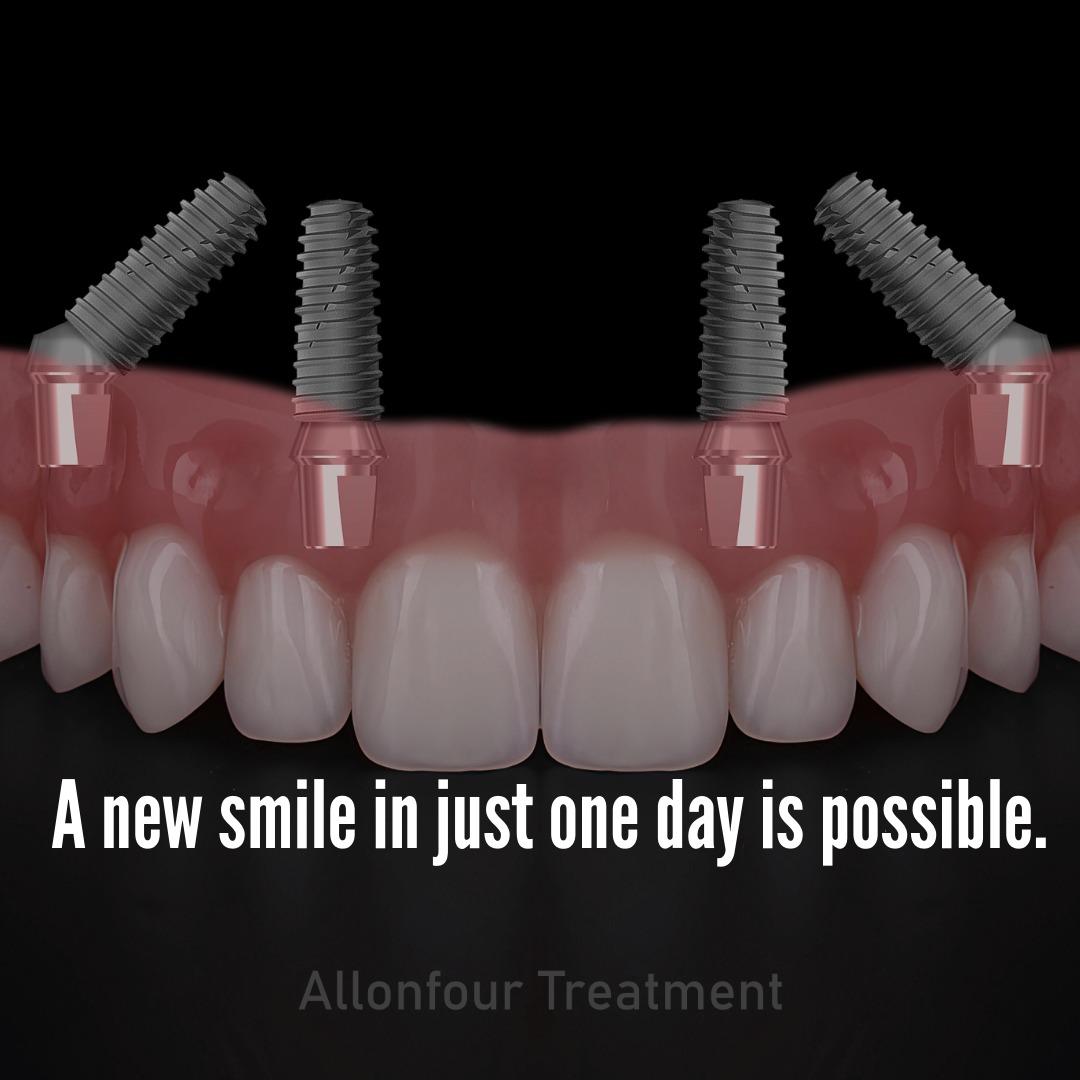
What "a new smile in one day" means
All-on-4 replaces every tooth in one jaw with a fixed bridge screwed onto four implants. Where the anatomy allows, the two back implants are tilted to keep clear of the sinus and the nerve canal. The design, who it suits and its risks are explained on the All-on-4 page.
The phrase is about timing. After the remaining teeth are removed and the implants placed, there are two routes:
- Immediate loading. A fixed provisional bridge is attached to the implants soon after surgery. The Cochrane review of loading times defines immediate loading as within one week of placement1.
- Waiting for healing. In the same review, conventional loading means after more than two months. Until then a removable temporary denture is usually worn; your plan should say what you will wear, and from when.
On either route, the teeth you leave with are not the final bridge. Implants usually need three to six months to fuse with the bone. After that, new impressions are taken, tooth shape and colour are agreed at try-ins, and the final bridge is made and screwed in.
What decides whether the teeth go in straight away
The final decision is made during surgery. When an implant is placed, it is held in the bone mechanically; it has not yet fused with it. How firmly it sits at that moment is called primary stability. If the implants hold firmly enough, selected patients receive a fixed provisional bridge within a few days. If they do not, the provisional bridge waits until after healing, and a removable temporary denture is usually used meanwhile. This cannot be known for certain before surgery, so your plan should say what happens in both cases.
Other points are weighed before surgery:
- Bone. The amount and quality of bone, seen on a 3D scan, affect how firmly implants can be placed. If you need a bone graft, ask how it changes the timing.
- Clenching or grinding. In a review of 27 studies, the odds of implant failure were about 2.2 times higher in people judged likely to clench or grind3 (an odds ratio per implant, not a risk 2.2 times higher); clenching was not confirmed with instruments.
- Smoking. A review of 32 studies looked at early implant failure. In its implant-level analysis the odds ratio for smokers was about 2.64; an odds ratio is not the same as a risk 2.6 times higher.
- A history of gum disease. In 14 prospective studies, the rate of implant loss over follow-up was about 1.75 times higher5 in people treated for periodontitis than in people without that history (a hazard ratio). Active gum disease is treated first.
- Daily care. You will need to eat soft food and clean around the provisional bridge while the implants heal.
These factors were studied as associations with implant loss in general, not with immediate loading in particular. They belong in the same conversation.
What the studies found, and what they could not show
The evidence on timing is not settled, and most of the studies followed patients for a short time.
- The Cochrane review pooled 26 randomised trials. It found no convincing difference in implant or bridge loss1 between immediate and conventional loading. Follow-up ran from four months to one year, so it says nothing about five or ten years.
- A review of 39 randomised trials found slightly lower implant survival2 with immediate loading than with conventional loading. The difference was small but statistically significant. The Cochrane result points the same way but was too imprecise to show a difference, and most of its trials were at high or unclear risk of bias. Between immediate and early loading, the later review found no significant difference.
- With All-on-4 the remaining teeth are often removed in the same session as the implants are placed, so some implants may go straight into fresh sockets. For implants placed straight into the socket of an extracted tooth, one review found survival of 95.2 per cent, against 98.4 per cent6 in healed bone. That is about when implants are placed, not when teeth are attached, so it does not measure the risk of immediate loading.
These reviews cover implants in general, not All-on-4 only, and their results depend on which patients were chosen. For All-on-4 itself, a 2026 review of 55 studies found that about 98 in 100 implants7 were still in place at five years and beyond. That figure is per implant, not specific to immediate loading, and an average of widely varying studies, not a prediction for you. Staying in place is not the same as trouble-free. Around All-on-4 implants an average bone loss of about 1.3 mm at five years7 has been reported, and reviews of full-arch bridges followed for 5 to 15 years report screw loosening at 5 to 15 per cent8; the review summaries do not say whether that counts patients, bridges or implants. The bridge needs maintenance over the years; the All-on-4 page lists the risks.
The months with a provisional bridge
- Food. Eat soft food while the implants heal, which usually takes three to six months, and do not chew hard or sticky food with the provisional bridge. Your aftercare instructions say when you can move on.
- Cleaning. Clean around and under the provisional bridge every day in the way you are shown. The line where the bridge meets the gum is the hardest place to keep clean.
- Reviews. Keep the check-ups you are given while the implants heal. Once the bridge is in use, the European Federation of Periodontology guideline calls for a structured supportive care programme9 with regular assessment of the gum around the implants. Inflammation there can progress to loss of the bone that holds them; caught early, it can be treated.
- Smoking. Smoking impairs healing and is associated with implant loss (see above). At the least, avoid it during the healing period; if you want to stop altogether, ask your doctor for support.
- Speech and feel. Speech and chewing habits change in the first weeks.
- If an implant fails to fuse or is lost. The plan is reassessed. Replacing a lost implant and keeping the bridge is not always possible; further surgery, a new bridge or a removable denture may be needed.
Before surgery, ask these questions and get the answers in writing:
- Will I have fixed teeth straight away, and what happens if the implants do not hold firmly enough?
- What will I wear in the meantime, and for how long?
- When is the final bridge made, and what is it made of?
- What can I eat, and how do I clean the provisional bridge?
- What happens if an implant fails during healing?
When to see a dentist
After surgery, or at any time with the provisional or final bridge in place, contact your dentist if you notice any of these:
- Pain or swelling that increases after the third day, or bleeding that does not stop
- Numbness of the lip or chin that lasts beyond the expected duration of the anaesthetic
- The bridge moves, a screw feels loose, or a piece cracks or breaks
- Bleeding, a bad smell, discharge or receding gum around the bridge
- Pain on biting, or a bite that feels high (the teeth meet unevenly)
- Nasal discharge, blockage or sinus pain (upper jaw)
Emergencies. Difficulty breathing or swallowing, rapidly spreading swelling of the face or neck, high fever or swelling around the eye are serious signs. Do not wait for the clinic's reply: go to the nearest emergency department or call 112.
Frequently asked questions
Will I leave with fixed teeth on the day of surgery?
Possibly, if the implants hold firmly enough when they are placed; that is known only during surgery. If they do not, the fixed provisional bridge waits until after healing and a removable temporary denture is usually worn meanwhile. Ask what your plan says for both cases.
Are the teeth fitted straight away my final teeth?
No. They are a provisional bridge. Implants usually need three to six months to fuse with the bone. After that, tooth shape and colour are agreed at try-ins and the final bridge is made and screwed in.
Is immediate loading riskier than waiting?
The evidence is mixed. A Cochrane review found no convincing difference within one year; a later review of 39 randomised trials found slightly lower implant survival with immediate loading. Results depend on which patients are chosen, so it is decided case by case.
Can I eat normally with the provisional bridge?
Not straight away. Eat soft food while the implants heal, which usually takes three to six months, and do not chew hard or sticky food with the provisional bridge. Your aftercare instructions say when you can move on.
What happens if an implant does not heal?
The plan is reassessed. Replacing a lost implant and keeping the bridge is not always possible; further surgery, a new bridge or a removable denture may be needed. Ask how your plan would handle it before surgery.
Dt. Dilek AKSU GÜLER
Dentist · Founder
She has completed advanced training in implantology and works in aesthetic restorations and smile design.
Sources
- Interventions for replacing missing teeth: different times for loading dental implants (Cochrane review, 26 RCTs, 1,217 participants, 2,120 implants). Cochrane Database of Systematic Reviews 2013;(3):CD003878. 2013.↩doi.org
- Immediate versus early or conventional loading dental implants with fixed prostheses: systematic review and meta-analysis of randomized controlled trials (39 RCTs). Journal of Prosthetic Dentistry 2019;122(6):516-536. 2019.↩doi.org
- Bruxism and dental implants: systematic review and meta-analysis (27 studies; 2,105 implants in probable bruxers, 10,264 in non-bruxers). Journal of Oral Rehabilitation 2024;51(1):202-217. 2024.↩doi.org
- Smoking in relation to early dental implant failure: systematic review and meta-analysis (32 observational studies, 59,246 implants, 14,115 patients). Journal of Dentistry 2024;151:105396. 2024.↩doi.org
- Effectiveness of implant therapy in patients with and without a history of periodontitis: systematic review with meta-analysis of prospective cohort studies (14 studies, >=36 months). Journal of Periodontal Research 2025;60(6):524-543. 2025.↩doi.org
- Immediate implant placement into fresh extraction sockets versus delayed implants into healed sockets: systematic review and meta-analysis. International Journal of Oral and Maxillofacial Surgery 2017;46(9):1162-1177. 2017.↩doi.org
- All-on-4 and All-on-6 implant-supported fixed prostheses for the edentulous jaw: systematic review and meta-analysis (55 studies). International Journal of Oral and Maxillofacial Surgery 2026;55(9):1098-1112. 2026.↩doi.org
- Prosthetic complications of implant-supported complete arch prostheses: an umbrella review of systematic reviews (7 reviews, >=5-year follow-up). Journal of Prosthetic Dentistry 2026;136(1):52-59. 2026.↩doi.org
- Prevention and treatment of peri-implant diseases: the EFP S3 level clinical practice guideline. Journal of Clinical Periodontology 2023;50 Suppl 26:4-76. 2023.↩doi.org