
How long does dental treatment take?
It depends on the treatment, and the honest answer comes in stages rather than days. Laboratory-made crowns and porcelain veneers usually need more than one appointment: the restoration is made between preparing the tooth and fitting it. Implants take months: the implant usually has to fuse with the bone before the final tooth goes on.
In research, a tooth fitted on an implant more than two months after placement1 counts as conventional loading; fitting one sooner suits selected patients only. A staged bone graft adds a waiting period of its own. How many visits you need, and the gaps between them, depend on your mouth and should be written in your treatment plan.
- Crowns and veneers made in a laboratory take more than one appointment, with the laboratory work in between.
- An implant is surgery, then months of healing, then the crown or bridge.
- A temporary tooth on the implant straight away suits selected patients only.
- Treatment needed first, or a bone graft, adds time.
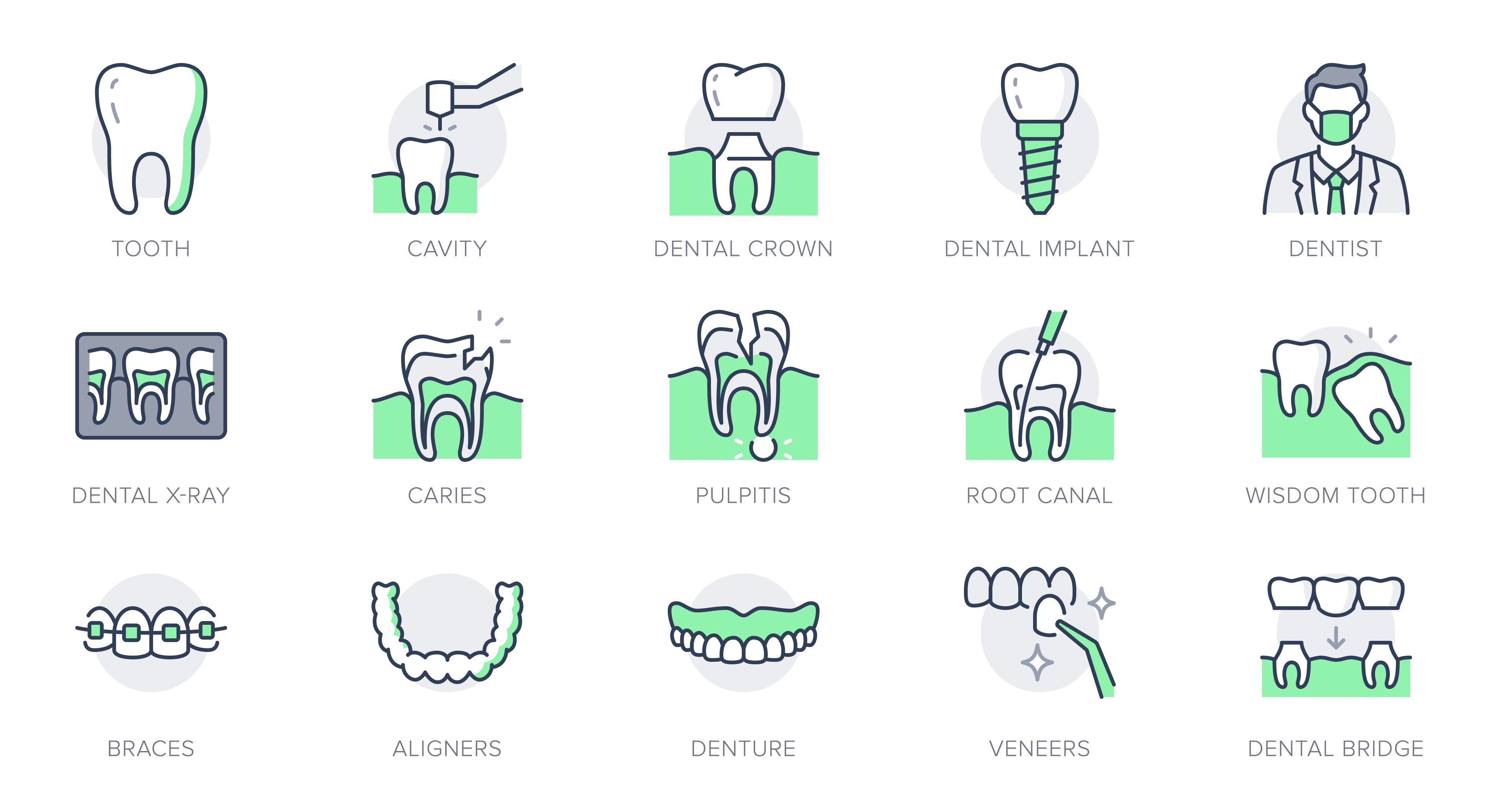
Why the answer comes in stages, not days
Four things set the length of a treatment.
- What has to be treated first. Decay, gum disease or infection comes before a crown, veneer or implant.
- Laboratory work. Crowns and veneers are made to measure between appointments.
- Healing. An implant usually has to fuse with the bone before it carries the final tooth.
- How appointments are grouped. That depends on the plan and on you.
So this article gives no number of days. Nobody can give yours before an examination. After it, your plan should say how many visits you need, what each covers and how long the gaps are.
Crowns: what happens at each appointment
These steps are for a crown made in a laboratory for a natural tooth. There is more than one appointment, with the laboratory work in between; a bridge or several crowns may take longer. Whether a crown can be made in one visit depends on the material and the method, so ask your dentist. Materials are compared on our zirconia crowns page.
- Examination: An examination, with X-rays where needed, decides whether the tooth needs a crown or something smaller.
- Preparing the tooth: Under local anaesthetic, every surface is reduced. A scan or impression is taken and a temporary crown fitted.
- Laboratory: The crown is made to measure. Avoid hard and sticky food on the temporary.
- Try-in and cementing: Fit, bite and shade are checked. Once you agree, the crown is cemented.
Veneers: what happens at each appointment
These steps are for porcelain veneers made in a laboratory. They follow a similar path, with one step worth time of its own: seeing the planned shape before any enamel is removed. Enamel taken off for a veneer does not grow back2, so the tooth will always need a veneer or another restoration. The trial is when the choice is still fully open.
If you want your natural teeth whiter, whitening comes first, because ceramic does not change colour afterwards. Ask how long to wait between the two.
- Examination: Enamel, gums and bite are assessed, and less invasive options discussed.
- Trial of the shape: The planned shape can be tried on your teeth in a temporary material, before any tooth is touched.
- Preparing the teeth: Under local anaesthetic, a thin layer is removed from the front, aiming to stay within the enamel. A scan or impression is taken, and temporary veneers may be fitted while the laboratory works.
- Laboratory: The ceramic is made to measure and matched to the neighbouring teeth.
- Try-in and bonding: Shape, colour and bite are checked. Once bonded, the colour cannot be changed.
Implants: surgery, healing, then the tooth
Implant treatment has two main stages, the surgery and the crown or bridge, with healing in between. The full steps are on our dental implants page.
When the crown or bridge is complete, an X-ray and gum measurements are taken as a baseline record3. Later changes are compared with it. After that, implants need a structured programme of regular checks4, set for your risk rather than taken from a routine check-up interval.
- Examination and 3D scan: Bone, gums and medical history are assessed, and the plan is given in writing.
- Preparation: Decay and gum disease are treated first. If a tooth comes out, the implant may go in at the same session or later.
- Surgery: The implant is placed under local anaesthetic, with sedation if you want it and it suits you.
- Check after surgery: The area is checked in the first weeks, and stitches are removed if you have them. You are given eating and cleaning instructions for the healing period, including when a temporary tooth went on the implant.
- Healing: The implant fuses with the bone over months, often faster in the lower jaw. You are told your own period after the examination.
- The final crown or bridge: Once healing is confirmed, a scan or impression is taken and the crown or bridge is fitted.
Can implant treatment be done faster?
Sometimes, for selected patients. Research names three timings for fitting the tooth: immediate (within a week), early (one week to two months) and conventional (after two months)1.
The studies do not agree. A Cochrane review of 26 randomised trials compared loading times, with follow-up of four months to a year. Between immediate and conventional loading, it found no convincing difference in failure of the implant or of the teeth fitted on it1. Most of its trials had a high or unclear risk of bias. A review of 39 randomised trials reported slightly lower implant survival5 with immediate loading.
Placing the implant at the extraction saves a wait too. In one review, about 95 in 100 implants placed straight into the socket6 survived, against about 98 in 100 in healed bone. The authors advise caution.
A tooth on the day of surgery needs the implant to hold firmly in the bone. That tooth is usually temporary, with the final one after healing; ask which yours would be. We have found no good research comparing a whole treatment compressed into a few days with one staged over months. The loading studies above compare when the tooth is fitted, not whole treatment schedules.
What can add time
A bone graft or a sinus lift
A small graft done with the implant often adds no separate wait. In a staged graft, the bone is left to form for months before the implant goes in. See our bone grafting page.
One trial shows how much a graft can add. It had 71 participants whose upper jaw had too little bone for standard implants. With a graft and then standard implants, teeth were fitted on average about 444 days from the start7. With zygomatic implants, anchored in the cheekbone, it took about 1.3 days. But zygomatic implants had more complications, though fewer implant losses. They are not a routine option or a shortcut for people who can have standard implants. The review calls the surgery technically demanding, notes possible serious complications and rates its evidence moderate to low certainty.
Treatment that comes first
Decay, gum disease and infection are treated before any crown, veneer or implant. A tooth may need root canal treatment before its crown.
Health and habits
Smoking impairs healing. Blood-sugar control and your medicines are reviewed before surgery.
Changes along the way
A try-in may show a crown or veneer needs adjusting. If an implant does not hold firmly enough for a temporary tooth on it, another option is used. One is a removable denture adjusted to spare the healing area. Agree the backup before surgery.
When to contact your dentist between appointments
Contact your dentist if:
- a temporary crown or veneer comes off or breaks (keep it; do not glue it back yourself)
- pain gets worse instead of better, or wakes you at night
- your bite feels high
- after implant surgery, bleeding does not stop, swelling increases after the first days, the gum opens or the implant feels loose.
Emergencies. Increasing pain, facial swelling or a fever: see a dentist without waiting. Difficulty breathing or swallowing, or swelling in the mouth or neck that spreads quickly: go to an emergency department or call 112.
Which stages would your treatment need?
Send a photo, or an X-ray if you have one, and tell us what you would like done. Our dentists will write back on which stages are likely; the plan, with its visits, follows an examination.
Frequently asked questions
Can I have teeth on the same day as implant surgery?
Sometimes, in selected patients: the implant has to hold firmly enough in the bone when it is placed. The tooth fitted then is usually temporary, and the final crown or bridge follows healing. This is decided during surgery, so ask what happens if it is not possible.
Why does an implant take so much longer than a crown?
A crown is made for a tooth that is already in place, so most of the wait is laboratory work. An implant replaces the root. It usually has to fuse with the jawbone before it carries the final tooth, and bone heals at its own pace.
Can veneers be finished in a few days?
It depends on how many teeth are treated, whether a trial of the shape comes first and the laboratory. The steps matter more than the speed. The trial and the try-in are when you can still change shape and shade, and enamel removed for a veneer does not grow back.
Another clinic offered fewer visits. Is that better?
Not necessarily, and not necessarily worse. We have found no good research comparing treatment compressed into a short period with treatment staged over months. Ask which stages each visit covers, whether the tooth fitted is temporary or final, and how long the gaps are.
Will I have a temporary tooth while the implant heals?
Not always. The gap may be left empty, or you may have a removable temporary denture or a temporary bridge bonded to the neighbouring teeth. In selected patients, a temporary tooth goes on the implant. Your plan should say which.
Sources
- Interventions for replacing missing teeth: different times for loading dental implants (Cochrane review, 26 RCTs, 1,217 participants, 2,120 implants). Cochrane Database of Systematic Reviews 2013;(3):CD003878. 2013.↩doi.org
- Veneers. American Dental Association, MouthHealthy.↩mouthhealthy.org
- Peri-implant diseases and conditions: consensus report of workgroup 4 of the 2017 World Workshop on the Classification of Periodontal and Peri-Implant Diseases and Conditions. Journal of Clinical Periodontology 2018;45 Suppl 20:S286-S291. 2018.↩doi.org
- Prevention and treatment of peri-implant diseases: the EFP S3 level clinical practice guideline. Journal of Clinical Periodontology 2023;50 Suppl 26:4-76. 2023.↩doi.org
- Immediate versus early or conventional loading dental implants with fixed prostheses: systematic review and meta-analysis of randomized controlled trials (39 RCTs). Journal of Prosthetic Dentistry 2019;122(6):516-536. 2019.↩doi.org
- Immediate implant placement into fresh extraction sockets versus delayed implants into healed sockets: systematic review and meta-analysis. International Journal of Oral and Maxillofacial Surgery 2017;46(9):1162-1177. 2017.↩doi.org
- Interventions for replacing missing teeth: zygomatic implants for the rehabilitation of the severely atrophic edentulous maxilla (Cochrane review, 2 RCTs). Cochrane Database of Systematic Reviews 2026;7(7):CD004151. 2026.↩doi.org
Dt. Dilek AKSU GÜLER
Dentist · Founder
She has completed advanced training in implantology and works in aesthetic restorations and smile design.