
What are buck teeth?
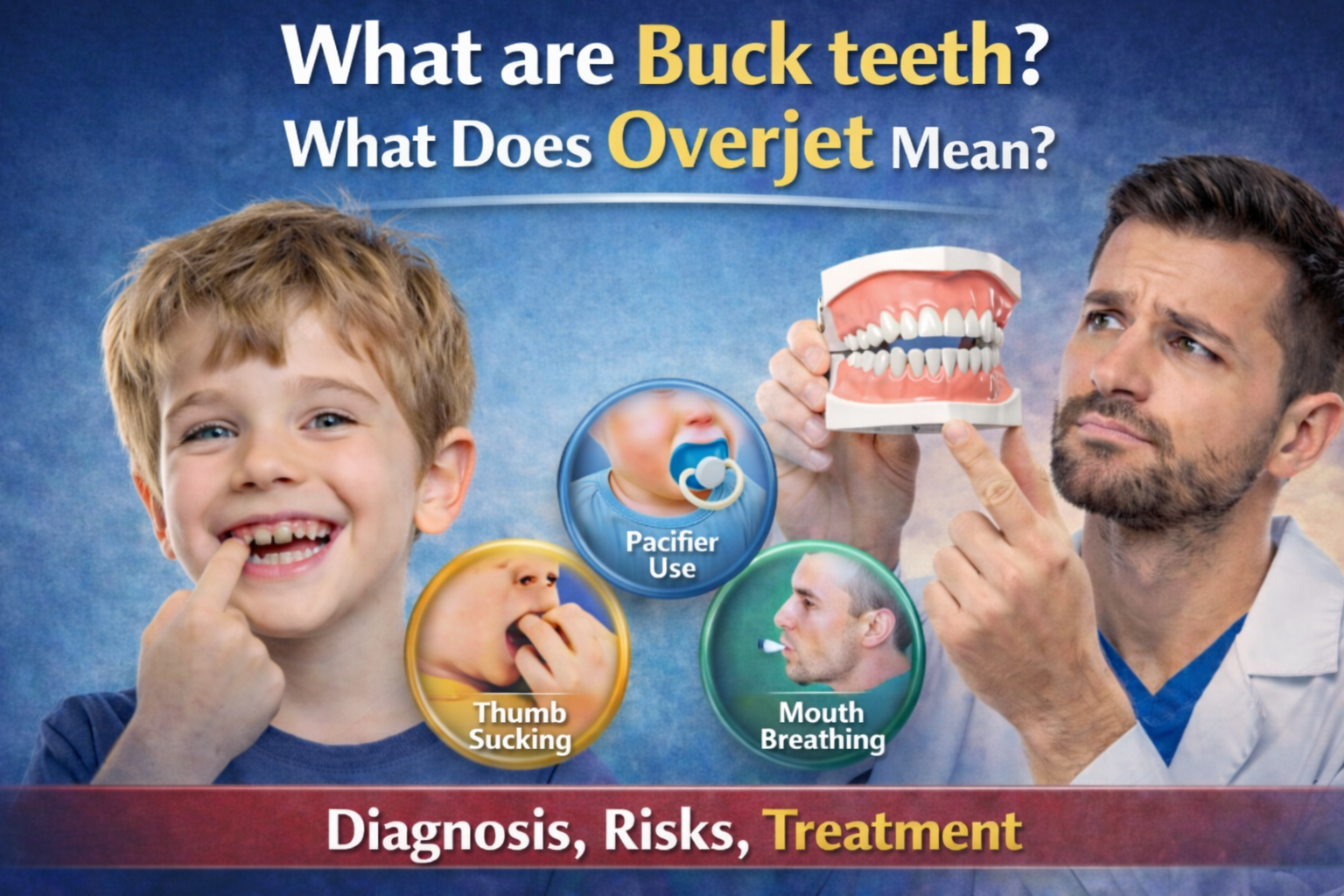
"Buck teeth" is the everyday name for upper front teeth that sit well ahead of the lower ones. Dentists call that distance the overjet. It can come from the position of the teeth, of the jaws, or both. A large overjet is linked to more injuries to the front teeth, and the right treatment depends on age and cause.
- Bite problems rarely have one cause: heredity, injury, early or late tooth loss and long-term thumb-sucking can all play a part.
- Children with a large overjet have higher odds of injuring their front teeth.
- Early treatment in children reduced new injuries but did not give a better final result than waiting.
- In adults, the options depend on whether the teeth or the jaws are the main cause.
What the overjet is
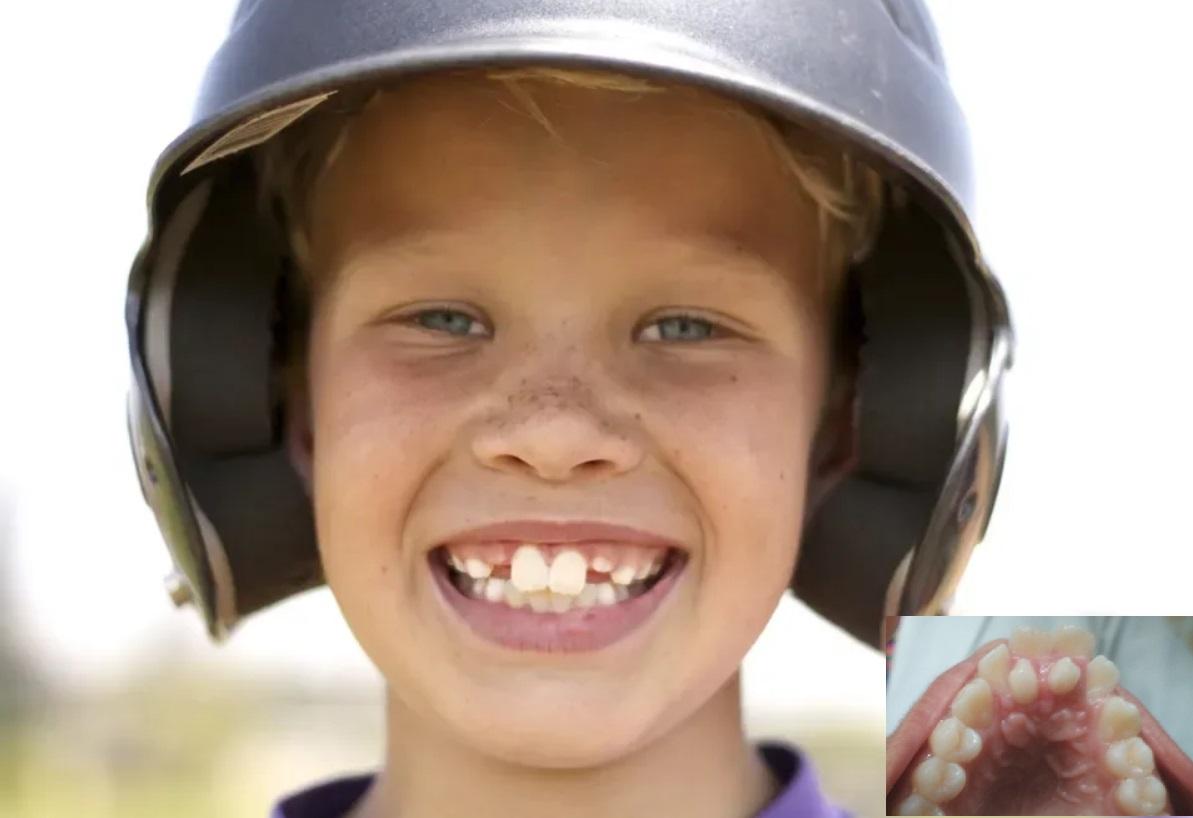
When you bite your back teeth together, the upper front teeth normally sit a little in front of the lower ones. The horizontal distance between them is the overjet. When it is large, the upper teeth stick out, and the lips may not close comfortably over them.
A dentist or orthodontist measures the overjet at an examination and looks at why it is large. Two broad situations are possible, and they are often mixed:
- The teeth are tipped forward, while the jaws are in a reasonable relationship.
- The jaws are out of line, most often with the lower jaw sitting further back than usual.
This matters because it changes what treatment can do, especially once a person has stopped growing.
Why upper front teeth stick out
There is rarely a single cause. According to the American Dental Association, bite problems may be inherited, or follow an injury, the early or late loss of teeth, or thumb-sucking1.
Thumb-sucking is the cause people ask about most. A review of 15 studies found that a longer sucking habit was linked to a higher risk of bite problems2. Children who used a dummy (pacifier) were less likely than thumb- or finger-suckers to develop an increased overjet, but dummies were linked to a higher risk of most other bite problems. The authors stress that bite problems have many causes.
So a child who sucked a thumb and has prominent teeth may have inherited the tendency too. Stopping a long-term habit is sensible, but on its own it may not correct a bite that has already developed. The review we rely on did not test that.
More than looks: the risk of injury
Upper front teeth that stick out are more exposed to knocks and falls. A review of 41 studies found that a larger overjet went with higher odds of injuring the front teeth:
- In children with overjet over 5 mm, the odds were about 1.8 to 2.4 times higher3, depending on age and the stage of the teeth.
- In children aged up to 6 with overjet of 3 mm or more, the odds were about 3.4 times higher3.
These are odds from observational studies, not the chance that any one child will be injured, and they do not prove that the overjet itself causes the injuries. They are still a reason to take a large overjet seriously in a child who plays sport or falls often.
Treatment in children and teenagers
A Cochrane review of 27 randomised trials of treatment for prominent upper front teeth included comparisons of starting early, at about 7 to 11 years, with waiting until adolescence, at about 12 to 16.
- Fewer injuries with early treatment. In a comparison of 332 children, early treatment with a functional appliance, a brace that holds the lower jaw forward, reduced new injuries to the front teeth. About 19 in 100 children treated early reported a new injury, compared with 30 in 100 who waited4 (moderate-quality evidence).
- No better final result. Once both groups had finished, the final overjet and the relationship of the jaws were not significantly different. The authors found no other advantage of early treatment.
- Early does not mean once. Early treatment in these trials was done in two phases, so starting early did not avoid braces later.
In teenagers, functional appliances reduced the overjet compared with no treatment, by about 4.62 mm on average with removable appliances and 5.46 mm with fixed ones4. These results come from small trials, and the evidence is of low quality.
Whether to start early is therefore a choice to weigh with your orthodontist: mainly whether the risk of injury justifies a longer, two-phase course for your child.
At any age, decay and gum problems are dealt with before an appliance is fitted, and fixed braces carry their own risk. In pooled studies whose patients averaged about 16 years old, about 55 in 100 orthodontic patients had white marks, an early stage of decay, compared with about 29 in 100 untreated people5. Careful cleaning and less sugar are the standard advice.
Treatment in adults
In adults the jaws have stopped growing, so appliances that rely on growth are not an option. None of the sources we rely on shows that they change the jaws in adults.
What an orthodontist can offer depends on the cause. Where the teeth are mainly tipped forward, braces or aligners may be enough to bring them back. Where the jaws themselves are the main cause, the options are different: some adults may be offered braces alone, and others braces combined with jaw surgery. Which applies to you can only be judged at an examination.
The UK dental regulator accepts that some parts of dental care can be provided safely at a distance, while others need a face-to-face visit or a physical examination6. For orthodontics, it says there is at present no effective substitute for a physical, clinical examination6. Treatment is a commitment: most people are in treatment for one to three years1. Ask what the plan is expected to achieve, what the alternatives are, including no treatment, and what the risks are for you.
After treatment: keeping the teeth in place
Once the overjet is corrected, teeth tend to drift back towards where they started7, so a retainer is worn to hold them. Your orthodontist will tell you how long you need to wear it8. Research has not settled on an exact length of time: most studies of retainers measured outcomes after less than a year7. If a retainer breaks, is lost or no longer fits, contact your orthodontist.
Do not try to move teeth at home
We found no evidence that pressing teeth back with a finger or the tongue improves them, and home methods can do serious harm. In one published case, an elastic band used by an 8-year-old to close a gap slipped under the gum, more than 75% of the bone holding the teeth was lost, and two front teeth could not be saved9. Teeth should be moved only after an examination and under a clinician's care.
When to see a dentist
Book a dental check-up if:
- your child's upper front teeth stick out noticeably, or the lips do not close over them
- your child has a thumb-, finger- or dummy-sucking habit that is not stopping: raise it at a routine check-up rather than waiting for the adult teeth to come through
- you are an adult who is bothered by prominent teeth or has trouble closing the lips
After a knock to a front tooth, see a dentist straight away if a tooth is knocked out, and the same day if it is chipped, loose or pushed out of place.
Emergencies. Call 112 or go to the nearest emergency department after a head injury with drowsiness, vomiting or confusion, or if there is heavy bleeding that does not stop, or difficulty breathing.
Wondering about your child's bite?
Send us a message with your question. Our dentists will explain what an examination would look at and which options might be worth discussing.
Frequently asked questions
Are buck teeth caused by thumb-sucking?
Sometimes it plays a part. A long-term sucking habit is linked to bite problems, but heredity, injury and early or late loss of teeth can also contribute. Most bite problems have more than one cause.
Is it better to treat buck teeth early?
Early treatment in children reduced new injuries to the front teeth, but the final result was not shown to be better than waiting, and it usually meant two phases. Discuss the trade-off with an orthodontist.
Can buck teeth be fixed in adults?
Often, but how depends on the cause. If the teeth are mainly tipped forward, braces or aligners may be enough. If the jaws are the main cause, some adults are offered jaw surgery with orthodontic treatment.
Are buck teeth only a cosmetic problem?
Not only. In studies of children, a larger overjet was linked to higher odds of injuring the front teeth. That is one reason a dentist may suggest an orthodontic assessment.
Can I push my teeth back myself?
No. There is no evidence that pressing teeth moves them into a better position, and home methods such as elastic bands have caused serious harm. Teeth should only be moved under a clinician's care.
Sources
- Braces. American Dental Association, MouthHealthy.↩mouthhealthy.org
- Establishing the association between nonnutritive sucking behavior and malocclusions: a systematic review and meta-analysis. Journal of the American Dental Association 2016;147(12):926-934.e6. 2016.↩doi.org
- The association of overjet size and traumatic dental injuries - a systematic review and meta-analysis. Dental Traumatology 2019;35(4-5):217-232. 2019.↩doi.org
- Orthodontic treatment for prominent upper front teeth (Class II malocclusion) in children and adolescents. Cochrane Database of Systematic Reviews 2018;3:CD003452. 2018.↩doi.org
- Prevalence, incidence and risk factors of white spot lesions associated with orthodontic treatment - a systematic review and meta-analysis. Orthodontics & Craniofacial Research 2025;28(2):379-399. 2025.↩doi.org
- GDC statement on 'direct-to-consumer' orthodontic treatment. General Dental Council (UK).↩gdc-uk.org
- Retention procedures for stabilising tooth position after treatment with orthodontic braces. Cochrane Database of Systematic Reviews 2023;5:CD002283. 2023.↩doi.org
- Braces. NHS (UK). 2026.↩nhs.uk
- The Risks of DIY Braces: An Orthodontic Case Study. American Association of Orthodontists. 2024.↩aaoinfo.org

Dt. Dilek AKSU GÜLER
Dentist · Founder
She has completed advanced training in implantology and works in aesthetic restorations and smile design.