
What is full-mouth implant treatment, and what are the options?
A jaw with no teeth is not treated by one single method. There are four main routes, and one uses no implants. The first is a removable full denture. The second is a removable denture that clips onto implants. The third is a fixed bridge on four or six implants. The fourth is two or three shorter fixed bridges on more implants. Full-mouth implant treatment covers the three routes that use implants.
The implant numbers on this page are for one jaw. The choice depends on your bone, your expectations and how much daily care you can manage. This page is not written to promote one treatment; it is written to help you choose. It compares the four routes first. It then sets out the questions that decide, the options when bone is lacking, the process, the risks and the survival data. If you are missing one or a few teeth, the dental implants page is closer to your question. The treatment described here is provided at our clinic in Antalya, Turkey; on this page, "we" means that clinic.
- There are four routes, and none is better than the others for every patient; the choice depends on bone, expectations and daily care.
- With a fixed bridge, about 97 to 98 in 100 implants were still in place at five years and beyond. The bridge itself needs maintenance and occasional repair.
- No difference in survival has been shown between four and six implants; that is not proof that the two are equivalent for every patient. The number is chosen for the patient.
- Extracting all the teeth while some could be saved is a decision that cannot be undone; ask for the reasoning in writing.
- If there is not enough bone, a graft, a sinus lift or zygomatic implants may be considered; each has its own risks and time.
Four routes and a fifth: what are you choosing?
If teeth remain in the jaw, keeping them is a fifth route, and the list starts with it. The other four are for a jaw with no teeth left, or with teeth that cannot be saved.
- Keeping the remaining teeth. If teeth in the jaw can be saved, keeping them is also a route. Gum treatment, root canal treatment and a partial denture are smaller steps than extracting every tooth. Extracting all the teeth cannot be undone, so the first question is always "do they really all need to come out?"
- A removable full denture. It needs no implant surgery. If teeth have to be extracted first, those extractions cannot be undone. It rests on the gums and, in the upper jaw, on the palate. Getting used to it takes time, chewing force is limited and the jaw bone continues to shrink. On the other hand, it can be made now and is easy to replace.
- An implant-retained removable denture. It clips onto implants: often two in the lower jaw, usually at least four in the upper. You take it out to clean it. Grip is clearly better than with a full denture. In the lower jaw it can often be done with fewer implants. The number of implants and the extent of surgery depend on the jaw and the denture design. Because you can take it out, cleaning is easier than with a fixed bridge for most patients.
- A fixed bridge on four or six implants. You cannot take this bridge out; your dentist can. Where the anatomy allows, the back implants are placed at an angle. The details are on the All-on-4 and All-on-6 pages.
- Several short bridges on more implants. If there is enough bone, more implants can be placed and two or three separate fixed bridges made for the jaw. Some problems can then be dealt with in one section only, although others can still need treatment across the jaw. On the other hand, more implants mean more surgery, and a graft may be needed.
Not all five routes are possible for every patient. If you have been offered only one, ask why the others were ruled out.
| Removable full denture | Implant-retained removable denture | Fixed bridge on four or six implants | Several short bridges on more implants | |
|---|---|---|---|---|
| How is it held? | Rests on the gums, and on the palate in the upper jaw | Clips onto implants, often 2 in the lower jaw and usually at least 4 in the upper; you take it out | Screwed onto 4 to 6 implants; only the dentist removes it | Each bridge sits on its own implants; only the dentist removes it |
| Surgery | No implant surgery | Yes; often fewer implants, especially in the lower jaw | Yes; can be in the same session as the extractions | Yes; the most implants, and a graft may be needed |
| Is the palate covered? | Covered in the upper jaw | Can be left open, depending on the design | Open | Open |
| Bone | Shrinkage continues | Some bone loss around the implants is expected | Some bone loss around the implants is expected | Some bone loss around the implants is expected |
| Daily care | Take out and clean | Take out and clean; the clip parts are renewed | Special cleaning under the bridge; needs manual dexterity | Under each bridge and between them; needs manual dexterity |
| If a problem arises | Relining, renewal | Clip replacement, relining | Losing one implant can affect the whole bridge | Some problems can be dealt with in one section only |
| When bone is limited | Possible | Often possible with a limited number of implants | Angled implants may reduce the need for a graft | A graft or sinus lift may be needed |
The questions that decide
If you answer these questions for yourself before the examination, it becomes easier to judge the plan you are offered.
- Is taking a denture out of your mouth acceptable to you? If it is, an implant-retained removable denture can mean fewer implants and less surgery, especially in the lower jaw. It is also easier to clean for most patients. If it is not, a fixed bridge is discussed.
- What is the state of the bone? This is decided on a 3D scan. If there is bone at the front, a fixed bridge on angled implants may be possible. If the bone has shrunk severely, a graft, a sinus lift or zygomatic implants may be considered.
- Will you be able to do the cleaning? Cleaning under a fixed bridge is demanding, and you need to be shown how. Manual dexterity, eyesight and regular reviews decide a lot here.
- What is in the opposing jaw? Natural teeth, a denture or a bridge in the other jaw changes the design and the load.
- Do you clench or grind your teeth? If you do, the bridge material and a night guard become part of the plan.
- Are there teeth that could be saved? If so, ask for the reason for each extraction in writing, such as a root fracture, decay that cannot be repaired or advanced bone loss.
Being told "let's take them all out and make it fixed" is not a reason on its own. In the same way, "it won't work for you" should come with its reasoning. The reverse also holds: extracting healthy teeth because a patient asks is not a medical reason. Teeth that can be kept may help protect the bone. If what you want is a change in appearance, that may be possible without extractions.
Who it suits, and who it does not
When an implant solution is considered
- No teeth left in a jaw, or the remaining teeth cannot be saved (advanced decay, root fractures, advanced gum disease)
- People who cannot use a removable full denture, have problems with its grip or have a strong gag reflex
- General health that allows surgery and healing
- People who can keep up daily cleaning and regular reviews
What is associated with higher risk
The figures below are pooled results of observational studies. They show an association, not proven cause and effect.
- Smoking. In people smoking more than 20 cigarettes a day, implant loss was about 2.5 times as likely per implant as in non-smokers1. Per patient it was about 4 times as likely. For early loss, a pooled analysis of 32 studies gave an odds ratio of 2.59 per implant2. An odds ratio compares odds, not risk, so this does not mean 2.6 times as likely. No safe number of cigarettes has been shown.
- A history of gum disease. Across 14 prospective studies, the rate of implant loss was about 1.75 times higher3; after fast-progressing disease it was about 6 times higher. These are hazard ratios, not absolute risks. These were treated patients; implants are not placed while the disease is active.
- Clenching or grinding. Across 27 studies, people judged likely to clench or grind their teeth were compared with people who do not. In the first group, the odds of implant loss were about 2.2 times higher4 (an odds ratio). These studies did not test whether a night guard prevents loss.
- Diabetes. The findings are mixed. Two of three reviews found no significant difference in implant loss: a nine-study review of type 2 diabetes5 and an older review6. The third, covering 89 publications, reported a higher odds ratio7 for implant loss. All three found more bone loss around implants in people with diabetes. The type 2 review based its reassuring conclusion on strictly maintained oral hygiene. Blood sugar control, daily cleaning and regular reviews therefore matter.
- Bone-strengthening medicines (bisphosphonates, denosumab). The risk depends on why, at what dose and for how long the medicine is taken. Whether it is given by drip, by injection or by mouth does not on its own decide it. In people on high-dose antiresorptive treatment for cancer, elective implant surgery is usually avoided. That group includes bisphosphonates given by drip and denosumab given by injection under the skin. The decision is made together with your oncology team; do not stop a medicine without asking your doctor. Doses used for osteoporosis are assessed separately. In a 21-study review, implant loss in people taking bisphosphonates was about 1.7 times more likely per implant8. Jaw osteonecrosis (death of an area of jaw bone) was about 3.5 times more likely per patient. The per-patient analysis of implant loss found no significant difference. These figures are for bisphosphonates and cannot be generalised to denosumab; the certainty of the evidence is very low.
- Radiotherapy to the head and neck. Implants are lost more often in irradiated bone. There is a risk of wounds that do not heal and of bone death (osteoradionecrosis). Planning is done together with your oncology team.
When a fixed bridge may not suit
- People who cannot keep up daily cleaning. If the area under the bridge cannot be cleaned, the risk of inflammation around the implants rises. For these patients a removable solution may be safer.
- Expectations about lip support. Where the bone has shrunk severely, a fixed bridge may not support the lip and cheek as well as a removable denture. This is discussed before a decision is made.
- Active infection, untreated gum disease, uncontrolled medical conditions. These are dealt with first.
- A jaw that is still growing. In young patients, implants wait until growth is complete.
Suitability is decided by an examination, a 3D scan and your medical history. A plan based on photographs or a panoramic X-ray is not final; it is a preliminary assessment.
What if there is not enough bone?
Bone is the most common obstacle in a jaw with no teeth. The options differ in the extent of surgery, their risks and their duration. A graft or a sinus lift lengthens treatment. In suitable patients, angled or zygomatic implants can shorten it compared with grafting; zygomatic implants carry their own risks, set out below.
- Angled implants. The back implants are placed at a slant to keep clear of the sinus (upper jaw) or the nerve canal (lower jaw). The consensus report of the International Team for Implantology (ITI) states that, where conditions are suitable, implants can be deliberately placed at an angle9. In many patients this can reduce the need for a graft.
- Bone grafting and sinus lift. A review pooled 11 prospective studies with at least five years of follow-up. Its patients had 6 mm of bone height or less, and their sinus floor was raised through a side window (the lateral approach). Implant loss was 0.43 per cent per implant per year10. This result cannot be applied to methods that work through the top of the ridge. Vertical bone augmentation, on the other hand, is not a small extra step. In a Cochrane review, complications were more frequent than with short implants: an odds ratio of 4.97 per patient11. The 95 per cent confidence interval was 1.10 to 22.40. This does not mean that the absolute risk is five times higher. The difference in implant loss was not significant. The details are on the bone grafting page.
- Short implants. The same Cochrane review states that in a shrunken lower jaw, short implants appear to be a better option11 than vertical bone grafting. This rests on few studies, most at high risk of bias; whether short implants suit a full-arch design is assessed separately.
- Zygomatic implants. When the upper jaw bone is not enough for standard implants, implants anchored in the cheekbone can be used. A Cochrane review describes the procedure as technically demanding12 and notes that it may be associated with serious complications. One small trial compared them with implants placed after bone grafting. Zygomatic implants led to fewer implant losses but more complications12; the two results belong together. Among complications in the surrounding tissues, inflammation of the sinus is reported most often13. Infection comes next, then an opening between the mouth and the sinus. It is not a routine option; it is explained at the consultation.
Imaging alone does not decide which route suits you. Your dentist assesses the examination, the 3D scan, your medical history and a denture plan prepared in advance together, and discusses the options with you. If a graft or a sinus lift is done, treatment takes longer.
How the treatment runs
The sequence below is shared by the fixed bridge and the implant-retained denture; the details vary with the route chosen. Times vary from patient to patient, and your plan is given in writing. How the stages fit around travel is covered in "If you are coming from abroad" below. If you would like sedation, the details are on the anaesthesia and sedation page. When the denture or bridge is complete, measurements around the implants and an X-ray are taken as a baseline14, as the consensus report asks.
Examination, 3D scan and medical history
Remaining teeth, gums, the amount of bone and the position of the sinus and the nerve canal are assessed on a 3D scan. We ask about smoking, diabetes, gum-disease history, clenching, medicines and radiotherapy. The plan states the options, the number of implants and the reasoning, in writing.
Decision appointment
The routes, including keeping any teeth that can be saved, are weighed together against your bone and your expectations. If extractions are proposed, the reason is explained tooth by tooth. You do not have to decide at this stage; you can take the plan home and get a second opinion, including from your own dentist. You can say no, or ask to stop, at any stage; once a tooth has been extracted, that step cannot be undone.
Preparation
Active infection and gum disease are treated first. A graft or sinus lift is planned if needed. If you want sedation, whether it suits you is assessed first from your medical history and medicines. With a serious general illness your own doctor is consulted; with sleep apnoea or a high body weight the breathing risk is assessed separately. The escort and fasting rules are explained in advance. If you are travelling alone, raise the escort rule before you book.
Surgery
Under local anaesthetic, with conscious sedation if you want it and it suits you, the teeth are extracted and the implants placed. For a fixed bridge the back implants are often angled. Bone may need reshaping in the same session. For a fixed bridge, part of the jaw bone may be removed to make room for the bridge and to hide the junction line. This cannot be undone; if it is in your plan, ask about its extent, the reason and the alternatives before surgery.
Provisional period
If the implants' initial hold in the bone (primary stability) is sufficient, selected patients can receive a fixed provisional bridge within a few days. If the hold is not sufficient, a removable temporary denture is used and the fixed provisional bridge waits until after healing. This decision is made during surgery, patient by patient.
Healing
The implants need time to fuse with the bone. How long depends on the bone, whether a graft was done and how you heal; you are told after the examination. Soft food and careful cleaning matter during this time.
Final bridge or denture
Once healing is confirmed, impressions are taken. Tooth shape, length and colour are agreed at try-ins, where lip support and speech are also tested. The final bridge or denture is fitted and the bite adjusted.
Review programme
When the bridge or denture is complete, pocket measurements around the implants and an X-ray are recorded as a baseline. Your review interval is set by your risk and given in writing. Your dentist can remove a fixed bridge for cleaning at intervals. If a dentist at home will see you for reviews, take this record to them.
Risks and benefits
Risks
- Steps that cannot be undone. An extracted tooth does not come back. Extracting all the teeth while some could have been saved cannot be put right later. Removing part of the jaw bone, where that is planned, cannot be reversed either. That is why getting a second opinion is reasonable.
- Implant loss. In a 55-study review, about 2 to 3 in 100 implants15 were lost at five years and beyond. With a fixed bridge, losing one implant can affect the whole bridge; with short bridges, some problems can be dealt with in one section only. That difference has not been measured; it is clinical reasoning.
- Inflammation around implants. Peri-implant mucositis is inflammation of the soft tissue around an implant. Peri-implantitis is that inflammation with loss of the supporting bone. An umbrella review of reviews on full-arch bridges reports peri-implantitis at 4 to 18 per cent16. These rates are as given in the review abstracts; whether they count patients or implants could not be verified in the full text. In implant patients in general, a 57-study review found it in about 20 in 100 patients17. The rate depends on the definition used and the time in function.
- Bone loss. At five years the 55-study review reports an average bone loss of 1.28 mm per implant with four implants and 0.94 mm with six15. These are averages; they do not mean that this much loss is harmless for your own implants. Loss that continues, especially with inflammation, is checked against your baseline record14. "No bone loss" is not true.
- Technical problems with the bridge. Reviews report screw loosening at 5 to 15 per cent and framework fracture under 5 per cent16. Chipping of veneered zirconia is reported at 15 to 35 per cent. These rates are as given in the review abstracts; the follow-up period and the denominators could not be verified in the full text. In these reviews, bridges of solid (monolithic) zirconia chipped less than veneered zirconia, and monolithic and screw-retained designs had fewer technical problems.
- Surgical risks. Bleeding, swelling, bruising and infection. In the lower jaw, the nerve canal is close: the lip and chin may feel numb for a while and, rarely, permanently. In the upper jaw, the sinus membrane may tear, and sinusitis or an opening between the mouth and the sinus may follow. The 3D scan shows these structures, and the position and angle of each implant are planned to avoid them. Complications are still possible.
- Immediate loading. Provisional teeth on the same day or within a few days (immediate loading) can work well in selected patients. A review of 39 randomised trials found slightly lower implant survival18 with immediate loading; the Cochrane review19 found no convincing difference within one year. Placing an implant straight into the socket of an extracted tooth is a separate question. There, survival was lower than with implants placed in healed sockets: 95.2 versus 98.4 per cent20. If your plan places implants on the day of the extractions, ask whether any will go straight into a socket.
- Speech, lip support and adaptation. Speech and chewing change in the first weeks. A fixed bridge may not support the lip as well as a removable denture.
Benefits
- Implant solutions can improve grip and chewing comfort. Sensation and use are not the same as natural teeth; the result varies by person and design.
- An international consensus report of implant dentists recommends implant prostheses to help preserve the jaw bone and the chewing muscles21. That is a consensus view, not a measured effect, and some bone loss around implants is still expected (see "Bone loss" above).
- With a fixed bridge the palate stays uncovered; for many patients this matters for taste and speech.
- Where the anatomy allows, angled back implants can reduce the need for a graft and shorten treatment.
- An implant-retained removable denture can give a clear gain in grip with fewer implants, especially in the lower jaw. Because you can take it out, cleaning is easier for most patients.
After surgery and daily care
The first days
- Swelling and bruising usually increase over the first 48 to 72 hours, then settle. Use cold packs and the medicines prescribed.
- Eat soft, lukewarm food in the first weeks. While the provisional denture or bridge is in place, do not chew hard or sticky food; this protects healing.
- If you had sedation, do not drive or operate machinery for as long as the sedation team tells you. Whether you need an escort depends on the method. A UK national standard covers conscious sedation in dentistry. For adults, it says that every form of sedation other than inhalation sedation requires a responsible adult as an escort22. It also says that treatment under sedation must not be provided if an escort cannot be assured. Before you leave the clinic after surgery, you and your escort should have written aftercare instructions. You should also know how to reach the clinic, including out of hours.
- Smoking impairs healing. At the very least, do not smoke during the healing period.
- If you had a sinus lift, do not blow your nose or drink through a straw, and if you sneeze, keep your mouth open. These rules reduce pressure changes on the sinus membrane. Follow the written instructions you are given.
Flying
A 2023 narrative review suggests waiting at least 72 hours23 after implant placement before flying. After a sinus lift it suggests at least two, and ideally six, weeks. These intervals assume no pain, swelling or bleeding at the treated site. The authors say the research is limited and comes mostly from military aviation. They offer the intervals as a starting point for the dentist's decision, not as clearance to fly. Your plan is built around them.
Daily care
- With a fixed bridge: clean under the bridge every day with bridge floss, interdental brushes or a water flosser. Your dentist shows you which works in your mouth.
- With a removable denture: take the denture out and clean it with the cleaner your dentist recommends. Clean the implant heads and the clip parts separately. Ask whether to leave it out at night. The clip parts are renewed over time.
- Brush twice a day with a soft brush, paying particular attention to the line where the gum meets the bridge or denture. Use fluoride toothpaste on a fixed bridge and on any natural teeth; a removable denture is cleaned as above.
- If you clench, a night guard may be advised. It has not been shown to prevent implant loss; its purpose is to protect the bridge or denture from the forces of clenching.
- Reviews. The consensus report asks for an X-ray and pocket measurements to be taken as a baseline14 when the bridge or denture is complete. The European Federation of Periodontology guideline calls for a structured supportive care programme24. The UK's NICE guideline on dental recall covers check-ups in general, not implants. It asks for the interval between reviews to be set for each patient25. It is based on a risk assessment and discussed with the patient.
How long does it last?
The rates below are from published studies, not from our own records, and they are not promises. They are pooled estimates, calculated with statistical models from studies with different follow-up periods. What happens in your case depends on your bone, your habits and your care.
- Implants under a fixed bridge. In the 55-study review, about 97 to 98 in 100 implants15 were still in place at five years and beyond (per implant).
- The bridge itself. In an umbrella review of seven systematic reviews, bridge survival over 5 to 15 years was about 90 to 97 per cent16. That is as given in the review abstract; whether it counts bridges or patients could not be verified in the full text. A 2012 review looked at full-arch bridges on four to six implants. In the upper jaw, about 97 in 100 were in use at five years and 95 at ten26. In the lower jaw the figures were 98 at five years and 96 at ten.
- Several short bridges: indirect data only. We have no pooled direct data for this route. The nearest data are for single crowns. In a 46-study review, about 97 in 100 implants carrying a single crown were in place at five years, and about 95 at ten27. Of the crowns on them, about 96 in 100 were in use at five years and about 89 at ten. These figures cannot be carried over directly to short bridges or full-arch designs.
- Implant-retained removable dentures. The reviews cited on this page give no pooled survival figures for them, so this page gives none. The clip parts wear and are renewed, and the denture is relined over time; ask what your plan includes.
- Maintenance. Being in use does not mean no repair was needed. Regular cleaning and reviews are part of care. A loose screw or chipped porcelain needs extra repair. Some bridges have to be remade, which counts as losing the original bridge. Ask beforehand whether these are included in your plan.
- No one can promise a lifetime result. Follow-up in the reviews cited here goes up to 15 years. Longer studies of implants in general exist, but they cannot predict how long this particular bridge will last. An offer that promises a result for life is not based on evidence.
If you are coming from abroad
We have found no good research comparing full-mouth treatment squeezed into a few days with treatment spread over months. The nearest evidence, the Cochrane review of loading times19, followed patients for a year at most, so it cannot settle the question. The timing first has to meet clinical requirements: how firmly the implants hold and how you heal. Beyond that, judge it on practical grounds. How is healing checked? Who do you contact if something goes wrong? What aftercare is included in the plan?
Trips and days
The way we plan full-mouth treatment, a healing period separates the surgery from the final bridge or denture. So the treatment does not fit into one trip. A graft or a sinus lift lengthens it further. Your plan states how many trips it needs, what is done on each, how many days each one takes and when you can fly. Have that in writing before you book travel. The intervals before flying are under "After surgery and daily care" above.
Between trips, at home, you wear a provisional: a fixed provisional bridge in selected patients, or a removable temporary denture. Which one you will have is decided during surgery, so ask what happens in each case and whether both are included in your plan.
Between trips and after you go home
Between the stages, you can have a check with a dentist in your own country; if you do, we write it into the plan. Some dentists may not want to take on treatment that is in progress. So the plan also says where to turn if a problem arises in between. The Dutch dental association advises talking the plan through with your own dentist28 before you go. It also suggests asking whether you can go to that dentist if something goes wrong28. Ask your dentist at home, too, whether the treatment could be done where you live instead.
Once the bridge or denture is in use, the supportive care the European Federation of Periodontology calls for24 will mostly happen near your home. Before you fly home, ask for your record: the implant system placed, with its diameter and length, your baseline X-ray and measurements, and your scan. The record should also name the parts the bridge or denture is attached to. A dentist at home needs it to look after the implants. Before you go, ask your dentist at home whether they can work with that implant system. In Turkey, the health tourism regulation entitles international patients to an itemised bill. On request, they also get free copies of the records of the materials used, the tests and the imaging29. The regulation also requires a facility treating international patients to take out complication insurance for surgical and interventional procedures carried out in an operating theatre29. That does not by itself tell you whether your implant surgery is covered, so ask which procedures in your plan fall under it.
Whether care at home is covered depends on the health service or your insurer in the country where you live. The same goes for repairs to a bridge or denture made abroad. Ask them before you travel, and get the answer in writing.
Questions to ask before you commit
Ask us all of the questions below before you agree to treatment, and ask for the answers in writing.
- Who will carry out my treatment, and what are their qualifications?
- How many times have you carried out this procedure; what are your success, complication and infection rates?
- Are you regulated by a professional body and registered with it?
- If there is a complication, are the remake and correction terms in writing, and for how long do they apply?
- What aftercare do you provide, and who can I contact after the treatment?
- What happens if I am unhappy with the results?
- If there are complications, who pays for the further treatment, the extra flights and the hotel?
- Do you have a complaints system, and can I see a copy?
The rules for dentists differ between countries, so check the rules in your own country as well. The full list of questions to ask before treatment abroad, and how we answer each one, is on our page about dental treatment abroad. We give you the route to follow if there is a complication, and our remake terms, in writing before treatment. You can ask us for that document before you decide.
When to contact a dentist
After surgery, or at any time while you use your bridge or denture, contact your dentist if you notice any of the following.
- Pain or swelling that increases after the third day, or bleeding that does not stop
- Numbness of the lip, tongue or chin that lasts beyond the expected duration of the anaesthetic
- The bridge or denture moves, a screw feels loose, or a piece cracks or breaks
- Bleeding, a bad smell, pus or receding gum around the bridge or denture
- Pain on biting, or a bite that feels high
- Nasal discharge, a blocked nose or sinus pain (upper jaw)
- A sore spot under a removable denture, or a sore that does not heal
- A high temperature or feeling unwell after surgery
Before you fly home. If any of these starts while you are still in Turkey, tell us before you travel.
Once you are home. Contact us through the route written in your plan. If numbness persists, pain or swelling keeps increasing, or the bridge or denture moves, also see a dentist locally without waiting for our reply. If your plan names a dentist at home, contact them as well.
Emergencies. Difficulty breathing or swallowing, rapidly spreading swelling of the face or neck, or swelling around the eye are serious signs. If you have any of them, do not wait for the clinic's reply. Go to the nearest emergency department or call the emergency number where you are (112 if you are in Turkey).
What determines the cost?
This page carries no prices. The main factors in a plan are these:
- The route chosen: removable denture, implant-retained denture, fixed bridge or several short bridges
- The number of extractions, and any bone reshaping
- The number of implants, the system chosen and the connecting parts
- Whether a graft or a sinus lift is needed
- The provisional denture or bridge used during healing
- The material of the final bridge: monolithic zirconia, veneered zirconia or acrylic on titanium
- Sedation, the number of trips and the review programme
- The remake terms in case of complications
Ask in writing what your plan includes and which items are left for later. The plan should also state who pays for further treatment and extra travel if there is a complication. Two plans often do not describe the same scope: the number of implants, the material and the number of teeth can differ. Add travel and accommodation for each trip when you compare them. Before treatment we give you, in writing, the route to follow if there is a complication and our remake terms. You can ask us for that document before you decide.
Which route suits your jaw?
Send a panoramic X-ray or scan if you have one, and photographs of your teeth. Our dentists will write back with a preliminary view on which options are open to you, whether bone support may be needed and how many stages and trips are likely. This is not a treatment plan: the plan follows an examination and a 3D scan.
Frequently Asked Questions
Several short bridges, or All-on-4 or All-on-6: which suits me?
Several short bridges means more implants carrying two or three separate bridges. It is sometimes called "individual implants", but that does not mean one implant for each tooth. If there is enough bone, both routes are possible. Separate bridges mean more implants and more surgery, and a graft may be needed. On the other hand, some problems can then be dealt with in one section only, although others can still need treatment across the jaw. A fixed bridge on four or six implants needs fewer implants, but losing one implant can affect the whole bridge. We have found no study that compares the two directly. The decision rests on your 3D scan, how well you can clean and what you expect.
Why do all my teeth need to come out? I do not think they do.
That is a fair question, and the reason should be explained tooth by tooth. A tooth may need extracting because of a root fracture, decay that cannot be repaired or advanced bone loss. Extracting all the teeth in a jaw while some could be saved is a decision that cannot be undone. Ask for the reasoning in writing, based on the scan and the examination; getting a second opinion is reasonable.
Isn't All-on-4 at least as good as All-on-6?
The difference is the number of implants. In the 55-study review, about 97 to 98 in 100 implants were still in place at five years and beyond. No significant difference in survival was shown between the two designs. The umbrella review also found that the number of implants did not affect bridge survival. That does not mean the two are equivalent: the comparisons pool results from different groups of patients. The number is chosen by your bone, your jaw and your habits.1615
Could I have 10 or 12 teeth per jaw instead of 14?
How many teeth a jaw gets depends on where the implants sit, how far back the bridge can extend and the bite. We have no pooled data supporting a particular number, so this page gives none. Whether the back teeth are added to the bridge depends on the same assessment. The further the bridge extends, the more screw and porcelain problems may increase. That has not been measured in the reviews cited here; it is clinical reasoning. Ask how many teeth are planned for you and why; the number of teeth is not a measure of quality on its own.
Can I have fixed temporary teeth straight away?
In selected patients, a fixed provisional bridge can be fitted within a few days if the implants hold firmly enough at placement (primary stability). If the hold is not sufficient, a removable temporary denture is used. The evidence is mixed. The Cochrane review found no convincing difference within one year. A review of 39 randomised trials found slightly lower survival with immediate loading. The decision is made during surgery; nobody is promised fixed teeth on the same day. If you are travelling, this is what you will wear at home between trips, so ask what happens in each case before you book.1918
Once I have a fixed bridge, will it be trouble-free?
No. In published studies, about 97 to 98 in 100 implants were still in place at five years and beyond. Bridge survival over 5 to 15 years was about 90 to 97 per cent. But staying in use is not the same as trouble-free. Reviews report screw loosening at 5 to 15 per cent and chipping of veneered zirconia at 15 to 35 per cent. These bridge figures are as given in review abstracts; what they count could not be verified in the full text. No one can promise a lifetime result; the bridge may need to be remade over the years.1516
I was told I do not have enough bone. Can I still have a fixed bridge?
Often yes, but the route changes. Angled implants can reduce the need for a graft where the anatomy allows. If the bone has shrunk severely, a graft, a sinus lift or, in the upper jaw, zygomatic implants may be considered. Some patients had 6 mm of bone height or less and had their sinus floor raised through a side window. In them, implant loss was 0.43 per cent per implant per year. With vertical bone augmentation, complications were more frequent than with short implants (odds ratio 4.97 per patient). A graft or sinus lift lengthens treatment; angled implants or, in suitable patients, zygomatic implants can shorten it compared with grafting.111210
How many trips will I need? Another clinic said two.
Our full-mouth plans have a surgical stage and a final bridge or denture, with healing in between. So the treatment does not fit into one trip. How many trips your plan needs depends on the route, any graft and how you heal. If a plan offers fewer trips, ask how healing will be confirmed and where the try-ins will be done. A review suggests not flying for at least 72 hours23 after implant placement, if there is no pain, swelling or bleeding. That is a minimum before flying, not the length of the treatment. Your trips, your appointments and the time between them are given in your written plan.
How much does it cost, and what determines that?
This page gives no prices. The main items are the route chosen, the number of extractions, and the number of implants and the system. Any graft, the provisional, the material of the final bridge, the number of trips and the review programme also count. When you compare two plans, compare their scope. Look at the number of implants, the material, the number of teeth and the provisional. Check who pays for further treatment and travel if there is a complication.
What if something goes wrong after I go home?
If breathing or swallowing becomes difficult, or swelling spreads quickly or reaches the eye or neck, get emergency care where you are. Then tell us. For a high temperature or bleeding that does not stop, contact a dentist straight away. For other problems, contact us through the route in your plan. If numbness persists, pain or swelling keeps increasing, or the bridge moves, also see a local dentist without waiting for our reply. The route to follow if there is a complication is given to you in writing before treatment, including who pays for further treatment and travel. A check with a dentist in your own country can be written into the plan. Whether care at home is covered depends on the health service or your insurer in the country where you live. Ask them before you travel.
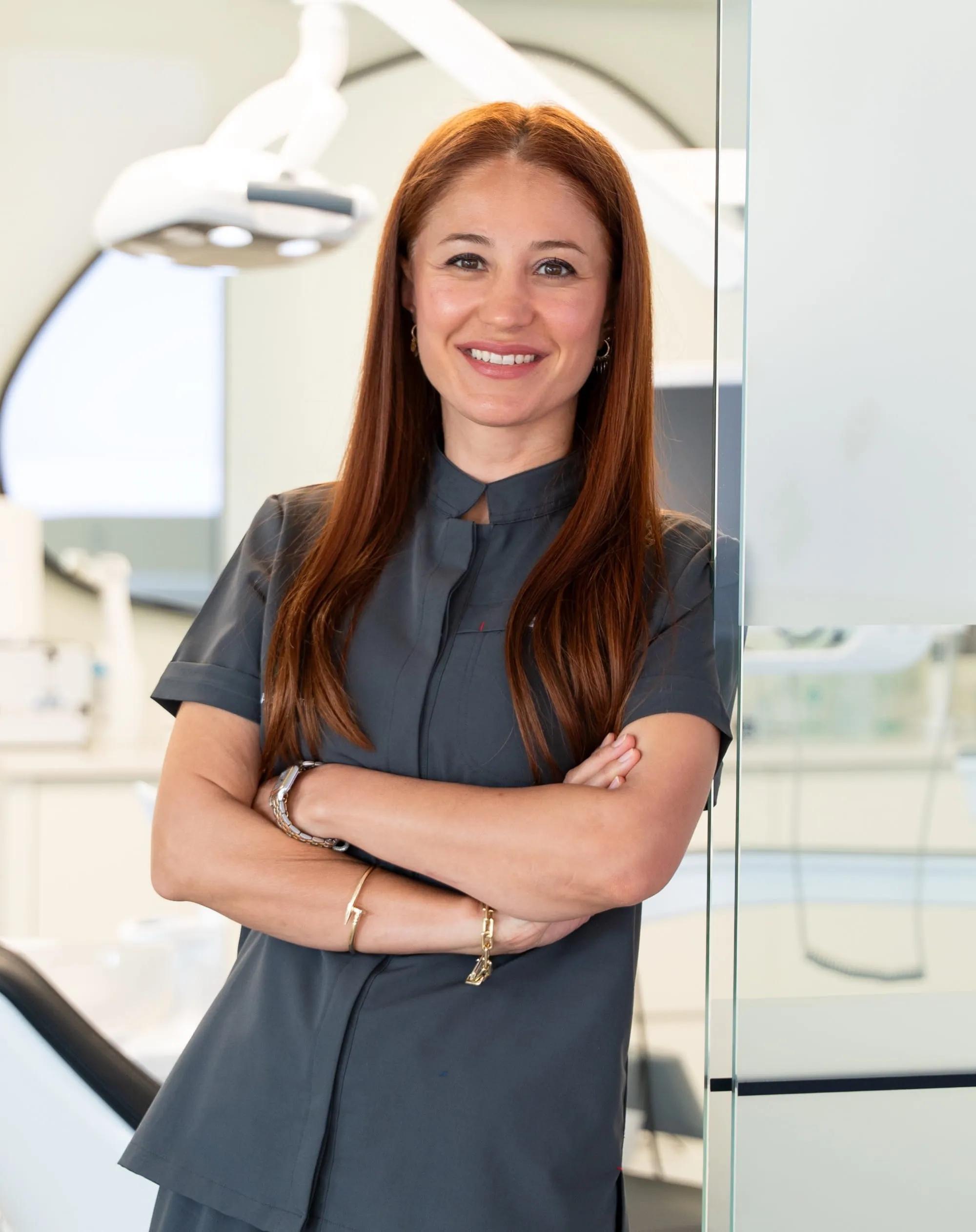
Dt. Dilek AKSU GÜLER
Dentist · Founder
She has completed advanced training in implantology and works in aesthetic restorations and smile design.
Sources
- Levels of smoking and dental implants failure: systematic review and meta-analysis (23 articles). Journal of Clinical Periodontology 2020;47(4):518-528. 2020.↩doi.org
- Smoking in relation to early dental implant failure: systematic review and meta-analysis (32 observational studies, 59,246 implants, 14,115 patients). Journal of Dentistry 2024;151:105396. 2024.↩doi.org
- Effectiveness of implant therapy in patients with and without a history of periodontitis: systematic review with meta-analysis of prospective cohort studies (14 studies, >=36 months). Journal of Periodontal Research 2025;60(6):524-543. 2025.↩doi.org
- Bruxism and dental implants: systematic review and meta-analysis (27 studies; 2,105 implants in probable bruxers, 10,264 in non-bruxers). Journal of Oral Rehabilitation 2024;51(1):202-217. 2024.↩doi.org
- Impact of hyperglycemia on the rate of implant failure and peri-implant parameters in patients with type 2 diabetes mellitus: systematic review and meta-analysis (9 studies). Journal of the American Dental Association 2021;152(3):189-201. 2021.↩doi.org
- The impact of diabetes on dental implant failure: a systematic review and meta-analysis. International Journal of Oral and Maxillofacial Surgery 2016;45(10):1237-1245. 2016.↩doi.org
- Diabetes mellitus and dental implants: systematic review and meta-analysis (89 publications; 5,510 implants in diabetic and 62,780 in non-diabetic patients). Materials 2022;15(9):3227. 2022.↩doi.org
- Effects of bisphosphonates and denosumab on dental implants: systematic review with meta-analysis (21 studies, ROBINS-I, GRADE). Oral Diseases 2025;31(10):2835-2847. 2025.↩doi.org
- Group 2 ITI Consensus Report: prosthodontics and implant dentistry. Clinical Oral Implants Research 2018;29 Suppl 16:215-223. 2018.↩doi.org
- Long-term effectiveness of maxillary sinus floor augmentation: systematic review and meta-analysis (11 prospective studies, follow-up at least 5 years). Journal of Clinical Periodontology 2019;46 Suppl 21:307-318. 2019.↩doi.org
- Interventions for replacing missing teeth: horizontal and vertical bone augmentation techniques for dental implant treatment (Cochrane review, 13 RCTs). Cochrane Database of Systematic Reviews 2009;(4):CD003607. 2009.↩doi.org
- Interventions for replacing missing teeth: zygomatic implants for the rehabilitation of the severely atrophic edentulous maxilla (Cochrane review, 2 RCTs). Cochrane Database of Systematic Reviews 2026;7(7):CD004151. 2026.↩doi.org
- Survival and complications of zygomatic implants compared to conventional implants in longitudinal studies with at least 5 years of follow-up: systematic review and meta-analysis (18 studies). Clinical Implant Dentistry and Related Research 2023;25(1):177-189. 2023.↩doi.org
- Peri-implant diseases and conditions: consensus report of workgroup 4 of the 2017 World Workshop on the Classification of Periodontal and Peri-Implant Diseases and Conditions. Journal of Clinical Periodontology 2018;45 Suppl 20:S286-S291. 2018.↩doi.org
- All-on-4 and All-on-6 implant-supported fixed prostheses for the edentulous jaw: systematic review and meta-analysis (55 studies). International Journal of Oral and Maxillofacial Surgery 2026;55(9):1098-1112. 2026.↩doi.org
- Prosthetic complications of implant-supported complete arch prostheses: an umbrella review of systematic reviews (7 reviews, >=5-year follow-up). Journal of Prosthetic Dentistry 2026;136(1):52-59. 2026.↩doi.org
- What is the prevalence of peri-implantitis? A systematic review and meta-analysis (57 articles, 2005-2021). BMC Oral Health 2022;22(1):449. 2022.↩doi.org
- Immediate versus early or conventional loading dental implants with fixed prostheses: systematic review and meta-analysis of randomized controlled trials (39 RCTs). Journal of Prosthetic Dentistry 2019;122(6):516-536. 2019.↩doi.org
- Interventions for replacing missing teeth: different times for loading dental implants (Cochrane review, 26 RCTs, 1,217 participants, 2,120 implants). Cochrane Database of Systematic Reviews 2013;(3):CD003878. 2013.↩doi.org
- Immediate implant placement into fresh extraction sockets versus delayed implants into healed sockets: systematic review and meta-analysis. International Journal of Oral and Maxillofacial Surgery 2017;46(9):1162-1177. 2017.↩doi.org
- Group 4 ITI Consensus Report: patient benefits following implant treatment in partially and fully edentulous patients. Clin Oral Implants Res 2023;34 Suppl 26:257-265. 2023.↩doi.org
- Standards for Conscious Sedation in the Provision of Dental Care (V1.1). Intercollegiate Advisory Committee for Sedation in Dentistry, Dental Faculties of the Royal Colleges of Surgeons and the Royal College of Anaesthetists, 2020. 2020.↩saad.org.uk
- Dental tourism and the risk of barotrauma and barodontalgia (narrative review with guiding principles). British Dental Journal 2023;234(2):115-117. 2023.↩doi.org
- Prevention and treatment of peri-implant diseases: the EFP S3 level clinical practice guideline. Journal of Clinical Periodontology 2023;50 Suppl 26:4-76. 2023.↩doi.org
- Dental checks: intervals between oral health reviews (clinical guideline CG19). National Institute for Health and Care Excellence, published 27 October 2004. 2004.↩nice.org.uk
- What is the optimal number of implants for fixed reconstructions: a systematic review (9 studies, per prosthesis). Clinical Oral Implants Research 2012;23 Suppl 6:217-228. 2012.↩doi.org
- Systematic review of the survival rate and the incidence of biological, technical and aesthetic complications of single crowns on implants (46 studies, mean follow-up 5 years). Clinical Oral Implants Research 2012;23 Suppl 6:2-21. 2012.↩doi.org
- Naar de tandarts in het buitenland? Wees op je hoede!. KNMT / Allesoverhetgebit.nl, 13 April 2026. 2026.↩allesoverhetgebit.nl
- Uluslararasi Saglik Turizmi ve Turistin Sagligi Hakkinda Yonetmelik. T.C. Saglik Bakanligi, Resmi Gazete 26/4/2025, No 32882. 2025.↩resmigazete.gov.tr