
What are mini dental implants, and how well do they work?
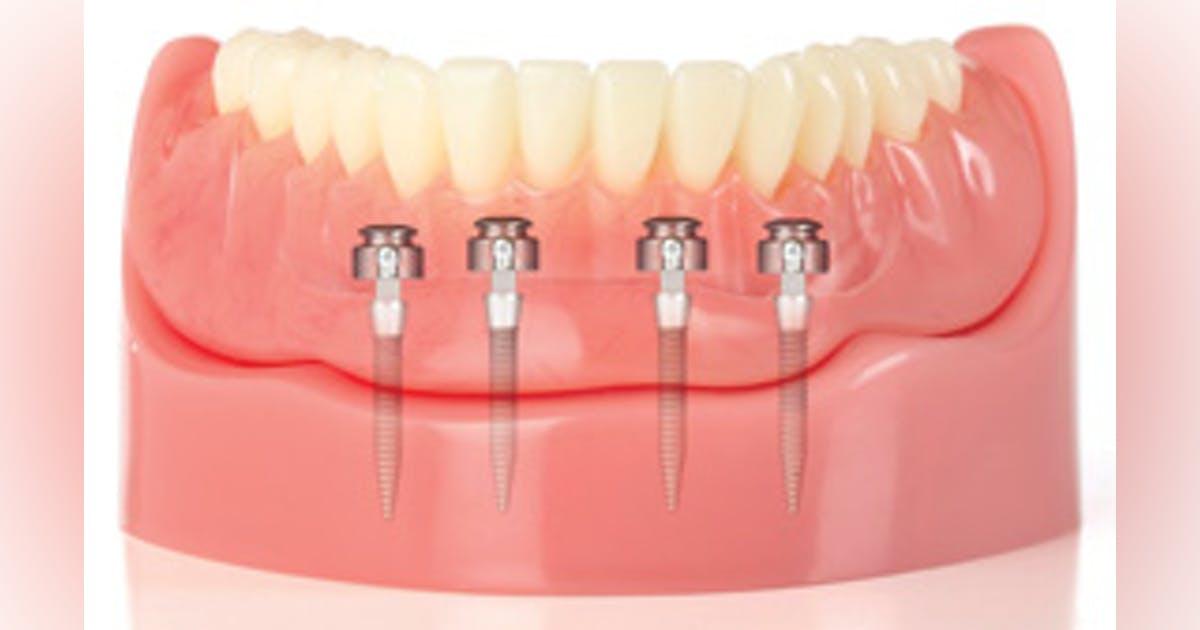
A mini implant is a dental implant much narrower than a standard one, usually under about 3 millimetres. It is mostly used to hold a removable denture, often a lower one, when there is too little bone for standard implants. Under lower dentures most stayed in place in short studies; upper-jaw results were worse. How they compare with standard implants long term is not settled.
- Mini implants are mostly used to hold a removable denture, most often a lower one, when there is too little bone for standard implants.
- In pooled studies, mostly of lower dentures, most mini implants stayed in place over an average of about two to three years; across both jaws, most losses happened in the first year.
- Results under upper dentures were clearly worse than under lower ones.
- Direct comparisons with standard implants are few, small and short, so which does better over the long term is not known.
- Published figures are averages pooled from many studies, not the result of one clinic, dentist or implant brand.
What counts as a mini implant
There is no single definition. A 2018 review calls implants narrower than 3.0 mm1 'mini-implants', and a 2025 review uses up to 3.0 mm2. The consensus report of the International Team for Implantology, also from 2018, puts the line at under 2.5 mm3. When you read a figure about mini implants, check which width the study meant.
In randomised trials, the mini implants were typically 1.8 to 2.4 mm wide4, against 3 to 4.1 mm for the standard implants they were compared with. The mini implants in an earlier review were one-piece5: the post and the part that holds the denture are made as one. In the upper-jaw studies reviewed in 2021, all used a one-piece implant with a ball-shaped top6, and all but one used a 2.4 mm implant.
Reviews describe mini implants mainly for jaws that have lost much of their bone1, and as an option when there is little bone7 or when standard treatment is not possible8. A 2014 review, covering research up to 2012, found them documented only for a jaw with no teeth and for single teeth in areas that do not take the main chewing load5. This article is about mini implants holding a denture, which is where most of the evidence lies. Whether your bone is enough even for a mini implant is decided after an examination and imaging.
How long mini implants last under a denture
The largest review, from 2025, pooled 39 studies of mini implants holding a denture: 1,005 people and 3,787 implants, followed for about 28 months on average. Of those implants, 202 were lost2, about 5 in 100. Most losses came early: 114 of the 202 in the first year. Counted per person, 13.2 per cent lost at least one implant.
The same review estimated that 96.9 per cent of implants were still in place after one year, 94.2 per cent after three years and 91.4 per cent at seven years. Most of the studies behind these figures were short, and 3,166 of the 3,787 implants were in the lower jaw, so long-term evidence is limited.
These figures count implants still in the mouth. They do not mean every implant worked without problems, and they are not your personal risk.
The upper jaw is different
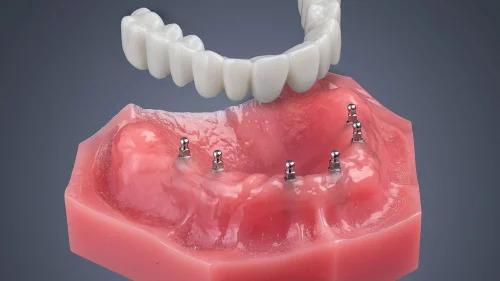
Every review used here that looked at the two jaws separately found worse results in the upper jaw. A 2021 review of upper-jaw studies, with 173 people, pooled survival at 77.1 per cent6 after an average follow-up of under two years. Single studies ranged from 53.8 to 94.3 per cent. In the 2025 review, 69 of 621 upper-jaw implants2 were lost (11.1 per cent), against 5.3 per cent overall, and 37 of 109 people lost at least one.
Whether the denture was fitted straight away mattered differently in the two jaws. Upper-jaw implants given a denture straight away did worse than those loaded later, while in the lower jaw immediate loading went with better survival. These data are observational, so neither result is a rule, and lower-jaw figures should not be used for an upper denture. The review's authors advise against fitting the denture straight away2 when the implants are not firmly stable once placed.
Mini implants or standard implants?
Across all uses, a 2018 review found that implants narrower than 3 mm failed significantly more often1 than standard-width implants: the odds of failure were 4.54 times higher. That is a relative figure, not the chance that your own implant fails, and the studies behind it were at high risk of bias. The consensus report based on that work placed the drop below 2.5 mm3 and found no difference in survival from 2.5 mm up.
For a lower denture, direct comparisons are few, small and short. A 2024 review found five randomised trials that followed people for 12 months at most. Only two reported survival: 89 to 98 per cent for mini implants and 99 to 100 per cent for standard implants4, not pooled. The longest follow-up of one trial, 37 people after about six and a half years, found no significant difference in survival9, but there too the mini implants were loaded straight away and the standard ones later, with different attachments. A review of narrow against regular implants found no significant difference7 in survival or bone loss, but its abstract does not say which widths it counted as narrow. In many trials the groups also differed in the number of implants, when the denture was fitted and how it attached, so a difference cannot be put down to width alone.
Bone around the neck of the implant tells the same story. Pooled studies found about 0.5 mm of bone loss2 around mini implants in the first six months and about 1.3 mm in studies lasting roughly five to six and a half years, with very large differences between studies. Against standard implants, results conflict: an 18-month trial found more bone loss with narrower implants10, that long follow-up found less9, and a review found no tangible difference11. Which does better over the long term is not known.
Breakage and upkeep
In the 2025 review, 76 of 1,026 dentures2 were counted as failed (7.4 per cent), 69 of them because the denture cracked across. Its authors suggest dentures with a metal framework to reduce cracking. Broken implants were included in the count of lost implants, but the review gave no separate figure for how often implants broke. In one trial, 5 of 296 mini implants broke at the tip12 while being placed. Those people had no problems around the implant over three years. Four of that study's authors declared funding from the manufacturer and the ITI.
Upkeep is frequent. In the studies that reported it, the small attachment parts in the denture had worn in 250 of 1,301 cases (19.2 per cent), 186 of 1,687 needed a new part (11.0 per cent) and 105 of 437 dentures were relined (24.0 per cent), meaning new material was added to the fitting surface so the denture fits again. The authors write that these dentures may require frequent maintenance2.
In the lower jaw, fewer implants were lost with four mini implants than with two: 96.2 against 92.2 per cent survival, and the review's authors recommend four instead of two. That recommendation rests on comparing different studies, not on a trial. An earlier review suggests at least four in the lower jaw and six in the upper8.
Mini implants are implants, so the usual implant problems apply to them too. Peri-implantitis is a plaque-associated condition13: inflammation of the tissue around an implant with progressive loss of the supporting bone, and if it progresses the implant can be lost. The mini-implant sources used here report no rate for it. The denture comes out to be cleaned every day; clean the attachment parts and around each implant as well, and ask the dental team to show you how.
What people report
Compared with their loose denture before treatment, people in the studies reported more satisfaction and a better quality of life8 with mini implants. A review of upper-jaw studies found the same6. Compared with standard implants, the picture is unclear. A review of two trials favoured mini implants, with low certainty14, while a later review of three trials found no difference4 in quality of life.
What the studies do not tell you
- Speed, surgery and grafting. Mini implants are described as an option when bone is limited, but no review used here compared them with bone grafting followed by standard implants. Claims that they are quicker or less invasive were not outcomes of these reviews. Whether you need a bone graft depends on your bone.
- Your health. How mini implants do in people who smoke, have diabetes or clench their teeth was not analysed2. For implants in general, smoking15, a history of gum disease16 and clenching or grinding17 are linked with more implant loss. Tell your dentist about all of them and the medicines you take.
- The jawbone. The bone figures above are bone around the implant. No source used here measured whether mini implants protect the jaw.
- Fixed teeth. The sources used here give no separate results for mini implants carrying a fixed bridge or replacing a single back tooth.
If mini implants are proposed, ask why they suit your case rather than standard implants, how many are planned and in which jaw, how the denture will attach, and who will maintain the attachments. Get the plan and the implant system written down. The dental implants page explains how implant treatment runs.
When to see a dentist
See a dentist if your denture is loose, rubs or makes eating hard. A conventional denture without implants needs no surgery and remains an option. Whether mini implants, standard implants, a conventional denture or another option suits you can only be decided after an examination and imaging of your bone.
Follow-up does not wait for symptoms. The consensus report on implant diseases recommends that an X-ray and probing measurements be taken as a baseline13 when the denture or bridge is completed, and the European Federation of Periodontology guideline calls for a structured supportive care programme18 once implants are in use.
If you already have mini implants, contact your dentist if you notice any of these:
- The denture no longer clicks in firmly, or rocks
- A crack in the denture, or a broken attachment part
- An implant that moves
- Bleeding, a bad smell, pus or receding gum around an implant
- Pain or swelling that increases after the third day following surgery
- Numbness of the lip, tongue or chin that lasts beyond the anaesthetic
Emergencies. Difficulty breathing or swallowing, rapidly spreading swelling of the face or neck, high fever or swelling around the eye are serious signs. Go to the nearest emergency department or call 112.
Frequently asked questions
Can I eat with a one-tooth denture?
Usually, with care, once your dentist says so. Start with soft food cut into small pieces and avoid biting into food with a front false tooth at first, especially while a temporary denture is worn over a healing area.
Can I drink sparkling water every day?
For plain, unsweetened sparkling water, laboratory evidence suggests only a small effect on enamel, far smaller than soft drinks. We found no study that set a daily limit. The flavoured ones tested were much more acidic; keep flavoured versions to mealtimes.
Is sparkling water as bad as cola?
No. In one laboratory study, plain sparkling mineral water dissolved roughly a hundredth as much as the soft drinks tested, and unsweetened water has no sugar to feed decay.
How long do mini implants last?
In pooled studies of mini implants holding a denture, about 5 in 100 implants were lost over an average of two to three years, most in the first year. Results in the upper jaw were clearly worse. Long-term evidence is limited.
Can mini implants avoid a bone graft?
They are described as an option when there is too little bone for standard implants, but no study used here compared them with grafting followed by standard implants. Whether you need a graft depends on your bone and is decided after an examination.

Dt. Dilek AKSU GÜLER
Dentist · Founder
She has completed advanced training in implantology and works in aesthetic restorations and smile design.
Sources
- Narrow-diameter implants: a systematic review and meta-analysis. Clin Oral Implants Res 2018;29 Suppl 16:21-40. 2018.↩doi.org
- Clinical and radiographic outcomes of mini-implant-retained maxillary and mandibular overdentures: a systematic review and meta-analysis. Clin Oral Investig 2025;29(3):164. 2025.↩doi.org
- Group 1 ITI Consensus Report: the influence of implant length and design and medications on clinical and patient-reported outcomes. Clin Oral Implants Res 2018;29 Suppl 16:69-77. 2018.↩doi.org
- Retention of mandibular complete overdentures using mini dental implants (<3 mm) and standard diameter implants (>3 mm): a systematic review and meta-analysis of randomised controlled trials. Oral Health Prev Dent 2024;22:181-188. 2024.↩doi.org
- Systematic review on success of narrow-diameter dental implants. Int J Oral Maxillofac Implants 2014;29 Suppl:43-54. 2014.↩doi.org
- Mini-implant-retained overdentures for the rehabilitation of completely edentulous maxillae: a systematic review and meta-analysis. Int J Environ Res Public Health 2021;18(8):4377. 2021.↩doi.org
- Narrow-diameter versus regular-diameter dental implants for mandibular overdentures: a systematic review and meta-analysis. J Prosthodont 2023;32(8):669-678. 2023.↩doi.org
- Complete overdentures retained by mini implants: a systematic review. J Dent 2017;57:4-13. 2017.↩doi.org
- Comparative clinical study of conventional dental implant and mini dental implant-retained mandibular overdenture: a 5- to 8-year prospective clinical outcomes in a previous randomized clinical trial. Clin Implant Dent Relat Res 2022;24(4):475-487. 2022.↩doi.org
- A 1.5-year randomized controlled trial comparing standard-sized implants and two diameters of mini-implants immediately loaded by mandibular overdenture. BDJ Open 2026;12(1):15. 2026.↩doi.org
- Factors and clinical outcomes for standard and mini-implants retaining mandibular overdentures: a systematic review and meta-analysis. J Prosthet Dent 2023;130(5):677-689 (epub 2022). 2022.↩doi.org
- Apical fracture of one-piece titanium-zirconium mini-implant for mandibular overdenture: a prospective 3-year follow-up. Clin Implant Dent Relat Res 2025;27(4):e70084. 2025.↩doi.org
- Peri-implant diseases and conditions: consensus report of workgroup 4 of the 2017 World Workshop on the Classification of Periodontal and Peri-Implant Diseases and Conditions. Journal of Clinical Periodontology 2018;45 Suppl 20:S286-S291. 2018.↩doi.org
- Comparison of patient satisfaction with mini-implant versus standard diameter implant overdentures: a systematic review and meta-analysis of randomized controlled trials. Int J Implant Dent 2017;3(1):29. 2017.↩doi.org
- Levels of smoking and dental implants failure: systematic review and meta-analysis (23 articles). Journal of Clinical Periodontology 2020;47(4):518-528. 2020.↩doi.org
- Effectiveness of implant therapy in patients with and without a history of periodontitis: systematic review with meta-analysis of prospective cohort studies (14 studies, >=36 months). Journal of Periodontal Research 2025;60(6):524-543. 2025.↩doi.org
- Bruxism and dental implants: systematic review and meta-analysis (27 studies; 2,105 implants in probable bruxers, 10,264 in non-bruxers). Journal of Oral Rehabilitation 2024;51(1):202-217. 2024.↩doi.org
- Prevention and treatment of peri-implant diseases: the EFP S3 level clinical practice guideline. Journal of Clinical Periodontology 2023;50 Suppl 26:4-76. 2023.↩doi.org