What is a smile makeover?
A smile makeover (also called smile design) means assessing the teeth, gums, lips and face together. It plans which treatments, in which order, will reach the look you want. It is not a treatment in itself. At the end of the assessment, the decision may be to do nothing, to postpone treatment, or to carry out one or more procedures. These include whitening, bonding, orthodontics and gum reshaping. They also include laminate veneers (thin shells that cover the front of a tooth) and crowns (caps that cover the whole tooth).
A good plan starts from the option that removes the least tooth tissue and gives a reason for every tooth. Packages sold as a "Hollywood smile" often mean veneers or crowns on all the front teeth. On sound teeth this is a loss of tissue that cannot be undone, and it is not right for every mouth. This page explains the steps, how much tooth tissue each option removes, how to judge a plan, and how the plan fits a trip.
- A smile makeover is a planning process; the treatments carried out at the end differ from tooth to tooth.
- A good plan looks for the option that meets the need with the least loss of tissue. The order depends on the diagnosis, and not every procedure has to be done.
- A "Hollywood smile" package often means covering all the front teeth; on sound teeth this cannot be undone.
- In suitable cases, a trial (mock-up) lets you try the planned look in your mouth before any permanent procedure. It does not show the exact result.
- Some options fit a single trip and some are simpler near home; a written preliminary plan should state the appointments and days before you book.
How does the process run?
The steps can vary between clinics. Where a trial is possible, the order below lets you try the planned look before any permanent procedure. It also helps you choose the route that removes the least tooth tissue.
Defining the concern
What you want to change is made specific: colour, shape, alignment, how much gum shows, gaps. Each concern has a different solution; trying to solve them all with one procedure often means choosing the route that removes the most tooth tissue.
Examination and records
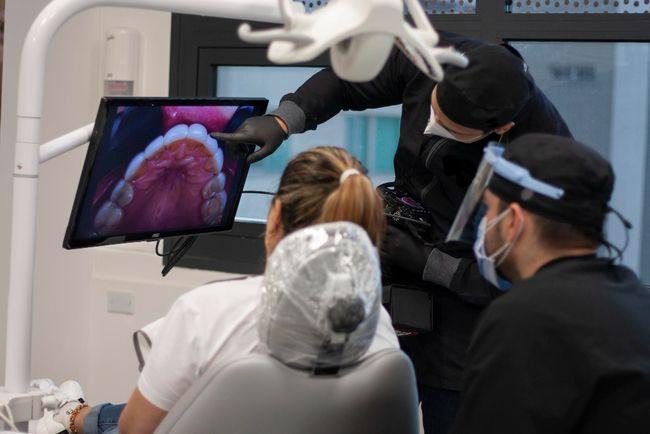
The health of the teeth and gums, the bite and any clenching or grinding habit are assessed. Photographs, an intraoral scan or impressions, and X-rays if needed, are taken. Your medical history and medicines are reviewed too. Active decay and gum disease are treated first.
Digital design
The length and width of the teeth and their relation to the lips are planned on the photographs and the scan. This is a visualisation, not a promise; the result depends on the actual condition of the teeth.
Trial (mock-up)
In suitable cases, the design is applied to your teeth in a temporary material, usually without cutting the teeth. On crowded or protruding teeth, a trial made by adding material can make the teeth look bulkier than they will be. It cannot represent every plan, and your dentist tells you this in advance. The trial gives an idea of the approximate shape and look; the final colour, translucency and gum appearance may differ. You can test the look, your speech and your bite, and ask for changes.
Setting the treatment order
Which procedure goes on which tooth is written down tooth by tooth. Health problems come first. Procedures that usually do not cut the tooth, such as whitening and orthodontics, are considered before those that do. Bonding, veneers and crowns are not steps that follow one another. They are alternatives chosen according to the condition of each tooth, and are used only on the teeth that need them.
Treatment and review
The treatments are carried out in the planned order. After permanent restorations are bonded, the bite is adjusted; at the review appointment, how the gums have settled and any sensitivity are assessed.
Treatments a plan may include
The list below runs roughly from the options that remove the least tooth tissue to those that remove the most. Orthodontics and gum reshaping do not fit neatly on this scale, because some plans involve an extraction or surgery on the gum and bone. It is not a ladder: each treatment answers a different problem, and not all of them need to be done.
- Whitening. Considered for a colour concern, once the cause of the discolouration has been assessed. It can cause temporary sensitivity and gum irritation, and it does not lighten existing fillings, crowns or veneers1. It does not give the same result on every kind of discolouration. Yellowish teeth usually respond well, brownish teeth may respond less, and greyish teeth may not lighten at all. The effect is not permanent; the teeth partly return to their earlier colour over time, and the treatment can be repeated. Whitening does not lighten ceramic, so natural teeth whitened afterwards may no longer match veneers or crowns. If they are planned, discuss whitening before their colour is chosen. After whitening, your dentist decides whether to wait before bonding, and for how long.
- Bonding (adding tooth-coloured composite to the tooth). Small chips, worn edges, small gaps and reshaping a single tooth; the tooth is usually not cut.
- Orthodontics. Crowding, rotated teeth and gaps; it corrects the alignment without cutting the teeth down for veneers or crowns, takes months and needs retention afterwards. Some plans need limited reshaping of the enamel between the teeth, or an extraction. The risks of shortening of the root tips, white spots on the enamel and gum recession are assessed separately. "Correcting" crowded teeth with veneers or crowns means removing a great deal of tissue from the teeth.
- Gum reshaping. When too much gum shows, the cause is assessed first. It may lie in the gum level, the supporting bone, the position of the teeth, the jaw or how the lip moves. In suitable cases, the gum, and the supporting bone where needed, is reshaped surgically; in others, orthodontics or different treatments are considered. The possibilities of sensitivity, exposure of the root surface and the appearance changing over time are discussed in advance.
- Laminate veneers. When the colour and shape of several front teeth are to change together, and there is enough enamel. Enamel is usually removed, and removed enamel does not grow back, so the treatment cannot be undone2.
- Crowns. Whether a crown is needed depends on the sound tissue left, any cracks and the chewing load. A root canal treatment or a large filling does not on its own mean a crown is needed. Options that remove less tissue, such as fillings and onlays (restorations that cover part of the chewing surface), are considered first. Where too little sound tissue is left, a crown may be the right choice. A crown on a sound tooth only for appearance is not the first option. More detail: Dental crowns.
The comparison table that sets the options side by side is on the dental veneers page.
Who it suits, and who it does not
Where it may be suitable
- Adults with healthy teeth and gums and a specific concern about how their teeth look
- People with more than one problem (colour, shape, alignment) who want to know in which order to solve them
- People who want to replace earlier fillings or crowns that no longer match
Where another treatment is needed first
- Active decay or gum disease: treated first.
- Uncontrolled clenching and grinding: this increases the risk of ceramics breaking. It is assessed first and protection such as a night guard is agreed; for some people, veneers may not be suitable.
- Marked misalignment: orthodontics is assessed first; covering it with veneers or crowns removes a lot of tissue from the teeth.
Who it is not for
- Veneers or crowns for people who only want a whiter colour on sound, straight teeth: whitening is considered first, because it does not cut the tooth. It does not reach the same shade on every kind of discolouration. The plan may end with whitening alone.
- Teeth that are still developing: in young patients, permanent veneers and crowns are usually postponed.
- Pregnancy and breastfeeding: cosmetic procedures that are not essential, whitening in particular, are postponed until after this period.
- People whose expectations do not match the condition of their teeth: where a trial is possible, it gives an idea of the achievable look. The plan is then discussed again on that basis.
Every plan gives a reason for each tooth. A single-line offer such as "veneers on the front 20 teeth" should be explained if it includes sound teeth. The same applies to a plan sent before an examination, from photographs alone.

Risks and benefits
Risks
The risks belong to the treatments in the plan; the detail of each is on its own page.
- Loss of tissue that cannot be undone. Preparing a tooth for a full crown removes enamel from every surface, and often the dentine beneath it. For a veneer, a more limited layer of enamel is usually removed. The tissue removed does not grow back2; the tooth depends on a restoration for life.
- The nerve of the tooth. Teeth that were alive at the start and then receive indirect restorations, such as crowns, partial crowns or bridges, can lose their vitality. In the pooled result of 37 studies with different follow-up periods, this was seen in about 5 in every 100 teeth3. This figure comes from published studies, not from our own records. The certainty of the evidence is low; the figure is not a personal risk or a risk for a particular year. The more crowns there are, the more teeth are exposed to this risk. If the nerve dies, root canal treatment is needed to keep the tooth; the figure above is not a root canal treatment rate.
- Fracture and debonding. These are the main reasons ceramic veneers fail4; clenching and grinding increase the risk.
- Colour mismatch. The colour of ceramic cannot be changed later; teeth that are not covered change colour over time, and a difference can appear.
- Decay and gums. A crown or veneer does not protect the tooth from decay. New decay and gum inflammation can develop at the edge of a restoration that does not fit well or is not cleaned well enough. The gum can also recede. New decay is among the main reasons restorations are lost in the long term.
- Repair and replacement. Restorations do not last for life; over time they may need repair or replacement, which has an additional cost. The more teeth are treated, the greater this burden becomes.
- Expectations. A digital design is a visualisation; the real result depends on the condition of the teeth, the gums and the bite. Images presented as a promise are misleading.
Benefits
- Planning the problems together rather than one by one aims to avoid unnecessary or conflicting procedures.
- Where a trial is possible, it lets you assess the planned look before any permanent procedure, and change your mind.
- A plan done in the right order can end with the option that removes the least tooth tissue.
How long does the result last?
No result is guaranteed for life. The figures below come from published studies, not from our own records. The effect of whitening fades over time5 and the teeth partly return to their earlier colour. About 94 to 97 per cent of the feldspathic, leucite-reinforced and lithium disilicate veneers studied were still in place6 after an average follow-up of about 10 years. There are no long-term data for zirconia veneers. The great majority of single crowns on natural teeth are still in place after five years7.
Still being in place does not mean free of complications. A restoration still in place may have needed repair, and in time it may need replacing. The result depends on the condition of the teeth, the bite, your habits and your care.
How to judge a smile makeover plan
- What is proposed for which tooth, and why? Ask for a reason for each tooth.
- Is doing nothing, or waiting, also an option? For healthy teeth, the consequences of not treating and of postponing should be discussed too.
- Why is a less invasive option not enough for this tooth? The answer should rest on the condition of the tooth, not on the package, the material or the time available.
- Is there a trial stage? Can you try the planned look in your mouth before any permanent procedure?
- How much tissue will be removed, and from how many teeth? This is decided by a clinical examination and restorative planning; X-rays are used when clinically needed. A plan made from photographs alone is only a preliminary assessment, not a firm plan.
- Could a root canal treatment be needed? For teeth where crowns are planned, the condition of the nerve is assessed in advance.
- How many days, and how many trips? Ask whether the proposed time is enough for the treatments, the trial, the try-ins and the reviews. Has it been shortened to fit a trip?
- What happens afterwards? Ask in writing who will deal with a fracture, a debonded restoration or sensitivity, and how, once you are back home.
If you are undecided between two plans, getting a second opinion is normal, for example from your own dentist; ask for your photographs and X-rays.
After treatment, and daily care
Care depends on the treatment carried out. The shared principles are:
- Brush twice a day with a fluoride toothpaste. Clean the edges of restorations and between your teeth every day.
- Do not bite hard objects with your front teeth; if you clench or grind, a night guard may be recommended.
- The colour of whitened teeth partly returns over time. Whitening does not lighten ceramic. Bonding composite is less stain-resistant than ceramic2, but ceramic too can discolour along its edges over time. Colour differences between restorations and your natural teeth are assessed at check-ups.
- If you have had orthodontics, wear the retainer for as long as your dentist recommends.
- Come for regular check-ups; the edges of restorations, the gums and the bite are assessed.
When to contact a dentist
Contact a dentist if any of the following happens after treatment. While you are in Antalya, that is the clinic; once you are home, it is usually your own dentist.
- Sensitivity that lasts more than a week or keeps getting worse
- Pain when biting, or a feeling that the bite is too high
- A break, crack or movement in a restoration; a crown or veneer coming off (keep the piece, and do not glue it back yourself)
- Bleeding, recession or a dark line in the gum at the edge of a restoration
Emergencies. Throbbing pain, facial swelling or a fever are not an expected result; see a dentist where you are without waiting for the clinic's reply. Go to an emergency department if you have difficulty breathing or swallowing, spreading swelling in the mouth and neck, or swelling around the eye. In an emergency, call the emergency number of the country you are in; in Turkey it is 112.
Before you fly home
Make sure your bite has been checked and that you have written care instructions. Take the written record of your treatment with you for your dentist at home. If a night guard or a retainer is part of the plan, make sure it has been handed over. If you are continuing whitening at home, make sure you know how long to use the product and whom to ask.
Once you are home
If a problem comes up that is not urgent, write to the clinic and send photographs. Photographs do not replace an examination, so see your dentist at home as well. In the emergencies above, do not wait for a reply.
If you are coming from abroad
Treatment is at our clinic in Antalya, Turkey; on this page, "we" means that clinic. The treatments in a plan fit a trip in different ways.
- Whitening. In the clinic it usually takes one appointment. Whitening at home goes on for weeks, so most of it happens after you leave. Your dentist decides the product and how long to use it.
- Bonding. Usually one appointment, with no laboratory work. It is checked regularly and may need polishing, repair or replacement over time, so it is often simpler to have near home.
- Orthodontics. Treatment runs over months and the result needs retention afterwards, so it is often simpler to have near home. If veneers or crowns are also needed, they are planned after orthodontic treatment.
- Gum reshaping. This is surgery on the gum, and sometimes the bone. Your dentist tells you how it fits into the days of the plan and when you can fly.
- Laminate veneers and crowns. Usually more than one appointment, with laboratory work between preparing the teeth and fitting the restorations; you may wear temporary restorations in between. Where a trial is possible, it comes before any permanent step.
The number of days in Antalya depends on which treatments are chosen and how many teeth are treated. It also depends on whether decay, root canal or gum problems need treating first. Before you book, you receive a written preliminary plan with the appointments and how many days they need. It is based on your photographs, so the examination confirms or changes it, and with it the days and the cost. If it changes, you receive the revised plan in writing before treatment starts. You can say no, or ask to stop, at any stage. Once a tooth has been prepared, that step cannot be undone.
Flying. A 2023 review of flying after dental treatment suggests waiting at least 24 hours after restorative treatment8. It suggests longer after surgical procedures, such as gum reshaping. These times assume there is no pain, swelling or bleeding where you were treated. The authors note that the research is limited and comes mainly from military aviation. Treat it as a starting point for your dentist's advice, not as a rule.
Your dentist at home. Talk to your own dentist before you go. They need to know the plan in case problems come up later. If you do not have a dentist where you live, it helps to find one before you travel. Ask for a written record of the treatment to take back to them. It should show what was done to each tooth, and the materials and products used. Ask for copies of your X-rays too. In Turkey, the health tourism regulation entitles international patients to an itemised bill. On request, they also get free copies of the records of the materials used, the tests and the imaging9.
Veneers, crowns and bonding need regular check-ups for as long as they are in the mouth. UK guidance (NICE) says the interval between check-ups should be set for each person according to their risk10; agree it with your dentist at home. Before you travel, check the rules of the health service or your insurer in the country where you live about care after treatment abroad.
Questions to ask before you commit. Before you agree to treatment abroad, ask:
- Who will carry out my treatment, and what are their qualifications?
- Are you regulated by a professional body and registered with it?
- Are the remake and correction terms in writing, and for how long do they apply?
- What aftercare do you provide, and who can I contact after the treatment?
- If there are complications, who pays for further treatment, extra flights and the hotel?
- Do you have a complaints system, and can I see a copy?
Before treatment, we give you in writing how complications are handled and the terms for remaking a veneer or crown. The full list, with our answer to each question, is on our page about dental treatment abroad.
What determines the cost?
This page does not show prices. A treatment plan is prepared for you after an examination. The main factors that shape it are:
- Which treatments the plan includes: whitening, bonding, orthodontics, gum reshaping, veneers or crowns
- How many teeth are treated
- The material and how it is made
- Treatment needed first: decay, gum treatment, root canal treatment
- The trial stage, temporary restorations and review appointments
- The number of trips the appointments need
For comparable treatments, the fewer teeth are treated, the lower the cost and the fewer teeth lose tissue. Ask for the plan in writing, showing which procedure is proposed for which tooth, why, and what is included. Ask too who pays for further treatment and extra travel if there is a complication. When you compare quotes, add travel and accommodation for each trip.
Ask for a preliminary view of your smile plan
Send a photograph of yourself smiling and tell us what you would like to change. One of our dentists will reply with a preliminary view of the options that may suit you. It starts from the one that removes the least tooth tissue. The reply may be that no treatment is needed. A photograph cannot show the condition of each tooth, so this is not a diagnosis. The plan is confirmed or changed at an examination in person.
Frequently Asked Questions
Are a smile makeover and a Hollywood smile the same thing?
A smile makeover is a planning process; in everyday language, a "Hollywood smile" usually means veneers or crowns on all the front teeth. The plan decides how many teeth need treatment and what they need; the result is not always veneers or crowns.
Does a smile makeover mean cutting the teeth?
The planning itself does not; it depends on the treatment carried out at the end of the plan. Whitening does not cut the tooth. In most cases, orthodontics aligns the teeth without cutting them; some plans may need limited reshaping of the enamel or an extraction. Bonding usually does not cut the tooth. For a veneer, a thin layer of enamel is usually removed. For a crown, enamel is removed from every surface of the tooth, and often dentine too.
What is a trial (mock-up), and is it compulsory?
In suitable cases, the design is applied to your teeth in a temporary material, usually without cutting them. You can test the look, your speech and your bite. It gives an idea of the look, not the exact result. It is not compulsory; we recommend it as part of the plan.
How many days do I need to be in Antalya?
It depends on the plan. Whitening in the clinic and bonding are quick. Veneers and crowns usually need laboratory work and try-ins, with time in between. Orthodontics takes months and is often simpler near home. Before you book, a written preliminary plan states the appointments and the number of days. It is made from photographs, so the examination confirms or changes it.
I was offered veneers or crowns on all my front teeth. Is that right?
When the same procedure is proposed for every tooth in a mouth, it needs a reason for each tooth. Ask why whitening, bonding or orthodontics is not enough for each one; getting a second opinion is normal.
Is the result permanent?
No result is guaranteed for life. Whitening fades over time and the teeth partly return to their earlier colour; tissue removed for veneers or crowns does not grow back. How long veneers and crowns stayed in place in studies is given under 'How long does the result last?' above. Staying in place does not mean free of complications. A restoration still in place may have needed repair, and in time it may need replacing. The result depends on the teeth, the bite, your habits and your care.
What if something goes wrong after I go home?
For urgent symptoms such as spreading swelling, a fever, or difficulty breathing or swallowing, get local emergency care first, then tell us. For a problem that is not urgent, write to the clinic and send photographs. Veneers, crowns and bonding need regular check-ups with a dentist where you live; tell them about the treatment and bring the written record. Before you travel, check the rules of the health service or your insurer in the country where you live about care after treatment abroad.

Dt. Dilek AKSU GÜLER
Dentist · Founder
She has completed advanced training in implantology and works in aesthetic restorations and smile design.
Sources
- Teeth Whitening (patient information). American Dental Association, MouthHealthy.↩mouthhealthy.org
- Veneers. American Dental Association, MouthHealthy.↩mouthhealthy.org
- Incidence of pulp necrosis and periapical pathosis after indirect restorations: systematic review and meta-analysis (37 studies, 11,615 teeth). BMC Oral Health 2023. 2023.↩pmc.ncbi.nlm.nih.gov
- Survival and failure causes of ceramic laminate veneers: systematic review (25 studies, 6,500 veneers, 3-21 years). Journal of Clinical Medicine 2021;10(5):1074. 2021.↩pmc.ncbi.nlm.nih.gov
- Tooth bleaching: umbrella review of 28 systematic reviews (416 randomised trials). Heliyon 2024. 2024.↩pmc.ncbi.nlm.nih.gov
- Survival and complication rates of ceramic laminate veneers by material: systematic review and meta-analysis (29 studies). Journal of Esthetic and Restorative Dentistry 2025;37(3):601-619. 2025.↩doi.org
- Survival of monolithic lithium disilicate, monolithic zirconia and metal-ceramic single crowns: systematic review. International Journal of Prosthodontics 2026;39(3):308-324. 2026.↩doi.org
- Dental tourism and the risk of barotrauma and barodontalgia (narrative review with guiding principles). British Dental Journal 2023;234(2):115-117. 2023.↩doi.org
- Uluslararasi Saglik Turizmi ve Turistin Sagligi Hakkinda Yonetmelik. T.C. Saglik Bakanligi, Resmi Gazete 26/4/2025, No 32882. 2025.↩resmigazete.gov.tr
- Dental checks: intervals between oral health reviews (clinical guideline CG19). National Institute for Health and Care Excellence, published 27 October 2004. 2004.↩nice.org.uk