
What helps with toothache?
For short-term relief, ibuprofen, or ibuprofen together with paracetamol, is the option best supported by the evidence, if these medicines are safe for you. Cold water held around the tooth, a warm salt-water rinse, clove oil on a decayed tooth and pharmacy numbing gels may help a little for a while. None of these treats the cause. Toothache needs a dentist.
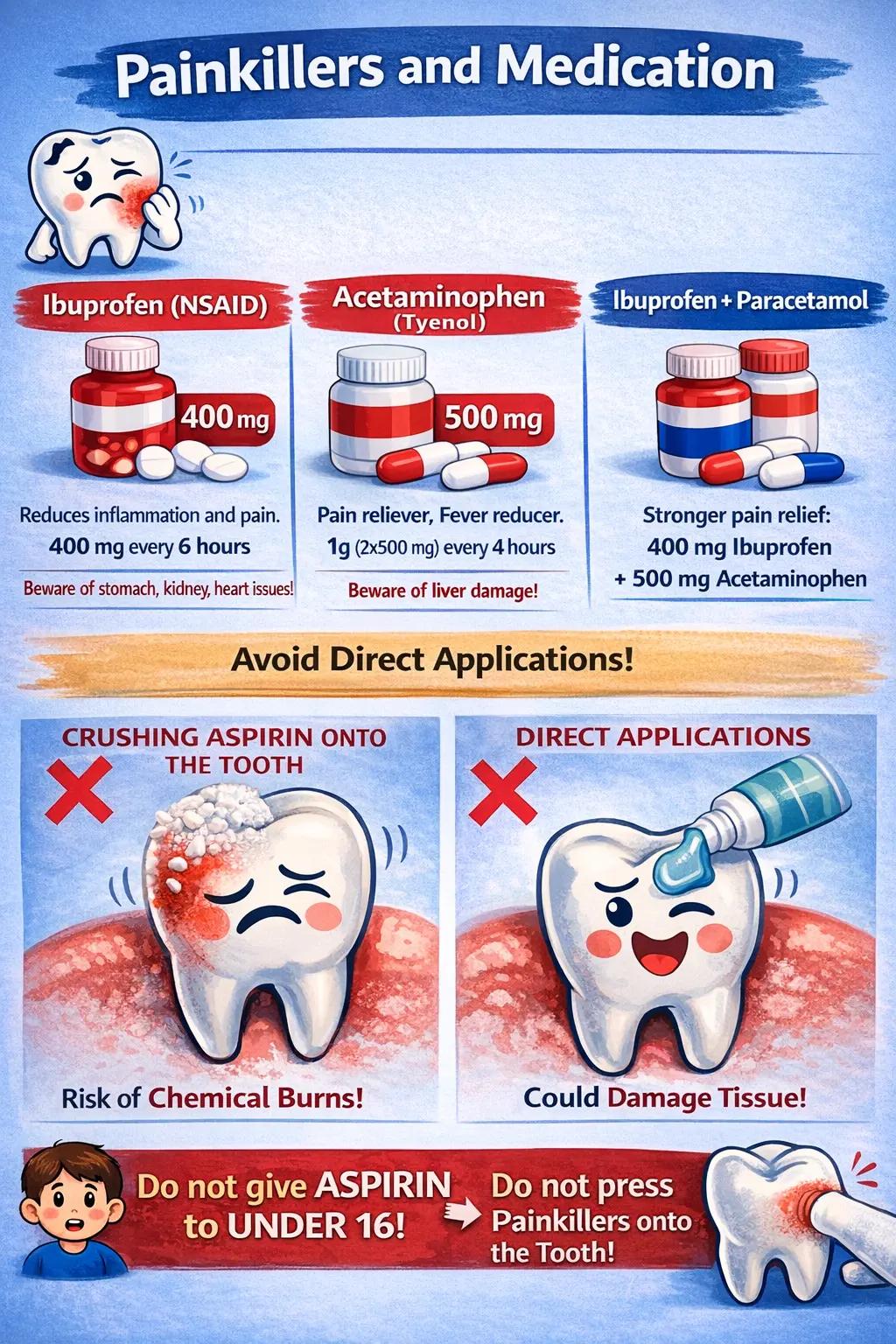
- Ibuprofen, alone or with paracetamol, has the best evidence; stay within the pack dose and never double up on paracetamol.
- Swallow painkillers; holding a tablet against the gum can damage it.
- Home remedies can ease pain briefly at best, and antibiotics are not recommended for toothache pain.
- Swelling that affects breathing, swallowing, your eye or your neck is an emergency.
Painkillers: what the evidence shows
Most of what we know about painkillers for dental pain comes from trials of pain after an operation, often after a wisdom tooth has been removed, not from toothache itself. The American Dental Association (ADA) says its panel found no direct evidence1 on painkillers for toothache, so its advice rests on those surgery trials.
Within that evidence, one combination stands out. A Cochrane review pooled 3 trials with 1,647 people in moderate or severe pain after having wisdom teeth removed. With ibuprofen plus paracetamol, about 69 to 73 in 100 people2 had at least half their pain relieved over 6 hours, depending on the dose. With ibuprofen alone it was about 52 in 100, and with a dummy tablet about 7 in 100.
The ADA's 2024 guideline for toothache, which covers people aged 12 and over, puts non-opioid painkillers first: an anti-inflammatory such as ibuprofen alone or together with paracetamol. The panel rated the certainty of that evidence as low. Scottish dental guidance (SDCEP) says most dental pain can be relieved effectively by anti-inflammatories3 such as ibuprofen. Paracetamol also works, but it does not reduce inflammation. Both guidelines see painkillers as a temporary measure until the tooth is treated.
Stronger does not mean better. A large Cochrane overview found no evidence of a pain-relieving effect4 for a single low dose of the opioid oxycodone after surgery (low-quality evidence). An ADA overview found opioid-containing medicines were among those most often linked to side effects5.
Taking painkillers safely
- Check that they suit you. Ask a pharmacist if you are not sure, for example if you are pregnant, take other medicines or have a long-term condition. SDCEP's self-care advice says to avoid ibuprofen or aspirin if there is bleeding.
- Stay within the dose on the pack. We give no doses here.
- Never take two products that contain paracetamol. Check every label, including cold and flu remedies. SDCEP warns that people in dental pain can take more than one paracetamol product3 without realising it and overdose by accident. For a smaller adult, even one tablet over the pack limit in a day can be an overdose. If you think you may have taken too much paracetamol, get urgent medical advice straight away, even if you feel well.
- Swallow the tablets. Do not hold a painkiller, including aspirin, against the gum or tooth: SDCEP warns this can damage the tissue6.
- No aspirin for children under 16. The NHS gives this warning for dental pain in its abscess advice7.
- Review after a day. SDCEP's self-care advice covers the first 24 hours. If you still need pain relief after that, ask a pharmacist, and keep trying to get a dental appointment.
Home remedies: an honest verdict
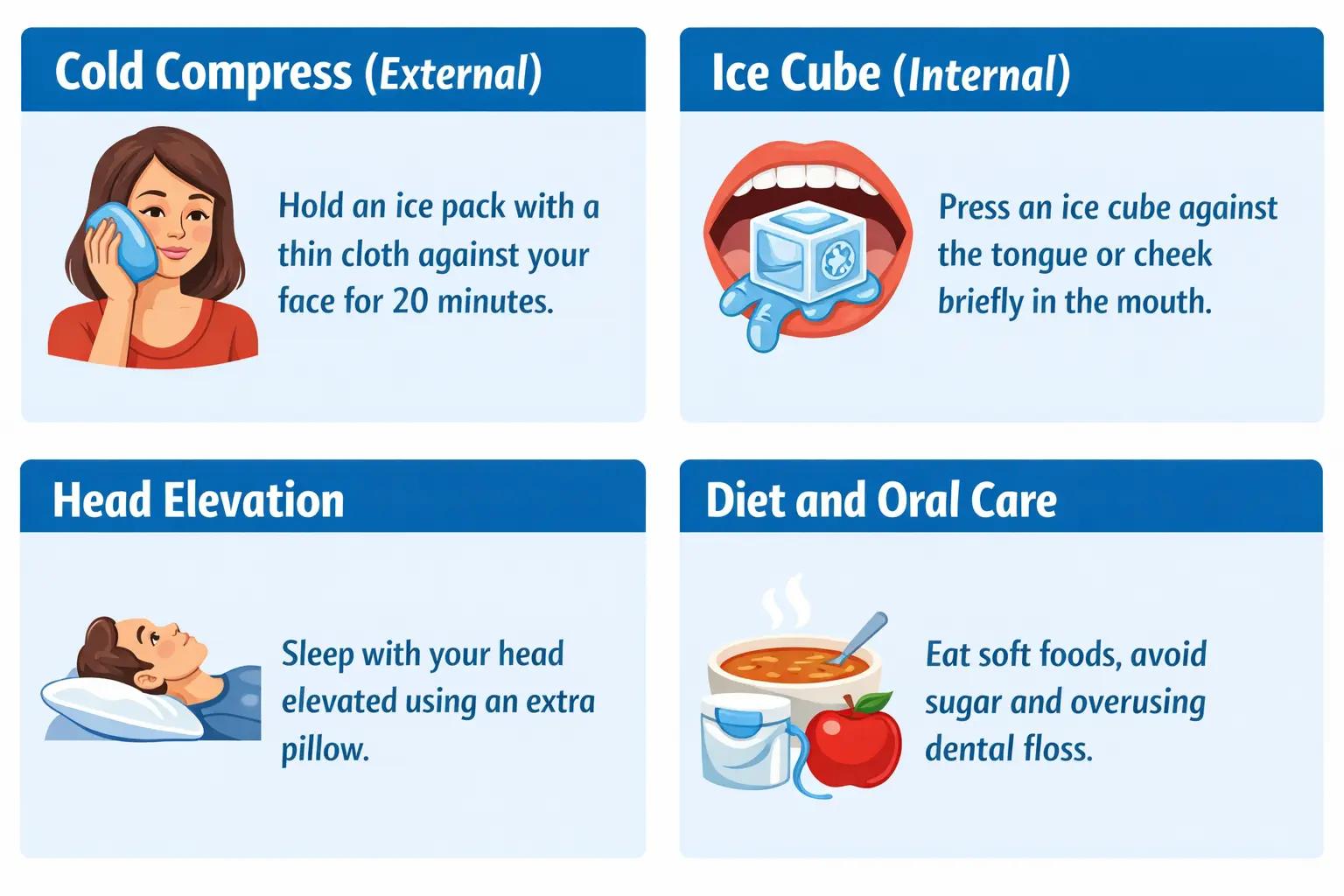
Cold water or ice around the tooth: may help some pain. SDCEP's self-care advice says that holding cooled water or crushed ice around the tooth6 can help some types of dental pain. The same advice says to avoid hot and cold food and cold air, because for other toothache cold makes it worse. If cold hurts, stop. We found no source on cold packs held against the cheek for toothache.
Warm salt-water rinse: fine to try, not a treatment. The NHS suggests half a teaspoon of salt in a glass of warm water8, rinsed and spat out, while you wait for an appointment. This is self-care advice, not evidence from trials that it works. It does not replace treatment, and children should not try it in case they swallow it.
Clove oil: traditional, short-term, with care. European regulators accept clove oil as a traditional herbal medicine for the temporary relief of toothache caused by a cavity9, applied on cotton to the decayed tooth, for adults and for no more than a week. That acceptance rests on long use, not on clinical trials. Avoid contact with the gums, and do not use it if you are allergic to cloves or to Peru balsam. It is not recommended under 18 or in pregnancy or breastfeeding. Swallowing 5 to 10 ml has caused life-threatening poisoning in children under 2, so keep it out of their reach. Trials of eugenol, the main substance in clove oil, were of dentist-applied products10, such as dressings; they say nothing about oil used at home. Clove oil does not treat an infection.
Numbing gels from the pharmacy: brief relief. In the ADA guideline, gels with 10 or 20 per cent benzocaine gave a clear reduction in pain at 20 to 30 minutes1 in toothache trials, with low certainty. The effect is short. Follow the pack, and ask a pharmacist before using one on a child.
Garlic, whisky, hydrogen peroxide, peppermint and similar remedies. We found no evidence on these for toothache, so we cannot recommend them.
What does not help
- Antibiotics. Antibiotics are not recommended for the pain of an inflamed nerve, and there is no good evidence that they help. SDCEP says they should not be used to manage the pain11 of such inflammation, and a Cochrane review found only one small trial of 40 people12, too little to show whether they help. A dentist may prescribe antibiotics for an infection that is spreading, is making you unwell or cannot be drained straight away, and they do not replace treatment of the tooth.
- Waiting for it to pass. Toothache has a cause in the tooth or gum, and neither painkillers nor time remove it. A dental abscess, for one, will not go away on its own.
- Doubling the dose when the pain is bad. It adds risk without treating the cause.
When to see a dentist
Toothache needs a dentist, even if a painkiller controls it. Painkillers and home measures only cover the time until the cause is found and treated.
Book a dental appointment for any toothache that does not settle. Ask for an urgent one if you think you have an abscess, if your face, cheek or jaw is swollen, or if you have toothache with a high temperature. The NHS lists a swollen cheek or jaw and a high temperature as reasons to see a dentist8.
Emergencies. Call 112 or go to the nearest emergency department if you have swelling that makes it hard to breathe, speak or swallow, a swollen or painful eye or sudden problems with your eyesight, swelling in your neck, a lot of swelling inside your mouth, or if you find it hard to open your mouth. These signs come from the NHS abscess and toothache pages.
Frequently asked questions
Can I put an aspirin on my tooth?
No. Swallow painkillers instead. Scottish dental guidance warns that a tablet held next to the painful area can damage the tissue. Children under 16 should not take aspirin at all.
Does every receded gum need surgery?
No. Where there is no gum disease, a dentist often monitors the area. Surgery is considered when recession is getting worse, the root is at risk or its appearance bothers you.
Is clove oil safe?
European regulators accept it for short-term relief of cavity toothache in adults, based on traditional use. Keep it off the gums, use it for no more than a week, do not use it under 18 or in pregnancy, and keep it away from small children.
How long can I manage toothache with painkillers?
Only until you can see a dentist. Painkillers are a temporary measure and do not treat the cause. If you still need them after 24 hours, ask a pharmacist. Book an appointment now, and seek urgent care for swelling or a fever.
Should I stop brushing if my gums bleed?
No. Keep brushing gently along the gum line and clean between your teeth. Bleeding from plaque-related inflammation usually settles as the plaque is removed. If it keeps coming back, see a dentist.

Dt. Dilek AKSU GÜLER
Dentist · Founder
She has completed advanced training in implantology and works in aesthetic restorations and smile design.
Sources
- ADA evidence-based clinical practice guideline for the pharmacologic management of acute dental pain in adolescents, adults, and older adults (2024). Journal of the American Dental Association 2024;155(2):102-117. 2024.↩doi.org
- Single dose oral ibuprofen plus paracetamol (acetaminophen) for acute postoperative pain (Cochrane review, 2013). Cochrane Database of Systematic Reviews 2013;(6):CD010210. 2013.↩doi.org
- SDCEP Drug Prescribing for Dentistry: Odontogenic pain. Scottish Dental Clinical Effectiveness Programme (SDCEP).↩sdcepdentalprescribing.nhs.scot
- Single dose oral analgesics for acute postoperative pain in adults: an overview of Cochrane reviews (2015). Cochrane Database of Systematic Reviews 2015;(9):CD008659. 2015.↩doi.org
- Benefits and harms associated with analgesic medications used in the management of acute dental pain: an overview of systematic reviews (2018). Journal of the American Dental Association 2018;149(4):256-265. 2018.↩doi.org
- SDCEP Management of Acute Dental Problems: Analgesia (supporting tool). Scottish Dental Clinical Effectiveness Programme (SDCEP). 2026.↩acutedentalproblems.sdcep.org.uk
- NHS: Dental abscess. NHS (nhs.uk). 2026.↩nhs.uk
- NHS: Toothache. NHS (nhs.uk). 2024.↩nhs.uk
- Community herbal monograph on Syzygium aromaticum (L.) Merill et L. M. Perry, floris aetheroleum (clove oil). European Medicines Agency, Committee on Herbal Medicinal Products, EMA/HMPC/534924/2010, adopted 13 September 2011. 2011.↩ema.europa.eu
- Analgesic efficacy of phytotherapeutic agents in dental pain management: a systematic review. International Journal of Dentistry 2025;2025:5614623 (Reddy MS et al.). 2025.↩doi.org
- SDCEP Drug Prescribing for Dentistry: Bacterial infections. Scottish Dental Clinical Effectiveness Programme (SDCEP). 2026.↩sdcepdentalprescribing.nhs.scot
- Antibiotic use for irreversible pulpitis (Cochrane review, 2019). Cochrane Database of Systematic Reviews 2019;5:CD004969. 2019.↩doi.org