
Do you need antibiotics for a tooth infection?
Usually not on their own. An infected tooth is treated at its source: the dentist drains the pus and deals with the cause, usually with root canal treatment or by removing the tooth. Antibiotics are added when the infection is spreading, when it makes you unwell with a fever, or when the pus cannot be drained straight away. They are not recommended for the pain of an inflamed nerve.
- Antibiotics do not remove the cause of a tooth infection; drainage and treatment of the tooth do.
- Guidance keeps antibiotics for spreading swelling, fever or feeling unwell, or pus that cannot be drained at once.
- If you are given antibiotics, the tooth still needs treatment, and your dentist tells you when to stop.
- Swelling that makes it hard to breathe, swallow or open your mouth is an emergency.

Why antibiotics alone do not fix the tooth
The causes the NHS lists for a dental abscess include tooth decay, gum disease and an injury to the tooth. When decay reaches the nerve inside a tooth, the nerve can die and infection can collect as pus around the tip of the root. That collection is an abscess. The NHS is plain about it: a dental abscess will not go away on its own1 and needs urgent treatment by a dentist.
When an abscess comes from an infected nerve, the source of the infection is inside the tooth, where tablets cannot clean it. Scottish dental prescribing guidance (SDCEP) explains that an abscess confined to the tissue around the root is mostly isolated from the circulation, so very little antibiotic gets into it2. That is why it tells dentists to treat an abscess first with local measures: draining the pus and, where possible, removing the cause.
The trials point the same way. A 2024 Cochrane review found 3 small trials with 134 adults in whom an antibiotic or a dummy tablet was added to root canal treatment. One tested a single dose before treatment in people without an abscess; two tested a 7-day course. None showed a clear difference in pain or swelling3, and the certainty of the evidence was low to very low. No trial compared antibiotics with a dummy tablet without any dental treatment, so there is no evidence that tablets alone are enough.
When dentists do use antibiotics
Both the Scottish guidance and the American Dental Association (ADA) keep antibiotics for particular situations. SDCEP's general rule is that antibiotics must only be prescribed when clinically indicated4, with local treatment first unless the infection is spreading or affects the whole body. For a dental abscess it names three situations:
- The infection is spreading: swelling that is growing, cellulitis (a spreading infection under the skin) or swollen glands in the neck.
- It is making you unwell: a fever or feeling generally unwell (malaise).
- The pus cannot be drained straight away with local treatment.
The ADA's 2019 guideline for adults with a healthy immune system reaches a similar position. When a dentist cannot start treatment straight away and there is a local abscess, the panel suggests an antibiotic together with an urgent referral5 for the treatment itself. This is a conditional suggestion based on very low certainty evidence. When the infection has spread and you are unwell, the guideline calls for urgent treatment together with antibiotics.
The two guidelines broadly agree: no antibiotics for a local abscess that can be drained and treated, and antibiotics when drainage is not possible, the infection is spreading or the whole body is involved. If your immune system is weakened by an illness or a medicine, tell your dentist, because the decision may be different.
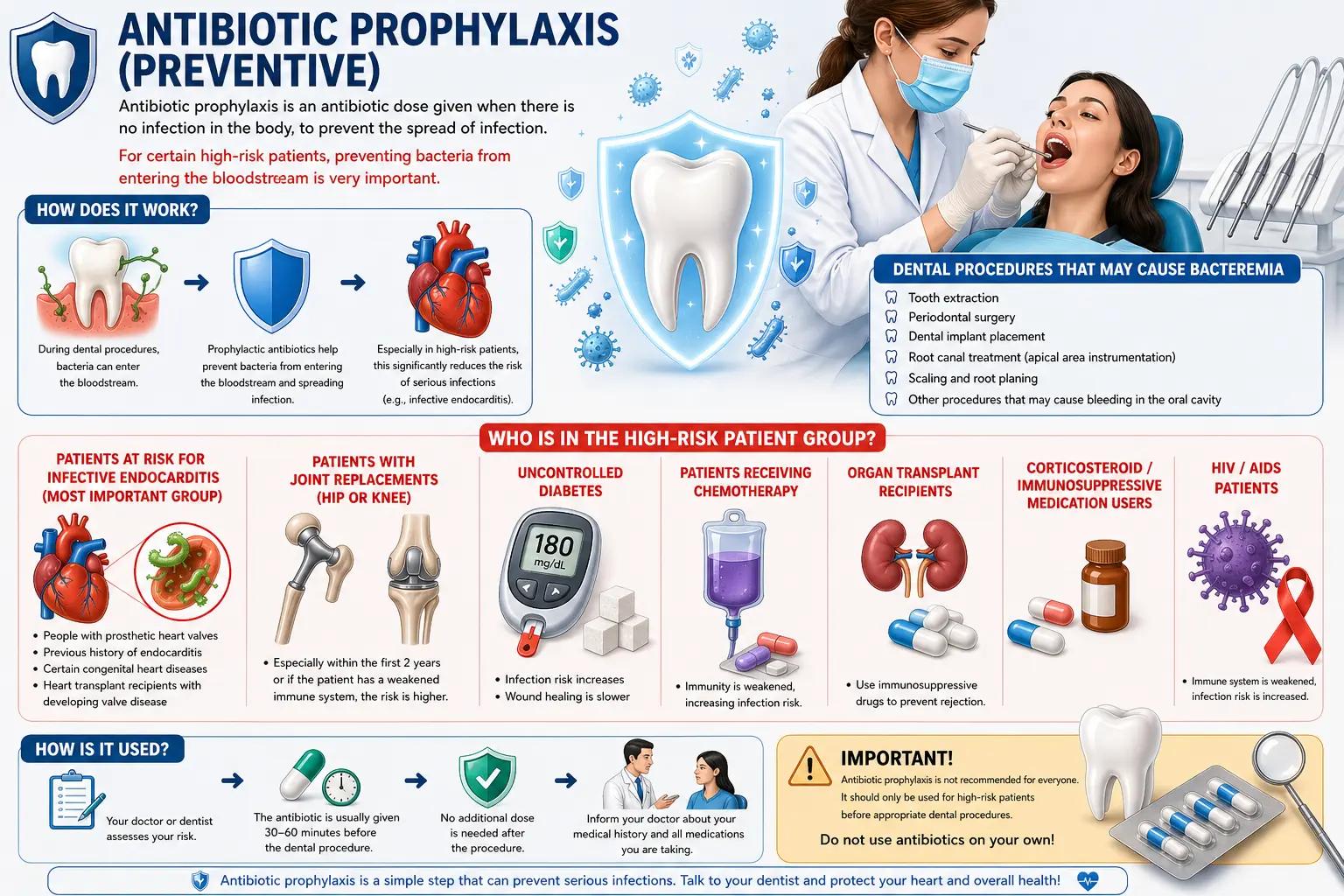
When antibiotics are not recommended
For toothache from an inflamed nerve. Pulpitis is inflammation of the pulp, the soft tissue inside the tooth that holds its nerve. SDCEP counts it among inflammatory conditions and says antibiotics should not be used to manage the pain4 of such inflammatory conditions. The ADA panel recommends against them for this pain, a strong recommendation based on low certainty evidence. A Cochrane review found only one small trial of 40 people6 and called the evidence insufficient to say whether antibiotics reduce the pain or not. So they are not recommended, and there is no good evidence that they help.
On top of treatment for a local abscess. When the dentist can drain the abscess and treat the tooth, the ADA recommends against adding an antibiotic. The panel weighed benefits of little to no difference against a potentially large increase in harm5, such as side effects. That is a strong recommendation, although it rests on very low certainty evidence.
An antibiotic can make a swelling settle for a while. If the cause stays in the tooth, the infection can return.
For the pain itself while you wait, SDCEP notes that most dental pain can be relieved by anti-inflammatory painkillers7 such as ibuprofen, if they are safe for you. Painkillers are only a temporary measure; follow the pack, and ask a pharmacist if you are not sure.
If you are given antibiotics
- Still have the tooth treated. The antibiotic buys time; it does not replace drainage, root canal treatment or removal of the tooth. Keep the appointment for the treatment itself.
- Expect a short course and a review. SDCEP says a course for a dental abscess is usually 3 to 5 days2, with a review ideally at about day 3.
- Do not wait for the review if you get worse. The ADA guideline tells dentists to ask patients to call if their condition deteriorates. If you feel worse on the medicine, or think you are reacting to it, contact your dentist or pharmacist straight away. Swelling that makes it hard to breathe or swallow is an emergency (see below).
- Stop when your dentist tells you to. The guidelines used here do not say that every course must be finished whatever happens. SDCEP advises dentists to tell the patient to stop once the general signs and symptoms have gone. The ADA tells dentists to have patients stop 24 hours after their symptoms resolve5. In both, the dentist decides and gives you the instruction; do not change the dose or stop early on your own.
- Follow the instructions on the pack and from your pharmacist. We do not give doses here: the right medicine and dose depend on you and are for the prescriber to set.
- Mention allergies and other medicines before anything is prescribed.
The root canal treatment page explains how a tooth with an infected nerve is treated: root canal treatment.
When to see a dentist, and when it is an emergency
See a dentist urgently if you think you have an abscess. The same applies if your face or jaw is swollen, or if toothache comes with a high temperature. These are reasons for an urgent dental appointment8, not a routine one.
Emergencies. Call 112 or go to the nearest emergency department, without waiting for a dental appointment, if you have:
- swelling that makes it hard to breathe, speak or swallow
- a swollen or painful eye, sudden problems with your eyesight, or swelling in your neck
- a lot of swelling inside your mouth
- difficulty opening your mouth
These signs are taken from the NHS abscess and toothache pages. Rarely, a dental infection leads to sepsis, when the body's response to an infection starts to damage its own organs. SDCEP calls this rare but potentially life-threatening9. Its signs can be vague: confusion, uncontrollable shivering (rigors), breathlessness, a fast heartbeat or mottled skin. If you have a dental infection and feel like this, get emergency help rather than waiting for the dentist.
Frequently asked questions
What does "uzman" mean on a dentist's name?
It means specialist. It may be used only for one of the nine legal dental specialties, by a dentist holding a specialist certificate registered by the Ministry of Health. Ask which specialty it is and check that it is on the dentist's working certificate.
Do I need a specialist for veneers?
Not necessarily. General dentists place veneers every day, and the law does not reserve them for specialists. What matters more is that each tooth is examined and that you understand why it needs a veneer and what cannot be undone.
Why would a dentist suggest four implants rather than six?
Usually because of the bone. Tilted back implants can keep clear of the sinus and the nerve canal, which avoids a graft in some patients. There are also fewer surgical sites. These are clinical reasons, not a measured advantage; ask to see them on your scan.
Does All-on-6 last longer?
The studies do not show that. In a 55-study review, about 98 in 100 All-on-4 implants were in place at five years and beyond. For All-on-6 it was 97 to 98 in 100. Staying in place is not trouble-free with either design.
Does a bridge damage the neighbouring teeth?
A conventional bridge usually needs the teeth either side reduced and crowned; that tissue does not grow back, and in long-term studies decay and the nerve dying in those teeth were the most common problems. A resin-bonded bridge needs little or no grinding.

Dt. Dilek AKSU GÜLER
Dentist · Founder
She has completed advanced training in implantology and works in aesthetic restorations and smile design.
Sources
- NHS: Dental abscess. NHS (nhs.uk). 2026.↩nhs.uk
- SDCEP Drug Prescribing for Dentistry: Dental abscess. Scottish Dental Clinical Effectiveness Programme (SDCEP). 2026.↩sdcepdentalprescribing.nhs.scot
- Systemic antibiotics for symptomatic apical periodontitis and acute apical abscess in adults (Cochrane review, 2024). Cochrane Database of Systematic Reviews 2024;5:CD010136. 2024.↩doi.org
- SDCEP Drug Prescribing for Dentistry: Bacterial infections. Scottish Dental Clinical Effectiveness Programme (SDCEP). 2026.↩sdcepdentalprescribing.nhs.scot
- ADA evidence-based clinical practice guideline on antibiotic use for the urgent management of pulpal- and periapical-related dental pain and intraoral swelling (2019). Journal of the American Dental Association 2019;150(11):906-921. 2019.↩doi.org
- Antibiotic use for irreversible pulpitis (Cochrane review, 2019). Cochrane Database of Systematic Reviews 2019;5:CD004969. 2019.↩doi.org
- SDCEP Drug Prescribing for Dentistry: Odontogenic pain. Scottish Dental Clinical Effectiveness Programme (SDCEP).↩sdcepdentalprescribing.nhs.scot
- NHS: Toothache. NHS (nhs.uk). 2024.↩nhs.uk
- SDCEP Drug Prescribing for Dentistry: Sepsis. Scottish Dental Clinical Effectiveness Programme (SDCEP). 2026.↩sdcepdentalprescribing.nhs.scot