
What are metal braces, and how do they compare with other braces?
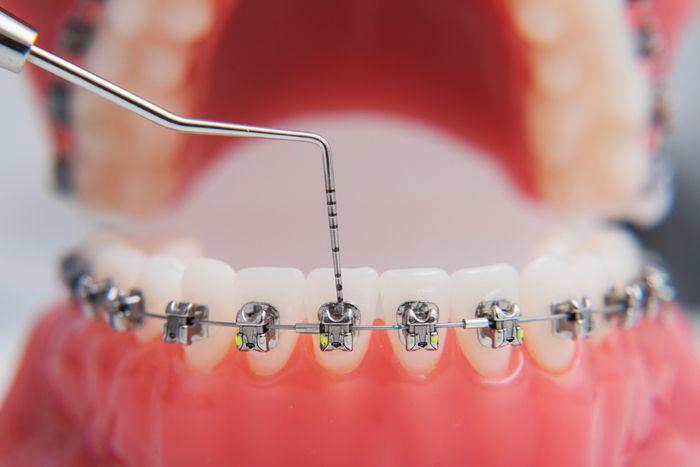
Metal braces are fixed braces with small metal brackets. The brackets are glued to the front of the teeth and a wire runs through them. You cannot take them out, and they need adjustment appointments until treatment ends. They show more than ceramic (tooth-coloured) brackets, which work in the same way.
Research comparing metal and ceramic brackets is limited. Two clinical studies1 counted bracket failures in the first year of treatment, and their results point in opposite directions2. A systematic review concluded that ceramic brackets may lead to more enamel fractures, particularly when the brackets are removed3. Much of that evidence comes from laboratory studies. When treatment ends, a retainer helps keep the teeth in place.
This page is written for readers who live outside Turkey and are considering treatment at our clinic in Antalya, Turkey. On this page, "we" means that clinic.
- Metal braces are fixed braces with metal brackets glued to the front of the teeth. They show more than ceramic brackets, cannot be taken out, and need adjustment appointments until treatment ends.
- Studies disagree on whether metal or ceramic brackets fail more often. A review concluded that ceramic brackets may lead to more enamel fractures, particularly when they are removed. Much of that evidence comes from laboratory studies.
- When braces are fitted or adjusted, teeth can be tender for a few days; pain is usually at its worst in the first days.
- White spots (early decay) are common on teeth while fixed braces are on; careful brushing and cutting down on sugar are recommended.
- If you travel to Antalya for treatment, agree in writing before the brackets are fitted who will carry out the adjustments, and where. After treatment, a retainer is used; your treating dentist decides how long you wear it.
Who are metal braces for, and when is another option discussed?
When metal braces may be considered
Metal brackets are an option for people who need fixed braces. Fixed braces are used for:
- Teeth that are crooked because there is not enough room for them in the jaw.
- Gaps between teeth.
- A bite where the upper and lower teeth do not meet properly. For example, the lower teeth close in front of the upper teeth, or the upper front teeth sit well in front of the lower ones.
Orthodontic treatment is not only for children; it is also done in adults. Bite problems, early treatment in children and all the appliance options are covered on the braces page.
Metal or ceramic brackets?
- How they look. Ceramic (tooth-coloured) brackets work in the same way as metal brackets and are less noticeable. More detail is on the ceramic braces page.
- What the research shows. It is limited. Two clinical studies that counted failed brackets found opposite results (see risks below). A review concluded that ceramic brackets may lead to more enamel fractures, particularly when they are removed3. In a laboratory test, ceramic brackets wore away more enamel from the teeth that rubbed against them4 than metal brackets did. Both enamel findings rest mainly on laboratory studies, and neither gives a rate. Ask your treating dentist which kind of bracket suits your teeth and your bite.
When clear aligners may suit better, or not
Clear aligners are clear trays that you take out and put back in yourself. For aligners, the choice also depends on whether you can wear them consistently. In cases where teeth have to be taken out to make room, fixed braces have shown better treatment quality than clear aligners5. In cases without extractions, no clear difference has been seen5 between the two. More detail is on the clear aligner treatment page.
When something else is discussed first
- Decay or gum disease. The state of your teeth and gums is assessed at an examination before treatment. If there is decay or gum disease, your treating dentist explains how it will be dealt with before orthodontic treatment starts.
- When the problem lies in the position of the jaw bones. In people who have stopped growing, adding jaw surgery to orthodontic treatment may be discussed for some jaw mismatches. We cannot say on this page when this is needed; your treating dentist explains the options after the examination.
- An allergy to metal. If you have ever had an allergic reaction to a metal, tell your treating dentist before treatment is planned. This page cannot say how often metal braces cause an allergic reaction.
- A child under 18. If the braces are for your child, ask your own dentist first. What a health service or an insurer covers for children's braces differs from country to country, so ask yours what they would cover.
Options: how do metal brackets compare?
- Not having treatment. If crowding or a gap is only about appearance, not having treatment is also an option.
- Metal brackets. The brackets are glued to the front surface of the teeth and stay in the mouth throughout treatment; you cannot take them out. They show more than ceramic brackets.
- Ceramic (tooth-coloured) brackets. They work in the same way as metal brackets and are less noticeable. Whether they fail more or less often than metal brackets is not settled. They may also carry more risk to the enamel when they are removed (see risks).
- Lingual braces. The brackets are glued to the back surface of the teeth and cannot be seen from outside. Studies of lingual braces mostly followed patients for about the first three months. In them, tongue soreness was reported clearly more often6 than with braces on the front of the teeth. Cheek and lip soreness was reported less often6. Changes in speech were much more common6.
- Clear aligners. Clear trays that you take out and put back in yourself, replaced one after another (see above).
- Braces near your home. Dentists and orthodontists where you live also provide braces. Ask the health service or your insurer where you live what they would cover.
| Metal brackets | Ceramic brackets | Clear aligners | |
|---|---|---|---|
| Where does it go? | On the front of the teeth | On the front of the teeth | Fits over the teeth |
| Can you take it out? | No | No | Yes |
| Can it be seen from outside? | Yes | Less than metal | A little |
| When you eat | Stays in | Stays in | Taken out |
How does treatment with metal braces go?
How long treatment takes depends on the state of your teeth, how severe the problem is and which appliance is chosen. According to the patient information page of the American Dental Association (ADA), most people are in treatment for one to three years7. This range comes from general patient information, not from research. For the braces it provides, the UK's National Health Service (NHS) says a fixed brace usually stays in place for 1 to 2 years8. We cannot say on this page whether treatment takes longer with ceramic brackets than with metal ones. Your treating dentist tells you the likely length of your treatment and how often you will need appointments after the examination.
On this page, "your treating dentist" means the dentist who plans and supervises your braces. Whether that dentist is an orthodontist is a question to ask (see who carries out the treatment, below).
Examination and records
You are asked about your medical history, including medicines, any allergies and smoking, and your teeth, gums and bite are examined. Photographs and impressions or a digital scan are taken; any X-rays needed are requested based on the examination findings.
Treatment plan
Your treating dentist discusses which appliance suits you and the likely length of treatment. This includes whether metal or ceramic brackets suit your teeth and your bite, and whether any teeth need to be taken out. If there is decay or a gum problem, the plan also says how it will be dealt with first.
Fitting the brackets
The tooth surfaces are prepared, the metal brackets are glued to the teeth and the wire is threaded through the brackets.
Adjustment appointments
At set intervals the wires are changed or adjusted; sometimes elastics are used too. These appointments continue for the whole of treatment. Teeth can be tender for a few days after an adjustment.
Removing the brackets
When the teeth have reached their planned position, the brackets are taken off and the tooth surfaces are cleaned. Ask beforehand how the brackets will be removed.
Retention
A fixed or removable retainer is made to keep the teeth in their new position. Your treating dentist tells you how long to wear it.
Risks and benefits
How metal and ceramic brackets differ
- Brackets that fail. Two clinical studies compared ceramic and metal brackets over the first 12 months of treatment, and they disagree. In a study of 80 patients, about 16 in every 100 ceramic brackets failed, against about 9 in every 100 metal brackets1. That study was not randomised. In it, the difference was in the lower teeth and the back teeth1; no difference was found in the upper teeth or the front teeth. A smaller study of 20 patients, randomly divided into two groups, found the opposite. In that study, about 7 in every 100 metal brackets came off, against about 1 in every 100 ceramic brackets2. With so few studies, we cannot say which kind fails more often. These figures come from published studies, not from our own records. A bracket that fails is repaired at an appointment, which matters more when your appointments are far from home.
- Enamel when the brackets are removed. A 2024 systematic review of 14 studies looked at changes to the teeth after braces are removed. It notes that ceramic is a brittle material. It concluded that ceramic brackets may lead to more enamel fractures, particularly when the brackets are taken off3. Much of the evidence on this point comes from laboratory studies on extracted teeth, and the review gives no rate for either kind of bracket. Ask your treating dentist how the brackets will be removed at the end of treatment.
- Wear of the teeth that bite against the brackets. In a 1990 laboratory test, upper teeth were rubbed against brackets on lower teeth in an artificial mouth. Ceramic brackets wore away more enamel from the upper teeth than metal brackets did4. This is one old laboratory study with no patients, and it gives no rate. Ask your treating dentist whether your teeth would touch the brackets when you bite.
- How they look. Metal brackets show more than ceramic brackets. Ceramic brackets are less noticeable, but they can pick up colour. In a small randomised trial, 40 teenagers with ceramic brackets were asked to rinse with either black tea or cola. Afterwards the brackets had changed colour, more with tea than with cola9. The change was measured with an instrument on the brackets after they were taken off; this page cannot say how visible it would be.
- Pain. We cannot say on this page whether ceramic and metal brackets differ in pain.
Risks and disadvantages of all fixed braces
- Pain and tenderness. When braces are first fitted or adjusted, your teeth can feel tender and under pressure for a few days. In studies of the first week, pain was usually at its highest in the first 24 to 48 hours and eased within about a week10.
- White spots (early decay). While fixed braces are on, plaque builds up around the brackets. In an analysis of orthodontic patients, based on 44 studies, new white spots developed during treatment in about 34 in every 100 patients11. The patients in that review were about 16 years old on average. The longer treatment lasted, the more common the spots were. These figures come from published studies, not from our own records, and they are not a personal risk estimate. This is why careful brushing and cutting down on sugary food and drinks are recommended.
- Teeth shifting after treatment. After orthodontic treatment ends, teeth tend to move back12 towards where they started. This is why the retention phase is part of treatment (below).
- Gum recession. Orthodontic treatment, poor oral hygiene and thin gums are listed among the factors that may raise13 the risk of the gums pulling back. This is an expert opinion and does not give a rate.
- Loose brackets and poking wires. A bracket can come away from the tooth, or the end of a wire can poke into your cheek. If this happens, contact the clinic or the dentist who looks after your braces (see below).
- A front tooth that was knocked in the past. Before braces are fitted, tell your treating dentist if a front tooth has ever been knocked or damaged. According to the NHS, such a tooth may need further treatment while wearing braces8.
- Long treatment and regular appointments. Treatment takes months, often years, and needs you to come to adjustment appointments regularly. If you live far from Antalya, this is the main practical question (see below).
- Other possible side effects. Other side effects, such as shortening of the tooth roots during treatment (root resorption), can also happen. We cannot say on this page how often they happen; ask your dentist at the examination.
Benefits
- The aim is to line the teeth up more evenly, improve the bite and close gaps. How far this is achieved varies; your treating dentist explains what is realistic for you.
- Unlike clear aligners, fixed braces stay on the teeth, so they do not rely on you wearing them consistently. In cases where teeth have to be taken out to make room, fixed braces have shown better treatment quality than clear aligners5. In cases without extractions, no clear difference has been seen5 between the two.
Daily life and care while wearing metal braces
If you have pain
- Over-the-counter painkillers reduced orthodontic pain compared with taking no medicine. This result comes from a Cochrane review covering 32 studies; the quality of the evidence is moderate14. Anti-inflammatory painkillers (NSAIDs, such as ibuprofen) were also compared with paracetamol (called acetaminophen in some countries). No clear difference was found, and the quality of that comparison's evidence is low. Follow the instructions on the pack; if you are not sure, ask your pharmacist or doctor.
- Non-drug methods such as chewing gum, bite wafers and vibration devices have not been shown15 to reduce orthodontic pain. The evidence on this is of very low quality.
- In the first days, soft foods may be easier to chew.
Eating and drinking
- Avoiding chewing gum during fixed braces treatment is recommended; gum can stick to the braces8. It is also best to avoid hard, crunchy and sticky foods.
- Cut down on sugary food and drinks; sugar can lead to plaque building up7 around the brackets.
Cleaning
- Brush your teeth twice a day with fluoride toothpaste; take care around the brackets and along the gumline.
- Clean between the teeth and under the wires every day, not only where food gets caught. The NHS advises using an interdental brush8 for this; ask your treating dentist which size to use.
- Alongside your orthodontic appointments, keep having regular check-ups with your own dentist near your home. UK guidance (NICE) says the interval between check-ups should be set for each person according to their risk of decay and gum disease16.
Will your teeth stay straight? The retention phase
When treatment ends, teeth tend to move back towards where they started. A retainer is used to hold the teeth8 in their new position.
- Which retainer? There are fixed wires glued behind the teeth and removable retainers. A Cochrane review covering 47 studies has not shown any one of them to be clearly better12 at keeping teeth straight. Each has pros and cons in terms of breakages, comfort and the gums; the certainty of the evidence is low or very low.
- For how long? Your treating dentist decides how long you wear the retainer8. According to a UK opinion piece, the British Orthodontic Society (BOS) has given patients the message that retainers should be worn for life17. The author of the piece, a dentist, argues that research does not support this general advice. The author points out that most retention trials lasted 6 to 24 months17. There is no evidence-based fixed length of time, and no retention method has been shown to hold teeth completely still for life. That is not a reason to stop early: keep to the schedule your treating dentist gives you.
- A fixed retainer wire can come loose. In studies of wires made of several strands (multistranded wires), bond failure has been reported at between 12 and 50 per cent18. This is not a single rate but the lowest and highest values reported in different studies; the quality of the evidence is low. The review's published summary does not give the follow-up period, so the range cannot be read as a risk over a set number of years.
- Who looks after the retainer near your home? Retention goes on after you are home. Agree before the brackets are fitted who checks the retainer near your home and who repairs or replaces it if it breaks or stops fitting. Ask whether these checks, repairs and replacements are included in your written plan. More on retainers: retainers.
Who carries out the treatment?
Your treatment is provided by our clinic in Antalya, Turkey. The appointments in Antalya are carried out by the clinic's dentists.
Orthodontics is one of the nine dental specialties set by law in Turkey19. In Turkey, only a dentist who holds a certificate in that specialty19, issued and registered by the Ministry of Health20, may use its title.
If you are comparing with an orthodontist near your home, compare like with like. Ask who will plan your treatment, who will fit the braces and who will carry out the adjustments. Ask what their titles are, where they qualified, and whether the dentist planning your braces holds a Ministry-registered specialty certificate in orthodontics. Ask for the answers in writing.
When should you contact the clinic or a dentist?
Contact your treating dentist, or the dentist who looks after your braces near your home, if you notice any of these.
- Pain that lasts more than a few days8 after braces are fitted or adjusted
- A bracket that has come off a tooth, or the end of a wire poking into your cheek or tongue
- A fixed retainer wire that feels loose or has broken
- A removable retainer that no longer fits or has broken
- White spots around the brackets, or gums that bleed or are swollen
- A knock to the front teeth during or after treatment
If you think you have a dental abscess, do not wait; an abscess does not go away on its own and needs urgent dental treatment21. Ask your own dentist for an urgent appointment. If you have swelling in your face or jaw, or a fever, get seen the same day by a dentist where you are.
Emergencies. The following need urgent medical help21. Do not wait for a dental appointment or for the clinic's reply. Go to the nearest emergency department or call the emergency number where you are (112 if you are in Turkey).
- Swelling that makes it hard to breathe, speak or swallow
- Swelling around your eye or in your neck22
- Swelling or pain in the eye, or sudden problems with your sight
- A lot of swelling inside your mouth
- Difficulty opening your mouth
Before you fly home
Know who will carry out your next adjustment, where and when. Make sure you have written care instructions, your treatment record and a way to reach the clinic. Ask what you can do yourself if a bracket or a wire rubs your cheek before a dentist can see it.
Once you are home
If a bracket comes off or a wire pokes, write to the clinic and send photographs. See the dentist or orthodontist who looks after your braces near your home for anything that needs someone to look in your mouth. In the emergencies above, do not wait for a reply.
If you travel for treatment: who carries out your adjustments?
Braces are not a one-trip treatment. After the brackets are fitted, the wires are changed or adjusted at set intervals until treatment ends. Then the braces are taken off and a retainer is fitted. For its own patients, the NHS in the UK describes an adjustment appointment every 6 to 8 weeks8. So before you decide, the practical question is who will carry out each appointment, and where.
Two ways to arrange it
There are two ways, and a plan may combine them. You come back to Antalya for the adjustment appointments. Or a dentist or orthodontist near your home takes over after the brackets are fitted. Repeated trips over many months need to fit your work, your family and your budget. For a child, they also need to fit around school.
A dentist or orthodontist near your home has to agree to take over treatment in progress, and some may not want to. They may also want to change the plan or the appliance. So ask a practice near your home in advance whether it would take over, and on what terms. Ask the health service or your insurer where you live what they would cover.
If a dentist near your home does take part, agree what they are asked to do. The General Dental Council (GDC) is the UK dental regulator. It states that when a dentist relies on another professional's examination, the responsibility for that judgement rests wholly with the prescribing dentist23. It wrote this for dentists on its UK register, not as a rule in Turkey or where you live. For your plan, it means asking which dentist is responsible for it at each stage.
Between appointments
Photographs you send can show the clinic a loose or broken bracket, or a wire that pokes. But a loose bracket is repaired, and a wire changed or adjusted, at an appointment. Ask before the brackets are fitted who repairs a loose bracket or a broken wire between trips, and who pays for it.
What to agree in writing
Agree the arrangement before the brackets are fitted, and have it in writing. Before you start, ask:
- Who carries out each adjustment, and where?
- Roughly how often are the adjustments, and how many trips to Antalya does the plan include?
- What happens if an appointment is missed?
- Who repairs a loose bracket or a broken wire between appointments, and who pays?
- Who takes the braces off and fits the retainer, and where?
- Which kind of bracket will be used on which teeth, and how will the brackets be removed at the end?
If you are considering clear aligners instead, ask the same questions about their check-ups; see clear aligner treatment.
The examination comes first
The GDC also states that some interactions between dentists and patients can be provided safely and effectively at a distance. For other stages of care, however, a face-to-face appointment or a physical examination is needed for patient safety. For orthodontics, the GDC says there is currently no effective substitute for a physical clinical examination23. This is a UK regulator's view, not a rule in Turkey or where you live. Before you book, you receive a written preliminary plan based on the photographs and any X-rays you send. It sets out the appointments and how many days the first trip needs. It is not a diagnosis: the examination confirms or changes it, and with it the days and the cost. If it changes, you receive the revised plan in writing before treatment starts. You can take time to decide, and you can say no, or ask to stop, at any stage. Having braces with a dentist or orthodontist where you live remains an option.
Flying. We have found no guidance that sets a waiting time before flying after braces are fitted or adjusted. A 2023 review of flying after dental treatment does give times for tooth extraction, which matters if teeth are taken out to make room. It suggests waiting 24 to 48 hours after a simple extraction and 72 hours after a surgical one24. These times apply only if there is no pain, swelling or bleeding where the tooth was taken out. The authors note that the research is limited and comes mainly from military aviation. The intervals are a starting point for the dentist's decision, not clearance to fly. Ask the clinic when you can fly after the brackets are fitted.
Back home: your own dentist, your records and your cover
Your own dentist
The Dutch dental association suggests discussing your plan with your own dentist25 before you go. It also suggests asking whether you can go to them if something goes wrong. They need to know the plan, and you keep seeing them for check-ups during treatment (see daily care above). If you do not have a dentist where you live, find one before you travel.
Ask for a written record of the appliance and brackets used, the stage your treatment has reached and the wires in place. Ask too for copies of your X-rays, scans and photographs. A dentist or orthodontist near your home needs it to continue treatment or repair the braces. The Dutch dental association also suggests asking for your patient record after treatment, and checking that it describes the materials used25. In Turkey, the health tourism regulation entitles international patients to an itemised bill. On request, they also get copies of the records of the materials used, the tests and the imaging, without charge26.
Health service and insurance where you live
A dentist near your home may not take over braces fitted abroad. What a health service or an insurer covers after treatment abroad also differs from country to country. Before you travel, ask the health service or your insurer where you live what they would cover. Ask, for example, about adjustments, repairs to the braces or a replacement retainer. Check the rules in your own country as well.
Travel insurance
Ask your insurer before you book whether anything linked to your treatment is covered, such as a complication or an extra trip. Do not assume that anything linked to planned treatment is covered.
Questions to ask before you commit
These are the questions we suggest you ask before treatment abroad, applied to metal braces. Each comes with what this page can answer today and what to ask for in writing.
- Who will carry out my treatment, and what are their qualifications? The treatment is provided by our clinic in Antalya, Turkey. Ask for the name of the dentist who will plan your braces and fit and remove the brackets. Ask too for the name of each dentist who will adjust them. Ask where they qualified and what their title is (see who carries out the treatment, above).
- Will they speak English, or will there be a translator? Ask who will explain the plan, the consent form and the care instructions to you in English. In private dental facilities in Turkey, a consent form is required for every intervention27. Two copies of the form are signed, and one is given to you28. Ask for your copy.
- Are you regulated by a professional body and registered with it? In Turkey, a health facility needs an authorisation certificate26 from the Ministry of Health to treat international patients. Authorised facilities appear in a register the Ministry publishes29, so you can check it yourself. The authorisation belongs to the facility, not to the dentist, and it says nothing about the result of your treatment. A dentist in private practice in Turkey must also register with the provincial or regional dental chamber30 within a month of starting. Ask for the treating dentist's own registration details as well. More is on our page about dental treatment abroad.
- How many times have you done this treatment, and what are your complication rates? The figures on this page come from published studies, not from our own records. Ask for the clinic's figures in writing, and how they were collected.
- Is the work guaranteed, are the terms in writing, and for how long do they apply? This page makes no guarantee. Ask for the clinic's written terms for braces. They should cover missed or extra adjustments, loose or broken brackets, the retainer, and what happens if teeth move back after treatment.
- What aftercare do you provide, and who can I contact after the treatment? Your written plan should name who to contact, how, and who carries out each adjustment (see above).
- If there are complications, who pays for further treatment, extra flights and the hotel? Ask for the answer in writing before you commit. Ask too what you would pay, and what is refunded, if the examination in Antalya shows that braces do not suit you.
- Do you have insurance to cover this treatment? In Turkey a facility treating international patients must take out complication insurance for surgical and interventional procedures carried out in an operating theatre26. That does not by itself tell you whether your treatment is covered, so ask which procedures in your plan, if any, fall under it. Ask too, in writing, whether the clinic or the treating dentist holds insurance for complications or errors, what it covers and whom it protects.
- Do you have a complaints system, and can I see a copy? Ask for it before treatment. A complaint goes to the clinic first. If it is not resolved there, you can apply to the provincial health directorate's Patient Rights Board28, which does not assess allegations of medical error. The dental chamber can also open disciplinary proceedings30 against a dentist. Turkish regulation makes the facility responsible for complications and medical malpractice arising after the health service it provided26.
If the braces are for your child, ask whether the clinic treats under-18s and how a parent gives consent. Under Turkish patient rights rules, treatment of a minor needs the permission of a parent or guardian28. The young person is still heard and involved in decisions as far as they can understand. Ask too who carries out the adjustments near your home. Ask your own dentist first.
Think twice before booking any treatment abroad if you see any of these signs. They are a hard sell, a lack of information, pressure to make a quick decision, no discussion of possible complications, and no mention of aftercare. You can use them to judge any clinic, including ours.
What determines the cost?
This page does not show prices. A treatment plan is prepared for you after an examination. The main factors that shape it are:
- The brackets chosen: metal or ceramic, and on which teeth
- How severe the problem is and the likely length of treatment
- Extra procedures, such as taking teeth out, or fillings or gum treatment before orthodontic treatment
- The number of adjustment appointments, and how many of them are in Antalya
- Repairs to brackets that come off or break, and where they are done
- The retainer after treatment and its check-ups
Ask for the plan in writing. It should say what is included, and especially whether the adjustments, bracket repairs, the retainer and its check-ups are included. Ask too who pays for further treatment and extra travel if there is a complication.
If you have a quote from a practice near your home, compare what each one includes, item by item. Add the cost of your own trips for adjustment appointments, and of any appointments near your home that your plan relies on.
Are metal braces right for you?
Send photographs of your teeth and your smile, and any X-rays you have. Our dentists will write back on the likely options, including whether ceramic brackets or aligners may suit you better, and how the adjustment appointments could work from where you live. The plan itself follows an examination in person.
Frequently Asked Questions
Are metal braces more noticeable than ceramic braces?
Yes. Metal brackets show more than tooth-coloured ceramic brackets. Both are fixed braces: they stay on your teeth, a wire runs through them, and they need adjustment appointments until treatment ends.
Do metal brackets come off more often than ceramic ones?
The research does not settle this. Two clinical studies compared the two over the first year of treatment and found opposite results. A bracket that fails is repaired at an appointment. So ask who repairs a loose bracket once you are home.
Do ceramic brackets put the enamel at more risk than metal ones?
A systematic review concluded that ceramic brackets may lead to more enamel fractures, particularly when they are taken off. Much of the evidence comes from laboratory studies, and the review gives no rate for either kind of bracket. Ask your treating dentist which bracket suits you and how the brackets will be removed.
Do metal braces hurt?
When braces are fitted and adjusted, your teeth can feel tender and under pressure for a few days. Pain is usually at its worst in the first days and then eases. Over-the-counter painkillers can help; if the pain lasts more than a few days, contact your treating dentist.
How long does treatment with metal braces take?
It depends on the state of your teeth, how severe the problem is and your plan. We cannot say whether treatment takes longer with ceramic brackets than with metal ones. Your treating dentist tells you the likely length of your treatment after the examination.
What if I am allergic to metal?
Tell your treating dentist before treatment is planned if you have ever had an allergic reaction to a metal. This page cannot say how often metal braces cause an allergic reaction. Ask what the brackets and wires in your plan are made of, and which other options there are.
Do I need to come back to Antalya for adjustments?
Fixed braces need adjustment appointments at set intervals until treatment ends. They can be done in Antalya, which means repeated trips, or by a dentist or orthodontist near your home who agrees to take over. Agree which before the brackets are fitted, and have it in writing. Ask which dentist is responsible for your plan.
Can I have braces near my home instead?
Dentists and orthodontists where you live also provide braces. Ask your own dentist about the options. What a health service or an insurer covers for braces differs from country to country, so ask yours before you decide.
Will a dentist near my home take over if something goes wrong?
Not necessarily. A dentist or orthodontist near your home has to agree to take over treatment in progress, and some may not want to. What a health service or an insurer covers after treatment abroad differs from country to country. Ask before you decide, and agree the arrangement with the clinic in writing.
Will my teeth move back after treatment?
Teeth tend to move back towards where they started. A retainer is used to reduce this. Your treating dentist decides how long you wear it; do not stop unless they advise it. There is no evidence-based fixed length of time, and no method has been shown to hold teeth completely still.

Uzm. Dt. Uğur AĞAR
Orthodontics Specialist
Uzm. Dt. Uğur AĞAR graduated from Hacettepe University in 1998 and completed his specialty training at Cumhuriyet University. At Antlara Dental he focuses mainly on orthodontics (braces, clear aligners) and also provides aesthetic dentistry and smile design.
Sources
- Metallic vs Ceramic Bracket Failures After 12 Months of Treatment: A Prospective Clinical Trial. International Dental Journal 2024;74(6):1371-1377. 2024.↩doi.org
- A Clinical Comparison of Failure Rates of Metallic and Ceramic Brackets: A Twelve-Month Study. BioMed Research International 2020;2020:9725101. 2020.↩doi.org
- Structural and Color Alterations of Teeth following Orthodontic Debonding: A Systematic Review. Journal of Functional Biomaterials 2024;15(5):123. 2024.↩doi.org
- Enamel abrasion from ceramic orthodontic brackets under an artificial oral environment. American Journal of Orthodontics and Dentofacial Orthopedics 1990;98(2):103-109. 1990.↩doi.org
- Quality and stability of orthodontic treatment outcomes with clear aligners versus fixed appliances: a systematic review and meta-analysis. European Journal of Orthodontics 2025;47(6):cjaf091. 2025.↩doi.org
- Comparison of adverse effects between lingual and labial orthodontic treatment. The Angle Orthodontist 2013;83(6):1066-1073. 2013.↩doi.org
- Braces. American Dental Association, MouthHealthy.↩mouthhealthy.org
- Braces. NHS (UK). 2026.↩nhs.uk
- Colour change of ceramic brackets with the use of coloured beverages in adolescent patients: A randomized clinical trial. International Orthodontics 2020;18(2):340-348. 2020.↩doi.org
- Comparison of pain intensity and impacts on oral health-related quality of life between orthodontic patients treated with clear aligners and fixed appliances: a systematic review and meta-analysis. BMC Oral Health 2023;23(1):920. 2023.↩doi.org
- Prevalence, incidence and risk factors of white spot lesions associated with orthodontic treatment - a systematic review and meta-analysis. Orthodontics & Craniofacial Research 2025;28(2):379-399. 2025.↩doi.org
- Retention procedures for stabilising tooth position after treatment with orthodontic braces. Cochrane Database of Systematic Reviews 2023;5:CD002283. 2023.↩doi.org
- Mucogingival conditions in the natural dentition: narrative review, case definitions, and diagnostic considerations. Journal of Clinical Periodontology 2018;45 Suppl 20:S190-S198. 2018.↩doi.org
- Pharmacological interventions for pain relief during orthodontic treatment. Cochrane Database of Systematic Reviews 2017;11:CD003976. 2017.↩doi.org
- Non-pharmacological interventions for alleviating pain during orthodontic treatment. Cochrane Database of Systematic Reviews 2016;12:CD010263. 2016.↩doi.org
- Dental checks: intervals between oral health reviews (clinical guideline CG19). National Institute for Health and Care Excellence, published 27 October 2004. 2004.↩nice.org.uk
- British Orthodontic Society's initiative on orthodontic retention, a GDP's perspective. British Dental Journal 2018;224:481-486 (Mc Crory PV). 2018.↩nature.com
- Failure of fixed orthodontic retainers: a systematic review. Journal of Dentistry 2015;43(8):876-896. 2015.↩doi.org
- 1219 sayılı Tababet ve Şuabatı San'atlarının Tarzı İcrasına Dair Kanun (consolidated text). T.B.M.M.; RG 14/4/1928 No 863; consolidated on mevzuat.gov.tr. 1928.↩mevzuat.gov.tr
- Tıpta ve Diş Hekimliğinde Uzmanlık Eğitimi Yönetmeliği. T.C. Sağlık Bakanlığı; RG 3/9/2022 No 31942, amended RG 7/10/2023-32332 and 16/5/2024-32548. 2022.↩mevzuat.gov.tr
- NHS: Dental abscess. NHS (nhs.uk). 2026.↩nhs.uk
- NHS: Toothache. NHS (nhs.uk). 2024.↩nhs.uk
- GDC statement on 'direct-to-consumer' orthodontic treatment. General Dental Council (UK).↩gdc-uk.org
- Dental tourism and the risk of barotrauma and barodontalgia (narrative review with guiding principles). British Dental Journal 2023;234(2):115-117. 2023.↩doi.org
- Naar de tandarts in het buitenland? Wees op je hoede!. KNMT / Allesoverhetgebit.nl, 13 April 2026. 2026.↩allesoverhetgebit.nl
- Uluslararasi Saglik Turizmi ve Turistin Sagligi Hakkinda Yonetmelik. T.C. Saglik Bakanligi, Resmi Gazete 26/4/2025, No 32882. 2025.↩resmigazete.gov.tr
- Ağız ve Diş Sağlığı Hizmeti Sunulan Özel Sağlık Kuruluşları Hakkında Yönetmelik (consolidated text). T.C. Sağlık Bakanlığı; Resmî Gazete 6/10/2022 No 31975, amended RG 5/3/2024-32480 and 15/12/2024-32753. 2022.↩mevzuat.gov.tr
- Hasta Hakları Yönetmeliği (consolidated text). T.C. Sağlık Bakanlığı; Resmî Gazete 1/8/1998 No 23420, amended RG 8/5/2014-28994, 23/12/2016-29927, 16/1/2019-30657. 1998.↩mevzuat.gov.tr
- Yetkili Saglik Tesisleri ve Araci Kuruluslar. T.C. Saglik Bakanligi, Saglik Turizmi Daire Baskanligi, list updated 20 August 2026. 2026.↩shgmturizmdb.saglik.gov.tr
- Türk Diş Hekimleri Birliği Kanunu, Law No. 3224 (consolidated text). Resmî Gazete 25/6/1985 No 18792; consolidated PDF, mevzuat.gov.tr. 1985.↩mevzuat.gov.tr