
What is the difference between a crown, a bridge and a denture?
A crown is a cap covering the visible part of an existing tooth. A tooth-supported bridge replaces a missing tooth or teeth and attaches to neighbouring teeth. A removable denture replaces missing teeth and can be taken out by you. Teeth attached to implants can take the form of a single implant crown, a fixed bridge or a removable denture.
The choice involves more than appearance. After restorations such as crowns, loss of vitality in the tooth's pulp, which contains its nerves and blood vessels1 has been reported; your dentist can explain what further treatment that would mean. With bridges, decay and pulp problems in supporting teeth2 have been reported. Fixed implant-supported bridges can develop loose screws and porcelain fractures3. If a removable denture no longer fits, adhesive cannot correct the fit4.
This page compares the options. Follow the links below for treatment steps, materials and detailed care advice. On this page, “we” and “our” refer to our clinic in Antalya, Turkey.
- The pulp inside a tooth can lose vitality after restorations such as crowns; this risk cannot be attributed solely to tooth preparation.
- Decay and pulp problems have been reported in teeth supporting bridges.
- An implant-supported fixed bridge remaining in use does not mean it will never need repairs.
- Adhesive cannot correct a removable denture that no longer fits.
Which page should you read for your situation?
Your tooth is still present but is broken, worn or heavily filled
Start with the dental crowns page. A crown covers the visible part of a tooth; tooth tissue is removed during preparation. The page also explains when a filling or an onlay, which covers part of the tooth, may be considered instead, depending on the remaining tissue. Having had root canal treatment does not by itself determine whether a crown is needed; your dentist assesses what remains. The page also explains research findings on how long crowns remain in use5.
You have a missing tooth or several missing teeth next to each other
The dental bridges page compares fixed options supported by natural teeth. A conventional bridge requires neighbouring teeth to be filed down and crowned. A single missing tooth can also be replaced with an implant crown, without filing down the neighbouring teeth; see the single-tooth implant page. A resin-bonded bridge uses a wing bonded to the inner surface of a neighbouring tooth to hold the replacement tooth. At your examination, ask whether the neighbouring teeth already need crowns and whether they can support a bridge. The possibility of decay and pulp problems in supporting teeth2 is part of the decision.
You are missing some teeth or all the teeth in a jaw
The dentures page compares partial and complete dentures. A partial denture receives support from remaining teeth. A complete denture rests on the gums in a jaw with no teeth. You remove and replace both types yourself. Dentures may help with eating and speaking difficulties caused by missing teeth6. The page also covers getting used to dentures, cleaning and adjustments to their fit.
You are considering dentures attached to implants or fixed teeth for a toothless jaw
Not all implant-supported teeth are fixed. You remove an implant-supported removable denture for cleaning; only a dentist removes a fixed bridge. The full-mouth implants page compares these approaches, complete dentures without implants and shorter bridges supported by more implants.
In randomised trials involving people with no teeth in the lower jaw, removable dentures attached to implants were, on average, associated with greater satisfaction than conventional dentures7. The size of the benefit is uncertain. This finding cannot be applied directly to the upper jaw: a 2026 consensus report notes that the advantage may not hold there, although newer studies reported improved satisfaction8.
| Crown on a natural tooth | Tooth-supported bridge | Conventional removable denture | Implant-supported removable denture | Implant-supported fixed bridge | |
|---|---|---|---|---|---|
| What does it restore or replace? | The visible part of an existing tooth | One or several missing teeth | Some or all teeth in a jaw | Teeth in a toothless jaw | Several or all teeth in a jaw |
| What supports it? | The prepared natural tooth | Neighbouring natural teeth | A complete denture rests on the gums; a partial denture also receives support from remaining teeth | Implants, through attachment components | Implants |
| Can you remove it yourself? | No | No | Yes | Yes | No; a dentist removes it |
| Effect on natural tooth tissue | Tooth tissue is removed from all surfaces | Conventional bridges require supporting teeth to be filed down; resin-bonded bridges require little or no reduction | Depends on the partial denture design | Remaining teeth are assessed separately | Remaining teeth are assessed separately |
| Does it require implant surgery? | No | No | No | Yes | Yes |
| Daily cleaning | Around the crown margin and between teeth | Around supporting teeth and beneath the bridge | Clean the denture outside the mouth, as well as oral tissues and remaining teeth | Clean the denture outside the mouth, as well as around implants and attachments | Beneath the bridge and around implants |
What should you discuss before choosing?
Ask these questions at your examination:
- Can my tooth be kept? If a crown is proposed, ask whether enough tooth tissue remains. If extractions are proposed, ask for the reason for each tooth separately.
- What condition are my neighbouring teeth in? Ask what would need to be done to them for a bridge and whether an option that removes less tooth tissue would be suitable.
- Could I manage a removable denture? Explain your expectations about daily use and cleaning. If you are considering a fixed bridge, ask for a demonstration of how to clean underneath it.
- What assessment would I need for implants? Discuss your bone, general health, medicines and healing with your dentist.
- Does every gap need to be filled? Ask about leaving a gap untreated, particularly where back teeth are missing.
A review of adults who retained their front teeth and premolars but were missing back molars described leaving those missing molars unreplaced as encouraging in terms of chewing and satisfaction9. This finding cannot be applied to every tooth gap.
If you are satisfied with your upper complete denture and your oral tissues are healthy, an international consensus guideline does not recommend additional treatment beyond regular maintenance, and recommends that you are told about the alternatives8.
You can decide against treatment or ask to stop. Before an irreversible step such as tooth preparation or extraction, ask what it involves and what alternatives remain.
What are the main risks of each option?
Each treatment page explains its risks in more detail. Consider these differences when making your decision:
- Crowns and tooth-supported bridges. Tooth tissue removed during preparation does not grow back. In teeth that were initially vital, loss of pulp vitality has been reported after indirect restorations such as crowns1. The certainty of the evidence is low. The problem cannot be attributed solely to preparation; previous decay and fillings may also contribute. With conventional bridges, decay and loss of pulp vitality in supporting teeth are among the main problems2.
- Removable dentures. As the jawbone changes shape after extractions, dentures can become loose10. Pain, sores and slipping need assessment6. Teeth supporting partial dentures have been associated with a higher risk of extraction; this association does not prove that the denture caused the tooth loss11.
- Implant-supported teeth. The implants and the teeth attached to them are assessed separately. With fixed bridges replacing all the teeth in a jaw, implant loss12, inflammation around implants, screw loosening and porcelain fractures3 have been reported. Implant-supported removable dentures may also need attachment replacement, relining to adjust the fit, and repairs8.
Choosing a fixed option or using implants does not remove the need for maintenance and repairs.
How long do they last, and can results be compared?
A crown, a bridge, a denture and implant-supported teeth remaining in use are different outcomes. Results for single crowns on natural teeth5 cannot be applied directly to implant-supported crowns or bridges. For conventional bridges, remaining in place and remaining free of complications are also different outcomes13.
Putting results from different patient groups side by side does not establish which option suits you. A review examining bridges and single implants found no directly comparative study14.
These findings come from published studies, not our clinic's own records. Detailed figures and follow-up periods are on the relevant treatment pages. There is no fixed evidence-based interval for relining or replacing removable dentures15; the decision follows an examination.
Ongoing care is part of the choice
With crowns and bridges, cleaning natural teeth, restoration margins and the spaces between teeth remains necessary. Your dentist can demonstrate how to use suitable floss or interdental brushes beneath a fixed bridge. Studies of cleaning between teeth suggest that these tools, alongside brushing, may reduce plaque and gum inflammation16. The certainty of the evidence is low, and these studies looked at cleaning between teeth in general, not specifically beneath bridges.
Removable dentures are cleaned outside the mouth. A review found that combining brushing with a chemical cleanser was more effective for cleaning than either method alone17. Read the care section on the dentures page for products and storage methods suitable for the material.
For implant-supported options, the tissues around the implants need monitoring as well as the attached teeth. The European Federation of Periodontology guideline recommends a planned programme of supportive care, with regular checks of the tissues around the implants18. Before choosing treatment, ask how to clean it each day and what follow-up appointments you will need. If you are travelling for treatment, discuss how follow-up will be arranged with your dentist at home.
When should you seek dental care?
See a dentist if your removable denture causes pain, slips, does not fit or is broken6. Have its fit checked instead of using more adhesive; adhesive cannot compensate for a poorly fitting denture4.
If toothache is accompanied by swelling of the face or jaw, or a fever, seek urgent dental assessment. A dental abscess needs urgent treatment19.
Swelling that makes breathing, speaking or swallowing difficult; a swollen or painful eye or sudden vision problems; extensive swelling inside the mouth; or difficulty opening your mouth require emergency medical help19. Do not wait for a dental appointment. Go to an emergency department or call your local emergency number. In Turkey, call 112.
What affects the cost?
Ask for the scope of your plan in writing. Check whether it includes:
- The type and material of the crown, bridge or denture, and which teeth will be restored or replaced
- Any fillings, root canal treatment, gum treatment or extractions needed beforehand
- For implant-supported options, the implants, attachment components and any additional bone support needed
- Temporary crowns, bridges or dentures
- Follow-up appointments, adjustments, re-cementing, relining, repairs and replacement components
Ask why each option is recommended, why alternatives have been ruled out and whom to contact if a problem develops.
Before travelling, ask for the proposed visits, any healing periods and the aftercare arrangements in writing. Request copies of your treatment records, the materials used and the aftercare plan to share with your dentist at home. Clarify who would provide and charge for adjustments or repairs after you return. Care after you return home is usually with your own dentist, so check the rules of the health service or insurer in the country where you live.
Contact
Contact details for questions about treatment options and arranging an examination.
Frequently Asked Questions
Should I start with the crowns or bridges page?
If your tooth is still present and needs restoration, start with the crowns page. If a tooth is missing, read the bridges page for fixed options supported by natural teeth. The dentures page covers removable options.
Are implant-supported teeth always fixed?
No. Removable dentures can also attach to implants. You take these out for cleaning. Only a dentist removes an implant-supported fixed bridge. The full-mouth implants page compares options for a toothless jaw.
Does one option last longer than the others?
Results from different patient groups do not provide a direct ranking for you. Crowns, bridges, dentures and implants are assessed separately. Remaining in use does not mean remaining free of problems or repairs.
Can I use more adhesive if my denture becomes loose?
Adhesive cannot correct a denture that no longer fits. Have the fit checked. An examination can establish whether relining, repair or replacement is needed.
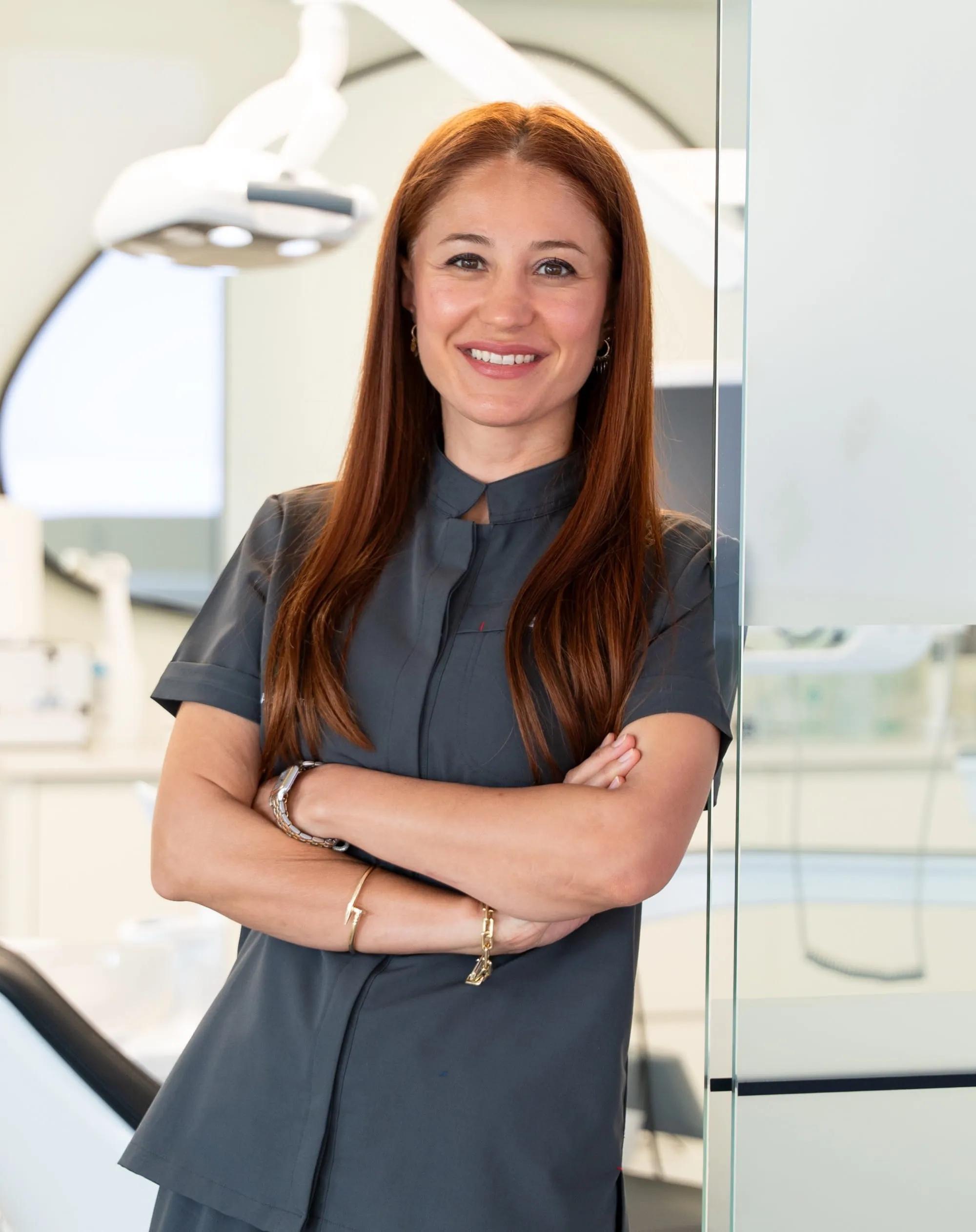
Dt. Dilek AKSU GÜLER
Dentist · Founder
She has completed advanced training in implantology and works in aesthetic restorations and smile design.
Sources
- Incidence of pulp necrosis and periapical pathosis after indirect restorations: systematic review and meta-analysis (37 studies, 11,615 teeth). BMC Oral Health 2023. 2023.↩pmc.ncbi.nlm.nih.gov
- Comparison of survival and complication rates of tooth-supported FDPs and implant-supported FDPs and single crowns. Clin Oral Implants Res 2007;18 Suppl 3:97-113. 2007.↩doi.org
- Prosthetic complications of implant-supported complete arch prostheses: an umbrella review of systematic reviews (7 reviews, >=5-year follow-up). Journal of Prosthetic Dentistry 2026;136(1):52-59. 2026.↩doi.org
- Oral Health Topics: Dentures. American Dental Association (ADA Library & Archives), topic last updated 12 April 2023. 2023.↩ada.org
- Survival of monolithic lithium disilicate, monolithic zirconia and metal-ceramic single crowns: systematic review. International Journal of Prosthodontics 2026;39(3):308-324. 2026.↩doi.org
- Dentures (false teeth). NHS (England). 2025.↩nhs.uk
- Impact of implant support for mandibular dentures on satisfaction, oral and general health-related quality of life: a meta-analysis of RCTs. Clin Oral Implants Res 2009;20(6):533-44. 2009.↩doi.org
- Consensus Report of Group 4 of the 1st Global Consensus for Clinical Guidelines for the Rehabilitation of the Edentulous Maxilla. Clin Oral Implants Res 2026;37 Suppl 30:S81-S107. 2026.↩doi.org
- Differences in functional outcomes for adult patients with prosthodontically-treated and -untreated shortened dental arches: a systematic review. PLoS One 2014;9(7):e101143. 2014.↩doi.org
- Evidence-based guidelines for the care and maintenance of complete dentures. J Prosthodont 2011;20 Suppl 1:S1-S12 (American College of Prosthodontists task force; funded by GSK Consumer Healthcare). 2011.↩doi.org
- Long-term assessment of the periodontal health of removable partial denture wearers: a systematic review and meta-analysis. J Prosthet Dent 2025;134(5):1664-1685. 2024.↩doi.org
- All-on-4 and All-on-6 implant-supported fixed prostheses for the edentulous jaw: systematic review and meta-analysis (55 studies). International Journal of Oral and Maxillofacial Surgery 2026;55(9):1098-1112. 2026.↩doi.org
- A systematic review of the survival and complication rates of fixed partial dentures after an observation period of at least 5 years. III. Conventional FPDs. Clin Oral Implants Res 2004;15(6):654-66. 2004.↩doi.org
- In patients requiring single-tooth replacement, what are the outcomes of implant- as compared to tooth-supported restorations?. Int J Oral Maxillofac Implants 2007;22 Suppl:71-95. 2007.↩pubmed.ncbi.nlm.nih.gov
- The frequency of denture replacement (position statement). American College of Prosthodontists; approved 20 Oct 2015, reaffirmed 30 Oct 2018. 2015.↩prosthodontics.org
- Home use of interdental cleaning devices, in addition to toothbrushing, for preventing and controlling periodontal diseases and dental caries. Cochrane Database of Systematic Reviews 2019;4:CD012018. 2019.↩doi.org
- Cleaning of removable dental prostheses: a systematic review. J Evid Based Dent Pract 2021;21(4):101644. 2021.↩doi.org
- Prevention and treatment of peri-implant diseases: the EFP S3 level clinical practice guideline. Journal of Clinical Periodontology 2023;50 Suppl 26:4-76. 2023.↩doi.org
- NHS: Dental abscess. NHS (nhs.uk). 2026.↩nhs.uk
Specialists Who Perform This Treatment
Dt. Dilek AKSU GÜLER
She has completed advanced training in implantology and works in aesthetic restorations and smile design.

Dt. Furkan ALTINEL
Dentist; aesthetic dentistry, implants and prosthetic treatments
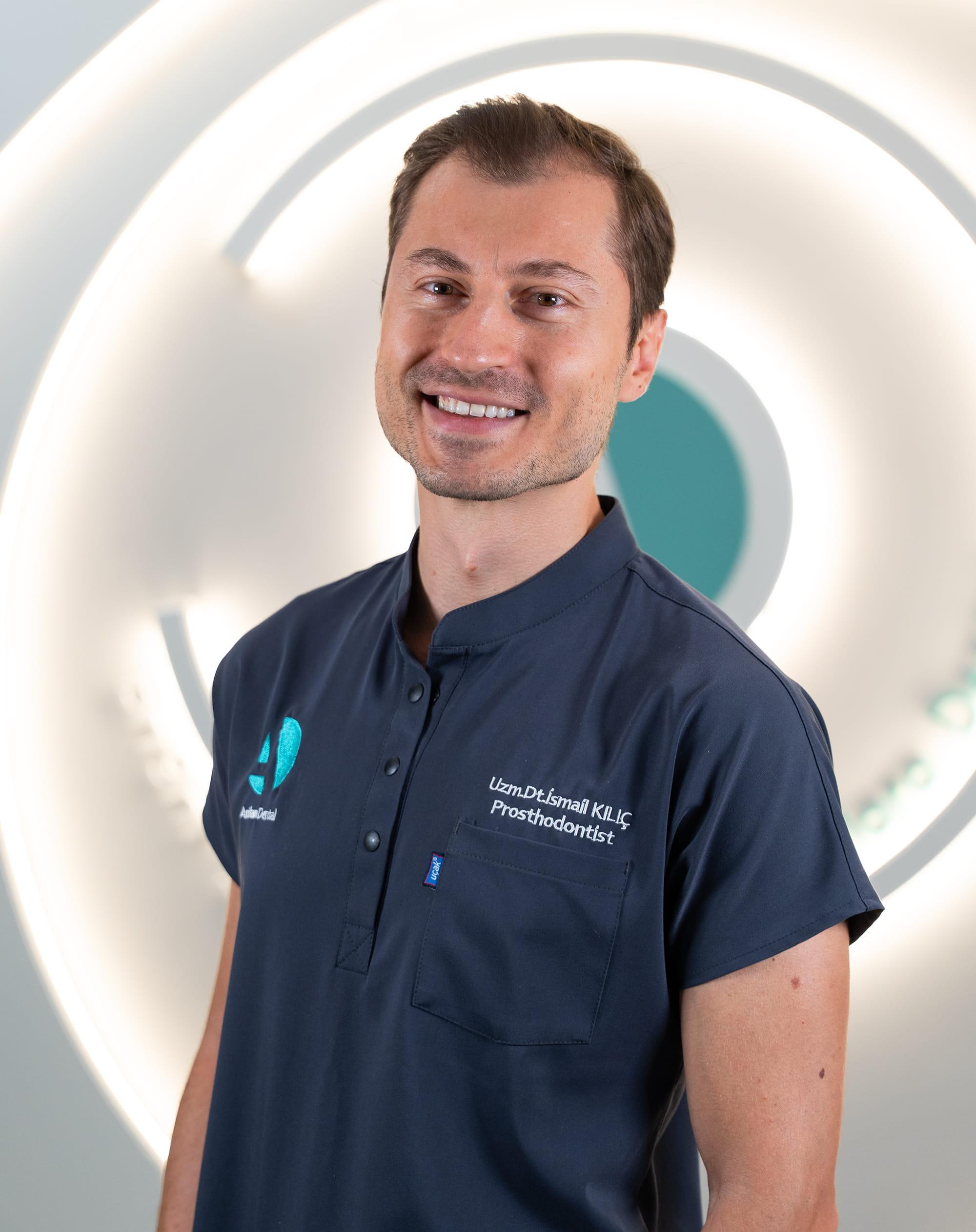
Uzm. Dt. İsmail KILIÇ
Prosthodontics Specialist; aesthetic dentistry, digital smile design and implants