
Should I choose composite or porcelain veneers?
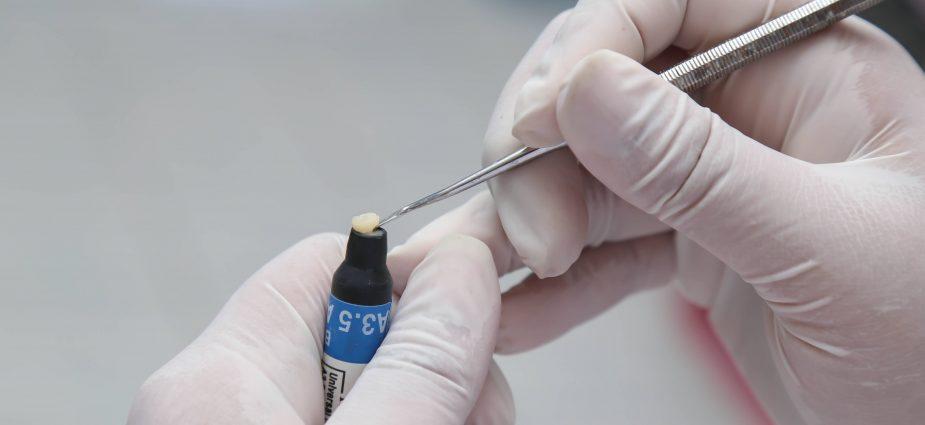
Porcelain (ceramic) veneers are usually made in a laboratory and bonded to the tooth. Composite veneers are usually built up from tooth-coloured resin directly on the tooth. Compared with porcelain, composite may need less enamel removed and is easier to repair, but it is less resistant to stains and wear1.
On how long they last, the evidence leans towards ceramic but is not settled. In a two-year randomised trial, the difference in survival was not significant2; a longer study from one practice found more repairs and replacements with composite, but it was not randomised. Neither is permanent, and neither can be reversed1. The choice rests on your tooth, your bite, how much change you want and how you feel about upkeep.
- Porcelain resists stains and wear better; composite may need less enamel removed and is easier to repair.
- Composite is usually built up on the tooth in one visit; porcelain made in a laboratory usually needs at least two visits.
- Longer-term studies lean towards ceramic, a two-year trial found no significant difference, and equal lifespans are not proven either way.
- Both can chip, crack or come off, and the colour of either cannot be changed after bonding.
| Composite veneer | Porcelain (ceramic) veneer | |
|---|---|---|
| How it is made | Usually built up on the tooth; can also be made in a laboratory | Usually made in a laboratory, then bonded |
| Visits | Often one, when built up on the tooth | Usually two or more when made in a laboratory |
| Enamel removed | May be less; sometimes very little | Usually a thin layer from the front |
| Stains and wear | Stains and wears more easily | More resistant to stains and wear |
| When it chips | Can be repaired in the chair; sometimes replaced | Small chips may be repaired; sometimes replaced |
| Colour after bonding | Cannot be changed | Cannot be changed |
| Clenching and grinding | Higher risk of damage | Higher risk of fracture |
How long each lasts: what the studies show
Each study below looked at a different group of patients over a different period, so their figures cannot be set side by side as if they came from one study.
- A two-year randomised trial. 28 selected patients with several gaps between their front teeth had 120 veneers, half composite and half lithium disilicate ceramic. Survival was about 93 in 100 for composite and 95 in 100 for ceramic, not a significant difference; composite edges discoloured more often2. The trial counted fractures, including composite ones that were repaired, against survival. People who grind their teeth were excluded.
- Ten years in one practice. 1,459 veneers in 341 patients were followed for up to 10 years. Annual failure rates calculated over the ten years, counting repairs and replacements, were 10% for composite and 2.8% for ceramic; counting only replacements, 4.1% and 1.2%3. These summarise the whole period; they do not predict the risk in any single year. The study was not randomised, so the difference may not be due to the material alone.
- Pooled studies of each material. Pooling randomised trials of composite veneers, made on the tooth or in a laboratory, about 88 in 100 were still in place4; the studies' average follow-up ranged from about 2 to 8 years. For three kinds of glass-ceramic veneer, about 94 to 97 in 100 were still in place at about ten years, with no significant difference between them5. These come from different studies and periods.
- Composite made in a laboratory. In a ten-year split-mouth trial of 48 veneers, 75% of the lab-made composite veneers and all of the ceramic ones survived6. This applies to lab-made composite only, not to veneers built up on the tooth.
An older review found no reliable evidence that veneers made on the tooth or in a laboratory last longer than the other7; it was withdrawn in 2015 as out of date, so it is history rather than today's answer.
Put together: the longer studies lean towards ceramic, but equal lifespans have not been shown2, nor has a longer life for porcelain in every patient3. How your own veneers do depends on the tooth, the bite, the enamel kept and your care; more on this in how long veneers last.
Stains, chips and repairs
Staining
Composite picks up stain from coffee, tea, red wine and smoking more easily. Porcelain is not immune at the edges: in the 2025 review of ceramic veneers, staining at the edge was reported in about 12 in 100 at around ten years5.
Chips and fractures
Porcelain can break too. Over about ten years, about 4 in 100 ceramic veneers cracked, 3 to 4 in 100 chipped, 2 to 3 in 100 fractured and about 2 in 100 came off5; the studies varied widely. The sources we use give no comparable long-term chipping rate for composite veneers built up on the tooth.
Repair
Composite is easier to fix if damaged1. With either material, small chips may be repaired, and sometimes a new veneer is needed8. For fillings, studies comparing repair with replacement found no clear difference9, but there were only three and the certainty was very low; none looked at veneers.
Colour
The colour of a veneer cannot be changed after it is bonded10, whichever material it is. Your natural teeth may change colour over the years, so a difference can appear with both.
Sensitivity, decay and daily care
Teeth can become more sensitive because some enamel is removed10. Neither material protects the tooth from decay, which can start at the edge. Brush twice a day with fluoride toothpaste, clean between your teeth every day, avoid biting hard objects with your front teeth, and keep to your check-ups.
Questions that decide it for your teeth
- How much do you want to change? Closing a small gap or rebuilding a chipped edge is a small change. Changing the colour and shape of several teeth at once is a bigger one, and worth planning tooth by tooth.
- How much enamel is left? Both materials bond best to enamel. For porcelain, veneers bonded to dentine were about 10 times as likely to fail11 in one retrospective study of 580 veneers.
- Do you clench or grind your teeth, or have a deep bite? Veneers may not be suitable for some people who clench or grind10, with either material; a deep bite is also assessed1. A night guard may be advised.
- How do you feel about upkeep? Composite stains and wears more easily, so expect repairs or a replacement along the way. Porcelain resists stains and wear better, but it can also chip or come off.
- Are the teeth and gums healthy? Decay and gum disease are treated first.
If the tooth is healthy and only the look bothers you, doing nothing is also an option. A small chip or gap may need only a small composite addition rather than a veneer. If the only concern is colour, whitening may be enough. If the teeth are crowded, orthodontic treatment is assessed first. The difference between a veneer and a crown is explained in crowns or veneers, and how a composite veneer is made in composite veneers.
When to see a dentist
Contact your dentist if any of these happens with a composite or a porcelain veneer.
- A chip, crack or rough edge
- A veneer comes off: keep it, and do not glue it back yourself
- Sensitivity that lasts more than a few weeks or gets worse
- Bleeding, swelling or a dark line at the gum edge
- Your bite feels high
Emergencies. Throbbing pain, facial swelling or a fever: see a dentist without waiting. Difficulty breathing or swallowing, or swelling in the mouth or neck that spreads quickly: go to an emergency department or call 112.
Composite or porcelain for your teeth?
Send a photo of your teeth and tell us what you would like to change. Our dentists will write back with the options for each tooth, starting from the one that removes the least.
Frequently asked questions
Can composite veneers be whitened?
No. Whitening lightens natural teeth, not resin or ceramic, and the colour of a veneer cannot be changed after it is bonded. If your natural teeth change colour later, the veneers may stop matching them.
Can a chipped composite veneer be repaired?
Composite is easier to repair than porcelain, and small chips may be repaired. Sometimes a new veneer is needed. Keep any piece that comes off and see your dentist.
Do composite veneers damage the teeth?
They may need less enamel removed than porcelain veneers, but the surface is still prepared so the resin bonds, and no source shows the treatment is fully reversible. Decay can still start at the edge, so daily cleaning matters.
Can I have composite veneers if I grind my teeth?
Veneers may not be suitable if you clench or grind your teeth. Your dentist assesses your bite first and may advise a night guard. Whether it protects a composite veneer from fracture is not certain.
Does whitening work on either?
No. Whitening lightens natural teeth, not composite or porcelain, and the colour of a veneer cannot be changed after it is bonded. If you whiten your natural teeth later, the veneers may look darker next to them.
Sources
- Veneers. American Dental Association, MouthHealthy.↩mouthhealthy.org
- Direct composite versus pressed lithium disilicate veneers for multiple diastema closure: double-blind randomised controlled trial, 2 years. Materials 2024;17(14):3514. 2024.↩pmc.ncbi.nlm.nih.gov
- 10-year practice-based evaluation of ceramic and direct composite veneers. Dent Mater 2022;38(5):898-906. 2022.↩doi.org
- Survival and complication rates of resin composite laminate veneers: a systematic review and meta-analysis. J Evid Based Dent Pract 2023;23(4):101911. 2023.↩doi.org
- Survival and complication rates of ceramic laminate veneers by material: systematic review and meta-analysis (29 studies). Journal of Esthetic and Restorative Dentistry 2025;37(3):601-619. 2025.↩doi.org
- Randomized clinical trial on indirect resin composite and ceramic laminate veneers: up to 10-year findings. J Dent 2019;86:102-109. 2019.↩doi.org
- Direct versus indirect veneer restorations for intrinsic dental stains (Cochrane review, withdrawn 2015). Cochrane Database Syst Rev 2004;(1):CD004347; withdrawn Issue 12, 2015 (CD004347.pub3). 2004.↩doi.org
- Veneers (patient information). Oral Health Foundation (UK charity); published January 2017, updated April 2026. 2026.↩dentalhealth.org
- Risk of failure of repaired versus replaced defective direct restorations in permanent teeth: a systematic review and meta-analysis. Clin Oral Investig 2022;26(7):4917-4927. 2022.↩doi.org
- Veneers. healthdirect Australia (government-funded health information), last reviewed February 2025. 2025.↩healthdirect.gov.au
- Porcelain laminate veneers, 580 veneers up to 12 years: effect of preparation in enamel versus dentin. International Journal of Periodontics & Restorative Dentistry 2013;33(1):31-39. 2013.↩doi.org

Dt. Dilek AKSU GÜLER
Dentist · Founder
She has completed advanced training in implantology and works in aesthetic restorations and smile design.