
Can you have implants if you have gum disease?
Often yes, but not while the gum disease is active: it is treated and brought under control first. People who have had periodontitis, gum disease that damaged the bone around the teeth, can have implants. Their risk is higher, though. In 14 prospective studies of treated patients, implants were lost at about 1.75 times the rate1 seen in people without that history. Gum treatment, daily cleaning and regular reviews are part of implant treatment for them.
- Active gum disease is treated first; the evidence on implants comes from people whose gum disease had been treated.
- A history of periodontitis is linked with more implant loss and about three times more inflammation with bone loss around implants.
- Bone lost to periodontitis largely does not grow back, but the disease can be stabilised.
- Smoking adds to the risk for both gums and implants.
Gum disease in brief
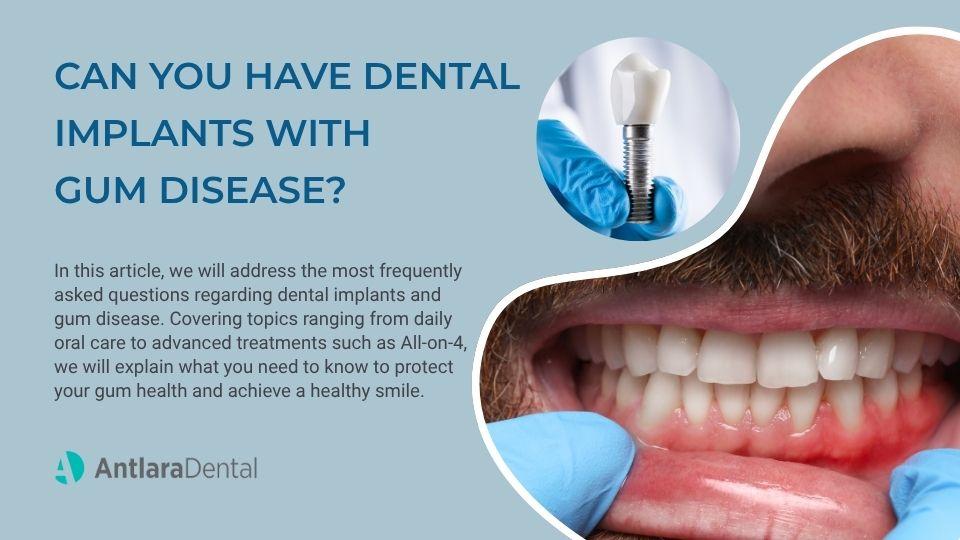
Gum disease starts with plaque, the soft film of bacteria that builds up on teeth. Gingivitis is inflammation of the gums alone: they bleed easily and may look red or swollen. Periodontitis goes further and damages the bone and fibres that hold the teeth in place. Teeth can then loosen, drift or be lost.
The two behave differently. UK guidance for dentists says that gingivitis is reversible with better self-care2. The damage periodontitis causes is not reversible, but the disease can be stabilised. The bone that has been lost largely does not come back3.
This matters for implants for two reasons. An implant needs enough healthy bone to hold it. And the bacteria and habits that caused gum disease around teeth can cause a similar disease around implants.
Why gum disease is treated first
The studies that followed people with implants and a history of gum disease were done in treated patients. Our sources contain no evidence on implants placed while periodontitis is still active. At our clinic, gum disease is treated and brought under control before an implant is planned.
The European guideline on periodontitis describes treatment in four steps4:
- Cleaning and risk factors: instruction in daily cleaning, help with risk factors such as smoking and diabetes, and professional removal of plaque and tartar above the gum. Tartar cannot be removed at home; it needs professional cleaning5.
- Deep cleaning below the gum: removing the deposits on the root surfaces inside the gum pockets.
- Further treatment where deep pockets remain after the first two steps; this may include surgery.
- Supportive care: regular reviews and cleaning for life, at intervals of 3 to 12 months set by your own risk.
Treatment can restore gum health, but a person whose periodontitis is under control remains at higher risk of it coming back6 and needs close monitoring. The same holds after implants are placed.
What a history of gum disease changes for an implant
The figures below come from observational studies. They show an association, not proven cause and effect, and they are averages across many clinics, not your personal risk.
- Implant loss. Across 14 prospective studies, people treated for periodontitis lost implants at about 1.75 times the rate1 of people without that history. In studies with ten or more years of follow-up it was about twice as high. After a fast-progressing form of the disease (grade C), it was about six times as high, an estimate with a wide margin of uncertainty.
- Inflammation with bone loss around the implant. Peri-implantitis was about three times more common per patient. For inflammation of the gum alone around implants (mucositis), the review found no significant difference.
- What is not known. These were treated patients. The review does not measure how much regular supportive care lowers the risk.
Other factors add to this. Smoking raises the risk of periodontitis starting or getting worse by about 85 per cent7. In people smoking more than 20 cigarettes a day, implant loss was about 2.5 times as likely per implant8. Per patient it was about 4 times as likely. For diabetes the findings on implant loss are mixed. Two of three reviews found no significant difference (2021 review9; 2016 review10), and the third found higher odds of implant loss11 in people with diabetes than in people without. All three found more bone loss around implants, so blood-sugar control, daily cleaning and regular reviews matter.
Gum disease around an implant: peri-implantitis
Plaque collects on an implant as it does on a tooth. Peri-implant mucositis is inflammation of the gum around the implant. Peri-implantitis is that inflammation together with loss of the bone that supports the implant; if it is not controlled, the implant can be lost. Peri-implantitis needs treatment by your dentist; what is done depends on what the examination finds, and it may need surgery. Daily cleaning helps to prevent it but does not treat it on its own.
It is not rare. A 57-study review found peri-implantitis in about 20 in 100 patients and about 12 in 100 implants12; the rate depends on the definition used, and these figures show how many people had it when they were examined, not a risk over a set number of years. In reviews of full-arch bridges on implants followed for 5 to 15 years, it was reported in 4 to 18 in 100 patients13, as far as the review summaries show; these figures come from different studies and definitions and cannot be compared directly. A history of periodontitis raises these odds, as the figures above show.
Where gum disease has cost most of the teeth in a jaw, a fixed bridge on four or six implants is one option. Before any teeth are removed, ask which could be kept, why each extraction is needed and what the alternatives are, such as a removable denture. The same risk factors and the same need for care apply; see the All-on-4 page. Where too little bone is left, bone grafting may be discussed; see bone grafting.
Keeping your gums and implants healthy
- Clean every day. Brush twice a day with fluoride toothpaste and clean between the teeth and implants every day. If you have a bridge on implants, ask your dental team to show you how to clean around each implant and under the bridge. For people treated for periodontitis, the European guideline recommends interdental brushes as the first choice4 where they fit. The wider evidence on cleaning between the teeth is of low certainty14.
- A baseline record. The 2017 consensus report recommends that an X-ray and gum measurements be taken as a baseline15 when the crown or bridge on the implant is completed. Later changes are judged against that record.
- Regular supportive care. The European guideline on peri-implant diseases calls for a structured supportive care programme16 once implants are in use. The interval between reviews is set for each patient17 by their risk; that guideline covers check-ups in general, not implants. A history of gum disease usually means closer follow-up.
- Smoking. Stopping helps both gums and implants. Tell your dentist if you smoke and how much.
How implant treatment runs, stage by stage, is explained on the dental implants page, and gum treatment on the gum diseases page.
When to see a dentist
See a dentist if your gums bleed when you brush or eat hard food18, if they are painful or swollen, or if you have bad breath that does not go away. Ask for an urgent appointment if your gums are very sore and swollen or your teeth feel loose. With implants, bleeding, swelling, pus, a bad taste or a gum line that is receding around an implant are also reasons to be seen, even if nothing hurts. An implant, or a crown or bridge on it, that feels loose should be checked soon.
Emergencies. Difficulty breathing or swallowing, rapidly spreading swelling of the face or neck, high fever or swelling around the eye are serious signs. Go to the nearest emergency department or call 112.
Frequently asked questions
I have bleeding gums. Can I still get an implant?
Bleeding gums are a sign of inflammation. Your dentist first finds out whether it is gingivitis or periodontitis and treats it. Once the gums are under control, an implant can be assessed. Bleeding gums alone do not rule an implant out.
Do implants cure gum disease?
No. An implant replaces a missing tooth; it does not treat the gum disease that caused the loss. The disease has to be controlled first and kept under control afterwards, around both the remaining teeth and the implants.
Can you tell veneers from natural teeth in a photo?
Not reliably. Whitening, bonding, orthodontic treatment, veneers and crowns can look alike in a picture, and lighting and editing change how teeth look. Even a dentist needs an examination to know what is there.
Can a veneer fall off?
Yes. Coming off and breaking are the main reasons veneers fail, mostly in the early years. If one comes off, keep it, do not glue it back yourself, and contact your dentist.
Can I whiten my veneers?
No. Whitening does not change the colour of ceramic. If you want your natural teeth whiter, it is done before the veneers are made so the shades can be matched.

Dt. Dilek AKSU GÜLER
Dentist · Founder
She has completed advanced training in implantology and works in aesthetic restorations and smile design.
Sources
- Effectiveness of implant therapy in patients with and without a history of periodontitis: systematic review with meta-analysis of prospective cohort studies (14 studies, >=36 months). Journal of Periodontal Research 2025;60(6):524-543. 2025.↩doi.org
- Prevention and Treatment of Periodontal Diseases in Primary Care, 2nd edition. Scottish Dental Clinical Effectiveness Programme (SDCEP), February 2024. 2024.↩periodontalcare.sdcep.org.uk
- Delivering Better Oral Health, Chapter 5: Periodontal diseases. Department of Health and Social Care / NHS England et al., updated 10 September 2025. 2025.↩gov.uk
- Treatment of stage I-III periodontitis - the EFP S3 level clinical practice guideline. Journal of Clinical Periodontology 2020;47 Suppl 22:4-60 (erratum 2021;48:163). 2020.↩doi.org
- Dental Floss/Interdental Cleaners (Oral Health Topics). American Dental Association, last updated August 2026. 2026.↩ada.org
- Periodontal health and gingival diseases and conditions on an intact and a reduced periodontium: consensus report of workgroup 1 of the 2017 World Workshop. Journal of Clinical Periodontology 2018;45 Suppl 20:S68-S77. 2018.↩doi.org
- Effect of smoking on periodontitis: a systematic review and meta-regression. American Journal of Preventive Medicine 2018;54(6):831-841. 2018.↩doi.org
- Levels of smoking and dental implants failure: systematic review and meta-analysis (23 articles). Journal of Clinical Periodontology 2020;47(4):518-528. 2020.↩doi.org
- Impact of hyperglycemia on the rate of implant failure and peri-implant parameters in patients with type 2 diabetes mellitus: systematic review and meta-analysis (9 studies). Journal of the American Dental Association 2021;152(3):189-201. 2021.↩doi.org
- The impact of diabetes on dental implant failure: a systematic review and meta-analysis. International Journal of Oral and Maxillofacial Surgery 2016;45(10):1237-1245. 2016.↩doi.org
- Diabetes mellitus and dental implants: systematic review and meta-analysis (89 publications; 5,510 implants in diabetic and 62,780 in non-diabetic patients). Materials 2022;15(9):3227. 2022.↩doi.org
- What is the prevalence of peri-implantitis? A systematic review and meta-analysis (57 articles, 2005-2021). BMC Oral Health 2022;22(1):449. 2022.↩doi.org
- Prosthetic complications of implant-supported complete arch prostheses: an umbrella review of systematic reviews (7 reviews, >=5-year follow-up). Journal of Prosthetic Dentistry 2026;136(1):52-59. 2026.↩doi.org
- Home use of interdental cleaning devices, in addition to toothbrushing, for preventing and controlling periodontal diseases and dental caries. Cochrane Database of Systematic Reviews 2019;4:CD012018. 2019.↩doi.org
- Peri-implant diseases and conditions: consensus report of workgroup 4 of the 2017 World Workshop on the Classification of Periodontal and Peri-Implant Diseases and Conditions. Journal of Clinical Periodontology 2018;45 Suppl 20:S286-S291. 2018.↩doi.org
- Prevention and treatment of peri-implant diseases: the EFP S3 level clinical practice guideline. Journal of Clinical Periodontology 2023;50 Suppl 26:4-76. 2023.↩doi.org
- Dental checks: intervals between oral health reviews (clinical guideline CG19). National Institute for Health and Care Excellence, published 27 October 2004. 2004.↩nice.org.uk
- Gum disease. NHS, page last reviewed 20 April 2026. 2026.↩nhs.uk