
Is a cosmetic dentist a specialist?
Not as such. In Turkey, dental specialties are set by law, and there are nine. Cosmetic or aesthetic dentistry, implant dentistry and smile design are not among them. "Cosmetic dentist" describes the kind of work a dentist does, such as veneers, bonding, crowns on front teeth or whitening. It is not a specialist title, although a dentist who does cosmetic work may also be a registered specialist in one of the nine fields.
A dentist may be called a specialist (uzman) only in one of the nine legal specialties, and only with a specialist certificate registered by the Ministry of Health. Courses, certificates, a master's degree or a doctorate do not make a dentist a specialist. Cosmetic treatment is carried out by general dentists and by specialists, and the training of restorative dentistry and prosthodontics specialists includes it. What tells you more than a title is how the dentist examines you, explains the options and plans each tooth.
- Turkish law lists nine dental specialties; cosmetic dentistry, implant dentistry and smile design are not among them.
- The title specialist (uzman) needs a specialist certificate registered by the Ministry of Health; a course, certificate, master's degree or doctorate is not enough.
- Cosmetic treatment is done by general dentists and by specialists; restorative dentistry and prosthodontics specialists train in it.
The nine dental specialties in Turkey
The list of dental specialties is set in an annex to Law No. 1219, not by a professional association or a clinic. The annex lists nine main specialties1:
- oral and maxillofacial surgery
- oral and maxillofacial radiology
- paediatric dentistry
- endodontics (root canal treatment)
- orthodontics
- periodontology (gums)
- prosthodontics (crowns, bridges, dentures and other replacements)
- restorative dentistry
- oral pathology
Dentistry has no sub-specialties in the law. Specialty training takes four years in oral and maxillofacial surgery, orthodontics and oral pathology, and three years in the other six. The Medical and Dental Specialty Training Regulation2 refers to the same list.
Aesthetic (cosmetic) dentistry, implantology, digital dentistry, laser dentistry and smile design are not on it. The list is set by law and can be changed by law, so it is worth checking the current text if a title matters to your decision.
How a dentist becomes a specialist
The ordinary route to a specialty starts with a national entrance exam for dental specialty training (DUS), which ÖSYM holds at least once a year2. The dentist then trains in an authorised programme for three or four years. To finish, they need an accepted thesis, the completed training period and rotations, a signed-off curriculum record and a pass in the final specialty exam. The specialist certificate is issued and registered by the Ministry of Health.
There are also rules for specialist qualifications gained abroad and for rights gained under earlier legislation, including transitional rules for some dentists who did a doctorate in a specialty field. A 2026 decision of the Medical Specialty Board also sets a conditional route for some dentists with such a doctorate: they must still sit DUS, reach a set score and show a completed list of treatments. In every case, a dentist who does not hold a specialist certificate may not use the specialist title2 anywhere or in any form.
A certificate course, a master's degree or a doctorate is valuable training, but on its own it does not make a dentist a specialist. The regulation on private dental clinics says so directly: such documents cannot be used as a specialist certificate3. "Dr." in front of a dentist's name can be an academic title; it is not the same as "uzman".
Who carries out cosmetic treatment
Under Law No. 1219, a dentist is authorised to diagnose, treat and rehabilitate1 the teeth, the gums and the mouth and jaw tissues directly connected to them. So veneers, bonding, crowns on front teeth and whitening are carried out by general dentists every day. Some procedures have their own requirements, so this does not mean that any dentist may do everything.
Specialty training includes cosmetic work too. The 2017 core curriculum for restorative dentistry covers modern aesthetic and restorative techniques4, including laminate veneers and whitening. The prosthodontics curriculum covers correcting aesthetic problems5, with laminate veneers, onlays and crowns. These curricula describe what specialists are trained in. They do not reserve the treatments for specialists.
In practice, a general dentist with training and experience in veneers and crowns, or a specialist in a relevant field, can both be appropriate; what matters is their training and experience for your case, and whether a referral is needed. Either way, the questions that protect you are the same: why this tooth, why this treatment, and what cannot be undone. Our articles on crowns and veneers and on "Turkey teeth" go through them tooth by tooth.
Titles, certificates and adverts: what the rules say
Turkish rules on health promotion are strict, and they apply to clinic websites and social media as well as signs. Under the 2025 promotion regulation:
- No specialist title from a certificate. Outside the specialties set by Law No. 1219, no specialist title based on a certificate or similar training document may be written or used, under any name6. The Turkish Dental Association's publishing guide allows certificates to be listed, but not worded as if they replaced a specialist certificate7, and its ethics rules forbid presenting oneself as a specialist in a field where one is not8.
- What a profile may show. A dentist's promotion may give their specialty, academic titles, where and when they see patients, and information that protects health. Within the specialty on their Ministry-registered diploma, it may also list training, Ministry-registered certificates, publications and society memberships.
- No advertising. Covert or overt advertising of health services is prohibited; only promotion and information within the listed principles is allowed.
- No testimonials, prices or superiority. Promotion may not be built on patients' thanks or satisfaction, may not present unproven methods, and may not give prices, discounts or campaigns. The Dental Association's guide also forbids wording that implies the clinic, its staff or its devices are superior7.
- Photos and dates. According to the Ministry's guidance, before-and-after photos9 need the patient's explicit consent on a set form, may not be technically altered afterwards, and must be taken under the same conditions and shown with the treatment and photo dates.
Clinics authorised for international health tourism may run sponsored promotion on separate platforms aimed abroad6, with some rules of their own; the rest of the regulation, including the rule on specialist titles, still applies to them.
So a title such as "implant specialist" or "aesthetic dentistry specialist" has no basis among the legal specialties. Whether a dentist may describe their practice as focused on cosmetic work, without the word "uzman", is not settled in the texts we read. Words like "best" or "top" are not information about your treatment. Our article on choosing a clinic for veneers or crowns explains what adverts and photos can and cannot tell you.
In the UK and the US
Cosmetic dentistry is not a recognised dental specialty there either. In the UK, dentists do not have to be on a specialist list to work in a field, but only those on the General Dental Council's specialist lists may use the title "specialist"10. In the US, the national commission recognises 12 dental specialties11, and cosmetic dentistry is not one of them. A specialist title from one country is not automatically recognised in another.
How to check a dentist's title
- Look at the working certificate. In a private dental clinic, a copy of the dentist's working certificate (çalışma belgesi), approved by the provincial health directorate, hangs in the surgery3. A clinic's sign, printed material and website may list only the specialties shown on that certificate. Everyone working in the clinic also wears a photo ID card with their name and title.
- Ask which specialty. If someone is called a specialist, ask in which field. It should be one of the nine above, and it should be on the working certificate.
- Check the registration. A dentist in private practice must register with the local dental chamber12, and the Turkish Dental Association's website has a search13 by name and province. It may not be complete or up to date, so a name you cannot find is a reason to ask, not proof.
- Ask about the work itself. Ask who will treat you at each visit and how often they do this treatment. A title describes training; it does not describe your plan.
Our article on choosing a dental clinic covers licences, the information you are owed before treatment, your records and where to complain.
When to see a dentist
You do not need a specialist to start. A general dentist can examine you, tell you what your teeth need and refer you to a specialist where one is needed.
If you already have veneers or crowns, see a dentist if one is loose, chipped or has come off (keep it, and do not glue it back yourself), if a tooth becomes painful or sensitive, or if your gums bleed or swell around a restoration.
Emergencies. Difficulty breathing or swallowing, rapidly spreading swelling of the face or neck, a high fever or swelling around the eye are serious signs. Go to the nearest emergency department or call 112.
Questions about a cosmetic plan?
Send us the plan you were given, or tell us what bothers you about your teeth. Our dentists will answer tooth by tooth, starting from the option that keeps the most of your teeth.
Frequently asked questions
Do I have to replace a missing tooth at all?
Not always. For a single back tooth, leaving the gap can be reasonable. Over time the nearby teeth can drift and the bone shrinks, so have it checked at regular visits.
Which alternative lasts longest?
None can be shown to last longest: bridges and implants were studied in separate groups of studies, and none compared them directly. Every option needs cleaning and reviews, and can need repair in time. Ask your dentist what to expect for your mouth.
Why didn't my dentist give me antibiotics?
Probably because the infection was local and could be treated at its source. When a dentist can drain the pus and deal with the cause, UK and US guidance advise against adding an antibiotic: trials found little or no extra benefit, while side effects remain possible.
Can I take antibiotics I have left over at home?
No. A leftover course may be the wrong medicine or the wrong amount, and it does not treat the tooth. See a dentist, who decides whether an antibiotic is needed at all.
Does "Dr." mean the dentist is a specialist?
Not by itself. "Dr." can be an academic title from a doctorate. A doctorate, master's degree or certificate course does not by itself make a dentist a specialist; the specialist title needs a registered specialist certificate.
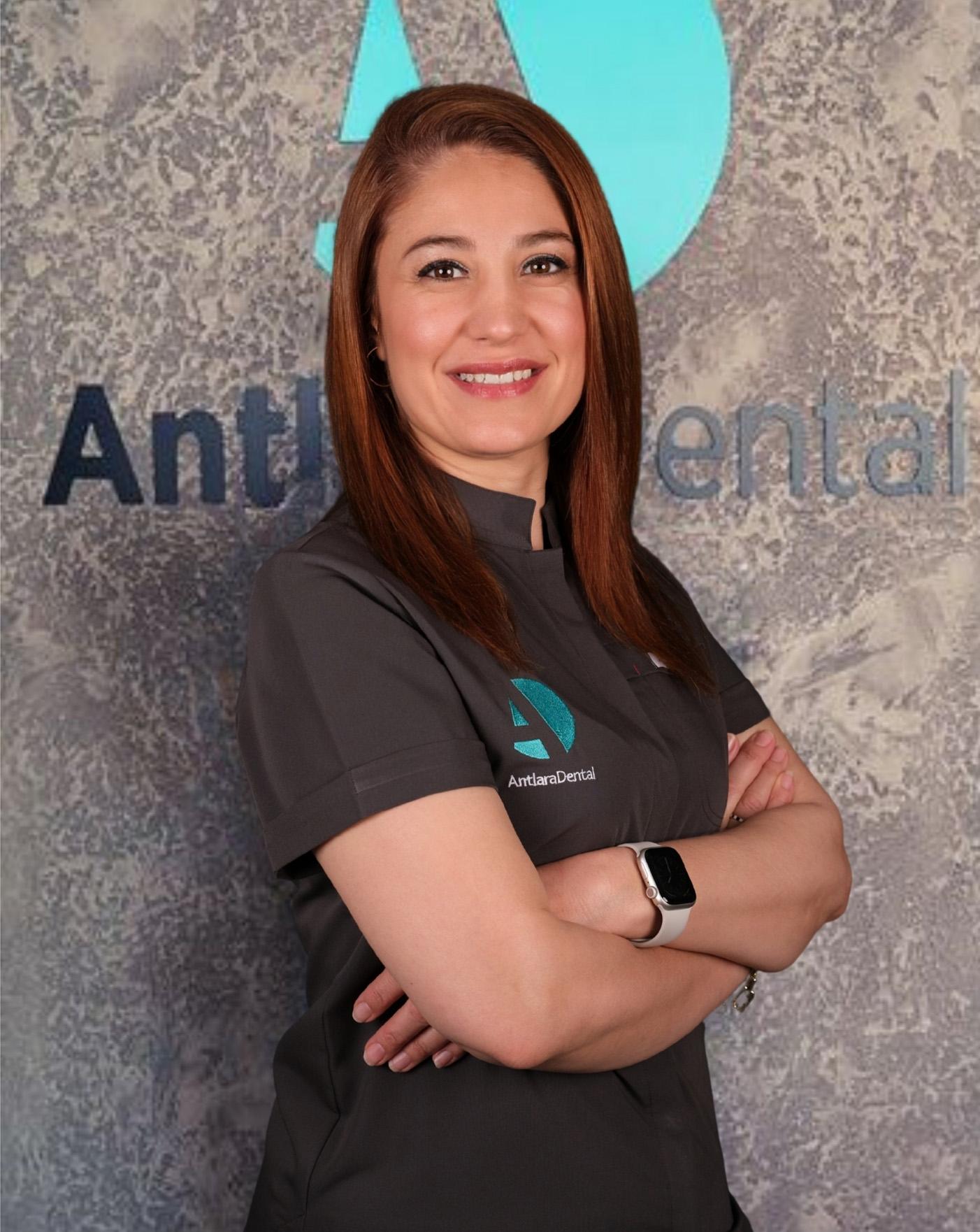
Dt. Dilek AKSU GÜLER
Dentist · Founder
She has completed advanced training in implantology and works in aesthetic restorations and smile design.
Sources
- 1219 sayılı Tababet ve Şuabatı San'atlarının Tarzı İcrasına Dair Kanun (consolidated text). T.B.M.M.; RG 14/4/1928 No 863; consolidated on mevzuat.gov.tr. 1928.↩mevzuat.gov.tr
- Tıpta ve Diş Hekimliğinde Uzmanlık Eğitimi Yönetmeliği. T.C. Sağlık Bakanlığı; RG 3/9/2022 No 31942, amended RG 7/10/2023-32332 and 16/5/2024-32548. 2022.↩mevzuat.gov.tr
- Ağız ve Diş Sağlığı Hizmeti Sunulan Özel Sağlık Kuruluşları Hakkında Yönetmelik (consolidated text). T.C. Sağlık Bakanlığı; Resmî Gazete 6/10/2022 No 31975, amended RG 5/3/2024-32480 and 15/12/2024-32753. 2022.↩mevzuat.gov.tr
- Restoratif Diş Tedavisi Uzmanlık Eğitimi Çekirdek Müfredatı v2.3. Tıpta Uzmanlık Kurulu, TUKMOS. 2017.↩dosyamerkez.saglik.gov.tr
- Protetik Diş Tedavisi Uzmanlık Eğitimi Çekirdek Müfredatı v2.3. Tıpta Uzmanlık Kurulu, TUKMOS. 2017.↩dosyamerkez.saglik.gov.tr
- Sağlık Hizmetlerinde Tanıtım ve Bilgilendirme Faaliyetleri Hakkında Yönetmelik. T.C. Sağlık Bakanlığı; RG 12/11/2025 No 33075. 2025.↩resmigazete.gov.tr
- Dişhekimlerinin Her Türlü İletişim Ortamında Yayın Yapmalarına İlişkin Kılavuz. Türk Dişhekimleri Birliği, Merkez Yönetim Kurulu kararı 4 Mar 2026. 2026.↩tdb.org.tr
- Dişhekimliği Meslek Etiği Kuralları. Türk Dişhekimleri Birliği (2018 version approved by the 17th General Assembly; 2024 paragraph under Art. 18). 2018.↩tdb.org.tr
- Sağlık Hizmetlerinde Tanıtım ve Bilgilendirme Faaliyetleri Hakkında Sıkça Sorulan Sorular. T.C. Sağlık Bakanlığı, Sağlık Hizmetleri Genel Müdürlüğü, Denetim ve Değerlendirme Dairesi; announcement 17 Nov 2025. 2025.↩dosyamerkez.saglik.gov.tr
- Specialist lists. General Dental Council (UK).↩gdc-uk.org
- Recognized Dental Specialties. National Commission on Recognition of Dental Specialties and Certifying Boards (ADA-housed, USA).↩ncrdscb.ada.org
- Türk Diş Hekimleri Birliği Kanunu, Law No. 3224 (consolidated text). Resmî Gazete 25/6/1985 No 18792; consolidated PDF, mevzuat.gov.tr. 1985.↩mevzuat.gov.tr
- Türk Dişhekimleri Birliği website: Find a Dentist. Türk Dişhekimleri Birliği (TDB).↩tdb.org.tr